International bitumen procurement involves much more than manufacturing and shipping products. A proper Bitumen Export Documentation Guide helps buyers understand the essential paperwork required for smooth customs clearance and delivery.
Incorrect or incomplete paperwork can result in shipment delays, additional charges, customs inspections, or even cargo being held at the destination port. For international buyers, understanding the purpose of export documents helps minimise procurement risks and improves supply chain efficiency.
This guide explains the most important documents used during international bitumen exports and why each one plays a vital role in successful global trade.
Why Export Documentation Matters
Every international shipment passes through multiple stages before reaching the buyer.
These stages include:
- Export customs
- Port handling
- Ocean freight
- Import customs
- Final delivery
Accurate documentation helps ensure each stage proceeds without unnecessary delays.
Proper export documentation provides:
- Customs compliance
- Faster clearance
- Shipment traceability
- Product verification
- Buyer confidence
- Reduced procurement risk
Industry Insight from Tiger Bitumen
Professional export documentation is just as important as product quality. Even premium-quality bitumen can experience costly delays if paperwork is incomplete or inaccurate.
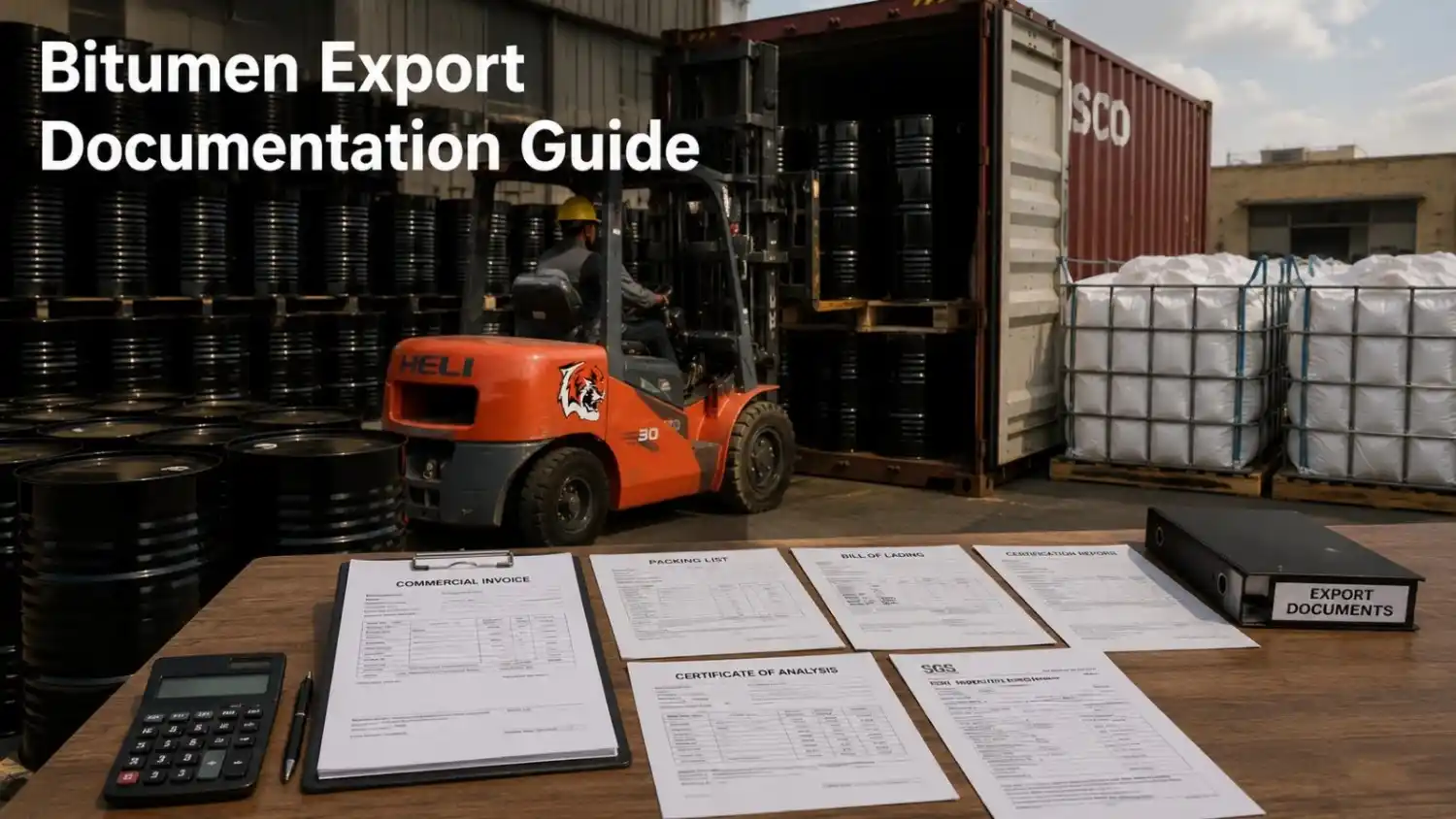
Commercial Invoice
The Commercial Invoice is one of the most important export documents.
It normally contains:
- Seller details
- Buyer details
- Product description
- Quantity
- Unit price
- Total shipment value
- Incoterms (FOB, CFR or CIF)
- Payment terms
Import authorities use this document to calculate customs duties and verify shipment information.
Packing List
The Packing List provides detailed information about how the cargo has been packed.
Typical information includes:
- Number of drums or packages
- Gross weight
- Net weight
- Packaging type
- Container numbers
- Dimensions (where applicable)
This document assists customs authorities and buyers during cargo inspection and unloading.
Bill of Lading (B/L)
The Bill of Lading is issued by the shipping line after the cargo has been loaded onto the vessel.
It serves as:
- Proof of shipment
- Transport contract
- Cargo receipt
- Document required for cargo release
Without a valid Bill of Lading, buyers generally cannot take possession of the shipment at the destination port.
Certificate of Origin
The Certificate of Origin confirms the country from which the goods originate.
Many customs authorities require this document to:
- Verify origin
- Apply trade regulations
- Determine import duties
- Process customs clearance
Providing the correct Certificate of Origin helps prevent unnecessary customs complications.
Certificate of Analysis (COA)
The Certificate of Analysis verifies that the supplied bitumen complies with the agreed product specifications.
The report may include results for:
- Penetration
- Softening Point
- Viscosity
- Flash Point
- Ductility
- Other technical properties
Reviewing the COA helps buyers confirm product quality before delivery.
Related Reading
Bitumen Quality Testing Explained
SGS Inspection Report
Many international buyers request an independent SGS inspection before shipment.
An SGS report may verify:
- Product quality
- Shipment quantity
- Packaging condition
- Container loading
- Compliance with customer specifications
Independent inspection provides an additional level of confidence throughout the procurement process.
Shipping Instructions and Supporting Documents
Depending on the destination country, additional documents may also be required.
These may include:
- Shipping Instructions
- Insurance Certificate (for CIF shipments)
- Fumigation Certificate (if applicable)
- Port-specific documentation
- Customs declarations
The exact documentation requirements vary according to destination regulations.
Buyers should also choose suitable bitumen packaging solutions to ensure safe international transportation.
How Tiger Bitumen Supports International Buyers
Preparing export documentation requires accuracy, experience, and attention to detail.
Tiger Bitumen assists international buyers by providing:
- Complete export documentation
- Accurate commercial paperwork
- SGS inspection coordination
- Product quality reports
- Logistics support
- Shipment tracking assistance
Our experienced export team works closely with customers to help ensure every shipment is prepared according to international trade requirements.
Common Documentation Mistakes
Some of the most common documentation issues include:
- Incorrect buyer information
- Product description errors
- Missing certificates
- Inaccurate shipment weights
- Wrong Incoterms
- Documentation submitted late
Working with an experienced exporter significantly reduces the likelihood of these issues.
Final Thoughts
Accurate export documentation is essential for successful international bitumen procurement. Documents such as the Commercial Invoice, Packing List, Bill of Lading, Certificate of Origin, Certificate of Analysis, and SGS Inspection Report help ensure compliance, improve shipment transparency, and support efficient customs clearance.
Partnering with experienced exporters such as Tiger Bitumen gives international buyers confidence that every shipment is supported by complete documentation, reliable logistics, and professional export services.
About Tiger Bitumen
Tiger Bitumen provides comprehensive export support to international buyers through premium-quality products, professional documentation, SGS inspection coordination, secure packaging, and reliable global logistics. Our experienced export specialists help simplify international procurement while ensuring smooth and efficient shipment processing.