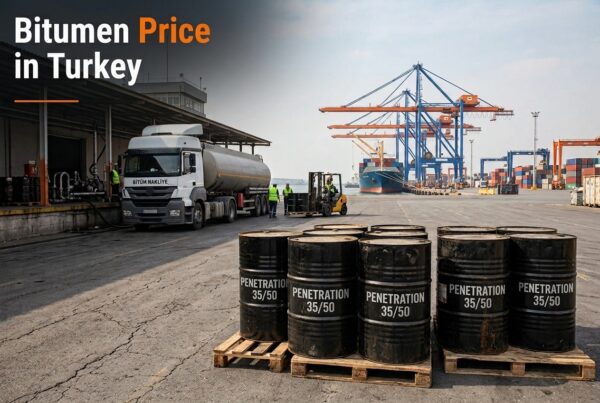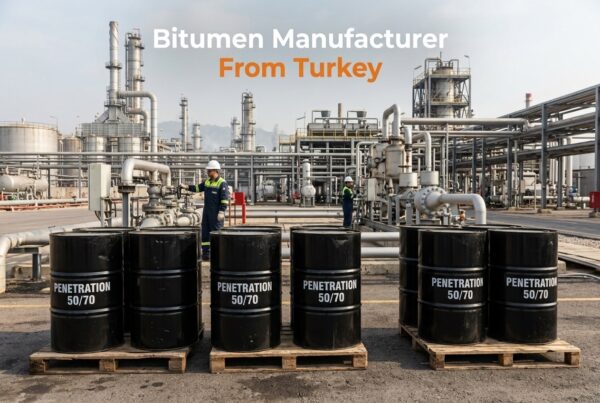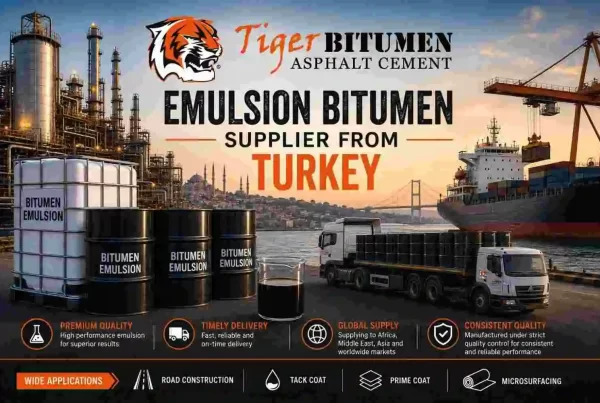
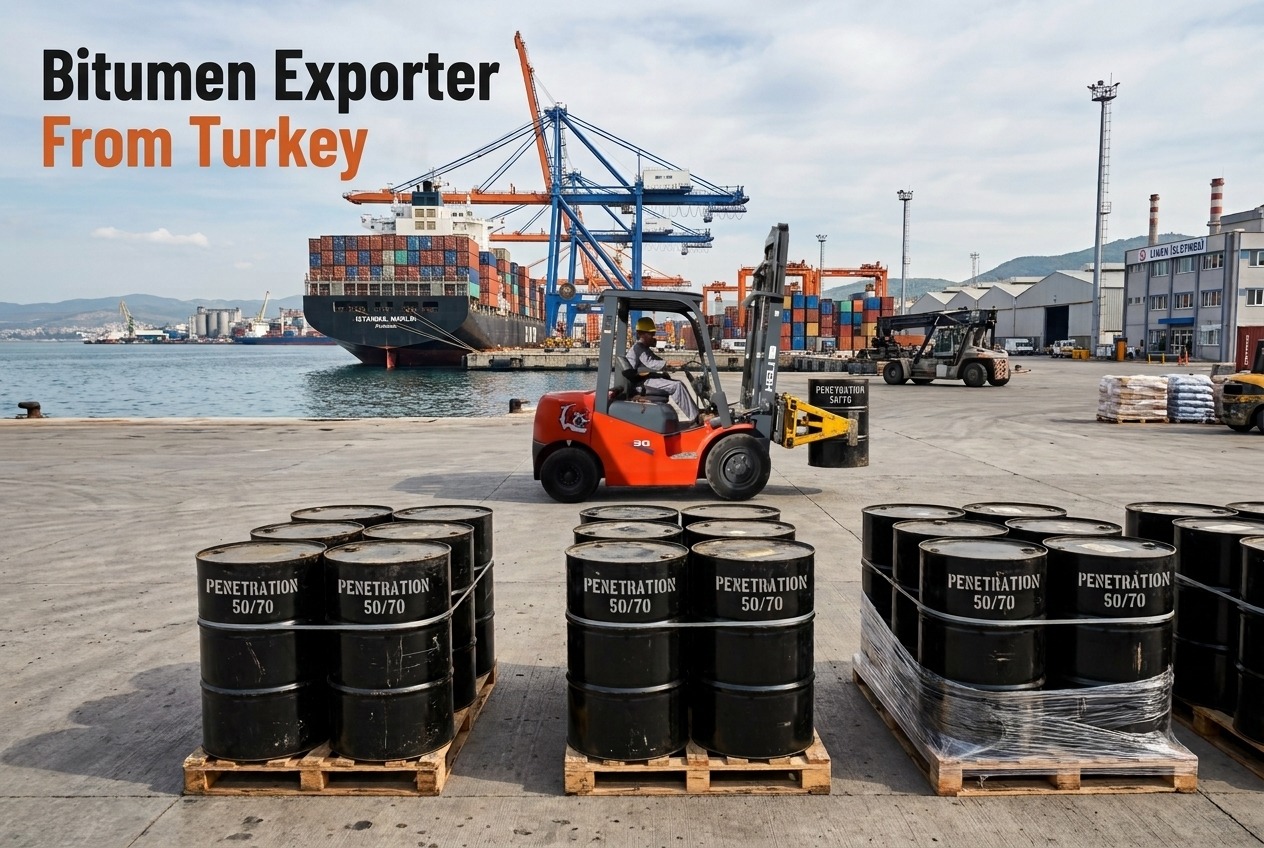
A company calling itself a Bitumen exporter from Turkey isn’t necessarily the source of the product it’s selling. “Exporter” describes a commercial and logistics function arranging the sale, documentation, and shipment of bitumen to an international buyer, and that function can be performed by the actual manufacturer, a licensed trading channel, or an independent company several steps removed from where the bitumen was originally produced. Confusing “exporter” with “manufacturer” is one of the most common and costly mistakes international buyers make when sourcing bitumen connected to Turkey.
This guide explains what a Turkish bitumen exporter actually does, how the export ecosystem is structured, and critically how to tell the difference between genuinely Turkish origin bitumen and material simply loaded or traded through Turkey. Tiger Bitumen, operated by HY International Group, is an international bitumen supplier and export partner, not a Turkish exporter or manufacturer; where relevant, this guide explains where that kind of international alternative fits for buyers whose sourcing needs don’t specifically require Turkish origin.
What Does a Bitumen Exporter from Turkey Actually Do?
An exporter’s core function is commercial and logistical: securing product, confirming its specification, arranging packaging and loading, preparing export documentation, and coordinating shipment to the buyer’s destination. An exporter may be:
- The manufacturer itself, selling directly through its own export division
- An authorized commercial channel, contracted to sell a manufacturer’s product internationally
- An independent trading company, sourcing bitumen from one or more manufacturers or regional networks and reselling under its own terms
- An international distributor, further removed from the source, sometimes handling product from multiple origins simultaneously
None of these roles is inherently more or less legitimate, but they carry different verification requirements. A buyer working directly with a manufacturer’s export division has a shorter, more traceable chain to the product’s actual source. A buyer working with an independent trader needs to do more of that verification work themselves.
Turkey’s Bitumen Export Ecosystem
Turkey has an established petroleum refining sector alongside significant domestic infrastructure demand, which supports both a genuine source of refinery-produced bitumen and an active regional trading and export function.
Beyond refinery-linked supply, Turkey’s export ecosystem also includes independent trading companies and terminal-based networks that handle bitumen movement, sometimes involving material sourced from outside Turkey. This layered structure is why understanding which type of exporter you’re dealing with matters more than the country label alone. (For a broader look at how this ecosystem fits together refineries, terminals, and traders see our dedicated guide to Turkey’s bitumen export structure.)
Turkish Origin Bitumen vs. Bitumen Loaded Through Turkey
This is the single most important distinction for buyers to understand, and it’s worth stating plainly: “loaded in Turkey” does not automatically mean “manufactured in Turkey.”
A shipment marketed as coming “from Turkey” may involve:
- Bitumen genuinely produced at a Turkish refinery
- Bitumen produced elsewhere and traded through regional commercial networks that happen to route through Turkey
- Material stored, blended, or handled at a Turkish terminal before onward shipment
- Product exported through Turkish logistics and port infrastructure without ever having been manufactured in the country
None of these arrangements is improper on its own. International bitumen trading legitimately works this way. The problem arises when a buyer assumes Turkish origin without verifying it, particularly where a specific contract, procurement policy, or import regulation requires documented Turkish origin material.
If Turkish country of origin genuinely matters for your order, verify it directly through:
- Certificate of Origin, issued for the specific shipment
- Manufacturer source information, identifying the actual production facility
- Certificate of Analysis, tied to a traceable batch
- Product and shipping documentation that’s internally consistent with the claimed origin
A supplier who can’t produce these on request, or who answers origin questions vaguely, hasn’t necessarily done anything wrong, but they also haven’t confirmed what you need confirmed, and that gap is yours to close before committing to the order.
Bitumen Grades Exported from Turkey
Penetration Bitumen
The standard product for road construction and asphalt production. Grades such as 30/40, 50/70, and 80/100 are commonly referenced in Turkish and Turkey connected export listings.
VG Bitumen
Viscosity Grade bitumen, relevant where a project specification calls for viscosity-based classification rather than penetration depth.
Oxidized Bitumen
Produced via air blowing of base penetration bitumen, used for waterproofing, roofing, and selected industrial applications.
Cutback Bitumen
Bitumen blended with a solvent to reduce viscosity, used in selected pavement applications requiring lower temperature handling.
Bitumen Emulsion
Bitumen dispersed in water, relevant to road maintenance and selected cold application work.
Polymer Modified Bitumen (PMB)
Bitumen modified with polymers for higher-performance infrastructure applications with more demanding requirements than standard grades.
Product and grade availability depends on the exporter’s actual source, refinery configuration, and current commercial availability. A general product listing isn’t confirmation that a specific grade is available for your order.
Bitumen Packaging for International Export
Common export packaging formats include:
- New steel drums, including 185 kg configurations commonly used in international bitumen export; availability depends on the specific supplier and shipment requirements.
- Jumbo bags, suited to certain bulk handling setups where appropriate for the specific product
- Bitutainers, flexible bulk packaging for particular logistics arrangements
- Bulk vessel supply, for larger orders where destination infrastructure supports bulk unloading
Packaging selection depends on product type, quantity, destination, shipping method, handling infrastructure, storage requirements, and customer preference. Specific figures for minimum order quantity, drum count, or container loading vary by exporter and should be confirmed directly for your order.
Export Documentation and Quality Inspection
Depending on destination and transaction requirements, relevant documentation may include a commercial invoice, packing list, Certificate of Origin, Certificate of Analysis, technical data sheet, inspection certificate, SGS inspection documentation where applicable, Bill of Lading or shipping documents, and export customs documentation. Not every document is mandatory for every shipment. Requirements vary by destination and agreed terms, and a professional exporter should be able to clarify exactly what applies to your order.
On quality specifically, buyers should expect verification covering grade confirmation against the applicable technical specification, batch consistency, a Certificate of Analysis for the specific shipment, sampling and laboratory testing support, and, where applicable or specifically requested, third-party inspection such as SGS, along with packaging integrity and correct labeling. A professional exporter should be able to explain clearly where the product comes from and how its quality was verified before shipment; vague or deflecting answers here are a genuine warning sign, not a minor gap.
How to Evaluate a Bitumen Exporter from Turkey?
Before committing to an order, work through:
- Confirm the actual exporter entity you’re contracting with
- Verify the manufacturer source; can they identify it clearly?
- Confirm country of origin, backed by documentation
- Confirm the exact grade, not a general product category
- Request technical specifications matching the applicable standard
- Review the Certificate of Analysis for the specific batch
- Confirm inspection options, including SGS where applicable
- Verify packaging appropriate to your handling capability
- Confirm the loading point, specifically identified
- Review export documentation for completeness
- Clarify the Incoterm used in the quotation
- Confirm the destination and any destination-specific requirements
- Review payment terms upfront
- Evaluate communication and technical support specific answers versus generic marketing language
- Verify delivery history, where independently possible
Each factor closes a specific gap: skipping origin verification risks paying for something other than what you specified; skipping the Incoterm check makes price comparison across quotes meaningless; skipping documentation review risks customs delays after the product has already shipped.
Common Mistakes When Choosing a Bitumen Exporter from Turkey
- Assuming Turkish loading means Turkish origin, the single most common and consequential mistake, addressed in detail above
- Choosing solely on the lowest quoted price, without confirming what’s actually included
- Not confirming the actual manufacturer, leaving the entire origin claim unverified
- Not checking grade specifications carefully, accepting a general product category as sufficient
- Accepting generic Certificates of Analysis that aren’t tied to the specific shipment or batch
- Ignoring inspection requirements, missing an opportunity for independent verification
- Not clarifying Incoterms, making quotations from different exporters impossible to compare fairly
- Not confirming packaging upfront, leading to mismatched expectations at loading
- Failing to specify the destination port clearly in the initial enquiry
- Not checking documentation requirements for the specific destination country
- Assuming every exporter has direct refinery access, when many are trading companies several steps removed
- Comparing an FOB quotation against a CFR or CIF quotation as if they represent the same price
Any single mistake here is usually recoverable. Several compounding together on a significant order is where real procurement problems originate.
Shipping Bitumen from Turkey
Practical shipping considerations include the destination port, whether the shipment is containerized or bulk vessel, loading arrangements and schedule, freight coordination, required shipping documentation, delivery planning, storage and handling capability at destination, and customs coordination. Turkey’s position connecting Europe, the Mediterranean, the Middle East, North Africa, and Central Asia is a genuine logistical factor supporting these routes. Specific transit times, freight rates, and port charges vary by shipping line, season, and current market conditions, and should be confirmed as part of an actual quotation.
FOB, CFR and CIF for Bitumen Exports
FOB (Free On Board) — The seller delivers and loads the goods at the agreed FOB point; the buyer arranges the main ocean freight and insurance from that point.
CFR (Cost and Freight) — The seller arranges and pays freight to the named destination port; marine insurance is not included by default.
CIF (Cost, Insurance and Freight) — The seller arranges and pays both freight and marine insurance to the named destination port.
No Incoterm is universally better. The right choice depends on the buyer’s own freight and insurance arrangements and how much of the logistics chain they prefer to manage directly.
What Buyers Should Provide for a Bitumen Quotation
To receive an accurate quotation, provide the required product and grade, quantity, packaging preference, destination port, delivery schedule, preferred Incoterm, technical specification, inspection requirements, and documentation requirements. Complete information upfront allows any exporter or international supplier to prepare a proposal that genuinely reflects your order, rather than a generic estimate that shifts once real details are confirmed.
Why International Buyers Consider Alternative Supply Channels
Not every buyer requires documented Turkish origin bitumen specifically. For some, the priority is reliable international supply, a competitive and transparent quotation, flexible sourcing, professional export documentation, available inspection options, suitable packaging, and coordinated shipment logistics regardless of the exact country of manufacture. Buyers in this position are well served by comparing Turkish origin sourcing against international supply alternatives on the same objective criteria: grade, quality documentation, packaging, freight, lead time, and total landed cost.
Why Consider Tiger Bitumen?
Tiger Bitumen, operated by HY International Group, is an international bitumen supplier and export partner. It is not a Turkish manufacturer, refinery, or exporter, and does not load or ship from a Turkish port. For buyers whose priority is reliable, well-documented international supply rather than Turkish origin specifically, Tiger Bitumen offers:
- A product range spanning penetration, oxidized, cutback, and emulsion bitumen
- International export expertise, drawing on roughly two decades of asphalt, tar, bitumen, and cement export activity
- Flexible export packaging, including new steel drums where suited to the order
- SGS quality and quantity inspection, where applicable to the shipment
- Professional export documentation prepared for customs clearance
- Shipment coordination from an export-oriented facility with access to Karachi Port and Port Qasim
- FOB, CFR, and CIF supply options, where applicable
- Technical product guidance for grade selection
- Competitive international quotations based on specific buyer requirements
- Dedicated customer support through enquiry, quotation, and shipment
This is Tiger Bitumen’s own international export configuration, entirely separate from Turkish sourcing offered as a genuine alternative for buyers whose requirements are flexible on origin.
How to Arrange an International Bitumen Supply?
- Submit your requirement — product, grade, quantity, packaging, destination, timeline.
- Confirm grade and technical specifications align on exactly what’s needed.
- Receive a quotation covering price basis, Incoterm, lead time, and payment terms.
- Confirm commercial terms and finalize pricing, quantity, and delivery schedule.
- Arrange inspection and documentation; agree on COA, SGS if applicable, and required export paperwork.
- Loading is coordinated according to the confirmed packaging and shipment plan.
- Shipment international transportation per the agreed Incoterm.
- Delivery arrival with documentation supporting customs clearance at destination.
Partner with the Right Bitumen Export Partner
Choosing well when sourcing from a bitumen exporter connected to Turkey comes down to verification rather than assumption: confirmed origin (not just confirmed loading), clear grade documentation, appropriate packaging, complete export paperwork, available inspection options, and transparent commercial terms throughout. Buyers who specifically require Turkish origin product should work through that verification chain directly and thoroughly. Buyers with flexible origin requirements have a genuine additional option worth comparing on equal terms: international suppliers such as Tiger Bitumen, evaluated on the same criteria of grade, quality, packaging, and total landed cost.
Contact Tiger Bitumen
To move forward, provide Tiger Bitumen with your required grade, quantity, packaging preference, destination port, delivery schedule, and preferred Incoterm. Tiger Bitumen’s team can then prepare a customized quotation as an international supply partner. Contact Tiger Bitumen to discuss your requirements.