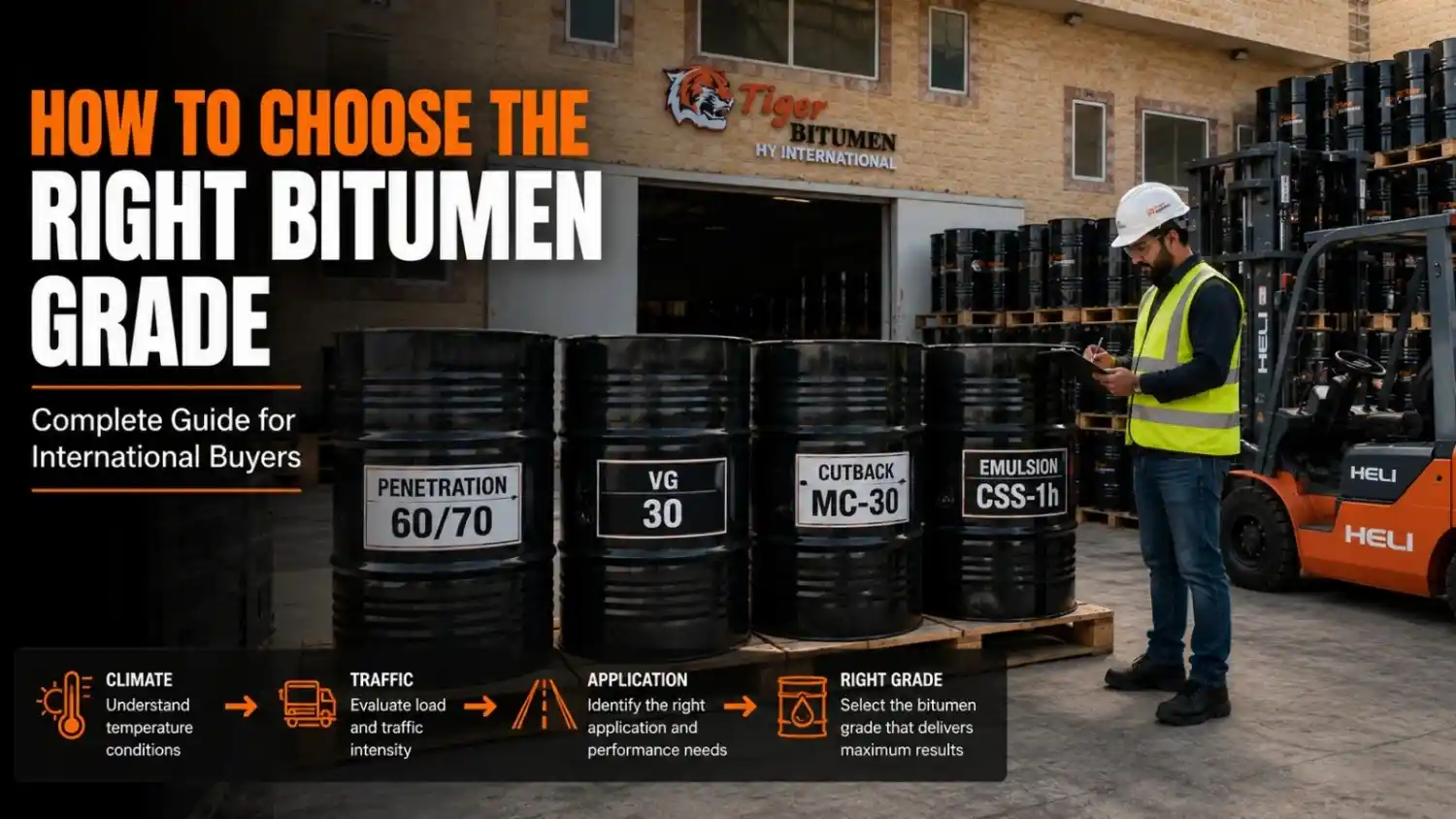
Selecting the right bitumen grade is one of the most important decisions in any road construction, infrastructure, waterproofing, or industrial project. Choosing an unsuitable grade can reduce pavement performance, increase maintenance costs, and shorten the service life of the finished application.
Because different bitumen grades are designed for different climates, traffic conditions, construction methods, and engineering requirements, buyers should evaluate their project carefully before placing an order.
This guide explains the most commonly used bitumen grades and shows international buyers how to select the product best suited to their specific application.
Why Choosing the Correct Grade Matters
Bitumen acts as the binding material that holds aggregates together in asphalt mixtures and many industrial applications.
Using the correct grade helps achieve:
- Longer pavement life
- Better resistance to heavy traffic
- Improved waterproofing performance
- Reduced maintenance costs
- Greater durability under different weather conditions
- Better overall project performance
Choosing the correct product from the beginning reduces procurement risks and helps contractors achieve long-term project success.
Expert Tip from Tiger Bitumen
Many buyers assume that all bitumen products perform the same. In reality, selecting the correct grade based on climate, traffic load, and application is one of the biggest factors affecting long-term performance.
Penetration Bitumen
Penetration Bitumen is one of the most widely used grades in road construction.
It is commonly supplied in grades such as:
These grades are suitable for:
- Highways
- Urban roads
- Airport pavements
- Asphalt production
- General road construction
Penetration Bitumen remains one of the most popular choices because of its proven performance across a wide range of climatic conditions.
Tiger Bitumen supplies penetration grades according to agreed product specifications for international infrastructure projects.
VG Bitumen
VG (Viscosity Grade) Bitumen is classified according to its viscosity rather than penetration value.
Common grades include:
VG Bitumen is generally preferred for:
- Heavy traffic highways
- Expressways
- Hot climate regions
- High-performance asphalt pavements
Its improved resistance to deformation makes it suitable for roads carrying higher traffic volumes.
Bitumen Emulsion
Bitumen Emulsion consists of bitumen dispersed in water using emulsifying agents.
It is widely used for:
- Tack coats
- Surface dressing
- Cold mix asphalt
- Preventive maintenance
- Road rehabilitation
Because bitumen emulsion can generally be applied at much lower temperatures than hot-applied bitumen, it can reduce the need for onsite heating and may lower energy requirements during construction.
Cutback Bitumen
Cutback Bitumen is produced by blending bitumen with petroleum solvents to reduce viscosity. It is used in selected prime coat, maintenance, and other applications where reduced viscosity is required.
Common applications include:
- Prime coats
- Selected cold-weather paving applications
- Remote construction sites where heating facilities are limited
- Road maintenance
Its lower viscosity can make application easier where conventional heating facilities are limited.
Polymer Modified Bitumen (PMB)
PMB contains specialized polymers that improve flexibility and durability.
It is recommended for:
- Motorways
- Airport runways
- Heavy traffic roads
- Bridge decks
- High-performance infrastructure
PMB can provide improved resistance to rutting, cracking, and temperature-related performance issues compared with conventional bitumen, depending on the polymer formulation and specification.
Oxidized Bitumen
Oxidized Bitumen is manufactured through a controlled air-blowing process that increases its softening point.
It is primarily used in:
- Roofing membranes
- Waterproofing systems
- Pipe coating
- Industrial insulation
- Expansion joints
Unlike road construction grades, Oxidized Bitumen is designed for industrial and construction applications requiring greater thermal stability.
Factors to Consider Before Choosing a Grade
Before placing an order, buyers should evaluate several technical and commercial factors.
These include:
- Project type
- Local climate
- Traffic volume
- Construction method
- Engineering specifications
- Maintenance expectations
- Budget
- Product availability
Discussing these requirements with an experienced exporter helps ensure the selected grade matches the project’s performance objectives.
Work with an Experienced Supplier
Selecting the correct grade is easier when working with an experienced supplier.
At Tiger Bitumen, our technical team assists international buyers by recommending products based on project specifications rather than simply offering the most common grade.
This helps contractors, distributors, and infrastructure developers reduce procurement risks while improving long-term project performance.
Final Thoughts
There is no single bitumen grade suitable for every project. The right choice depends on climate, engineering design, traffic conditions, and application requirements.
Understanding the characteristics of Penetration Bitumen, VG Bitumen, Bitumen Emulsion, Cutback Bitumen, Polymer Modified Bitumen, and Oxidized Bitumen enables buyers to make informed purchasing decisions while achieving better construction results.
Working with experienced exporters such as Tiger Bitumenprovides access to technical guidance, specification-based products, and professional export support for projects worldwide.
About Tiger Bitumen
Tiger Bitumen supplies a comprehensive range of internationally recognized bitumen products for road construction, airport development, waterproofing, roofing, and industrial applications. Our export specialists support international buyers with technical recommendations, strict quality control, SGS inspection, flexible packaging, and reliable global logistics.