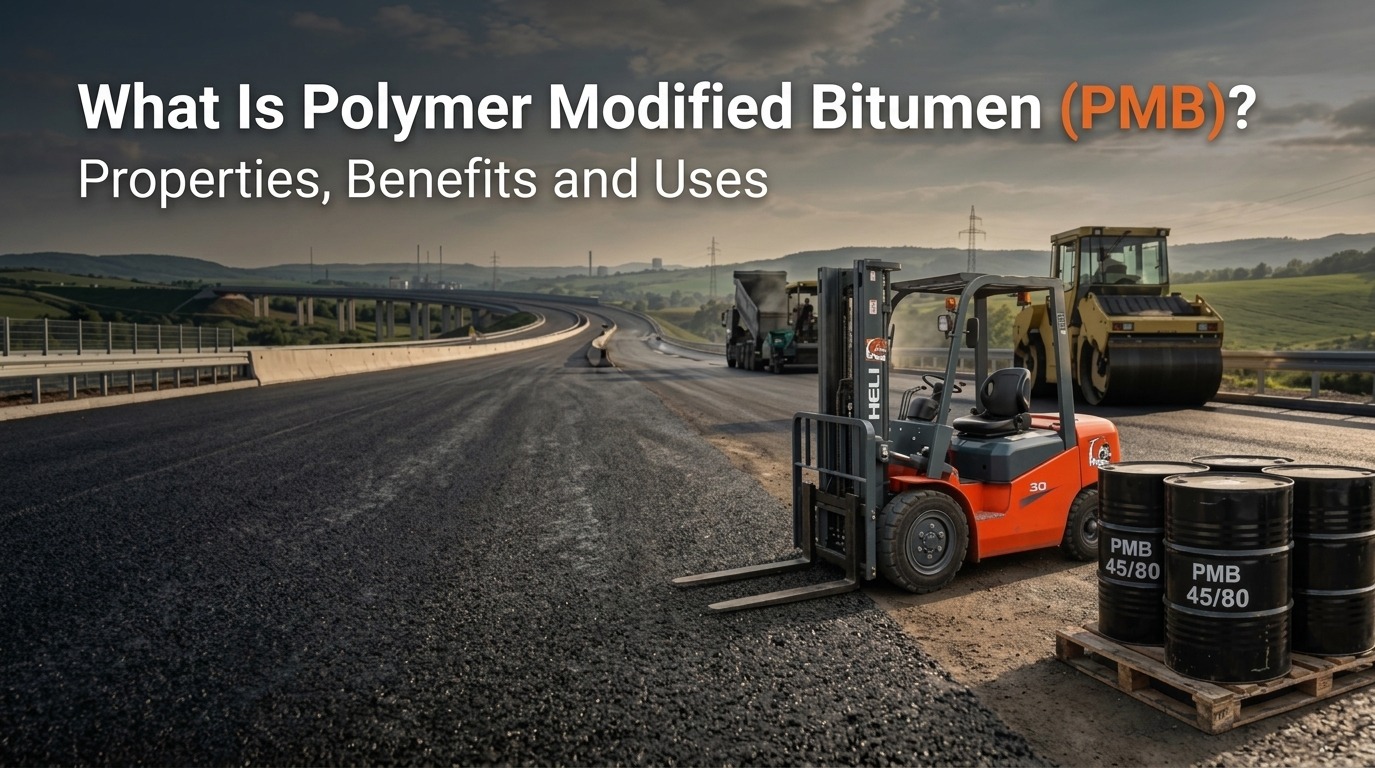
Polymer Modified Bitumen (PMB) is bitumen blended with one or more polymers to change selected performance characteristics compared with base bitumen. PMB is not one material with fixed properties. It is a family of engineered binders, and its performance depends on the polymer type, polymer dosage, base bitumen, and specification used for production.
This article explains what PMB is, how polymer modification changes bitumen behavior, the key properties affected, where PMB is commonly used, and what buyers should check before specifying or ordering it. For formal PMB classification and grading, see our articles on EN 14023 classification and PMB grades.
What Is Polymer Modified Bitumen?
Ordinary, unmodified bitumen is a thermoplastic material whose behavior changes significantly with temperature. It can flow under heavy, slow-moving loads at high temperatures and become brittle in cold conditions. Polymer modification changes this behavior by blending a polymer into the bitumen.
PMB is not a single formula. Different projects require different combinations of polymer type, dosage, and base bitumen. As a result, two products described as PMB can have meaningfully different properties.
PMB is therefore better understood as a category of modified binders. Manufacturers formulate each binder to meet the performance requirements of a specific specification or application.
How Does Polymer Modification Change Bitumen?
Polymer modification involves dispersing a polymer through hot bitumen, typically at a few percent by mass, until the blend reaches the required stability and performance. One of the most widely used modifiers for road-grade PMB is SBS (styrene-butadiene-styrene), a thermoplastic elastomer.
When manufacturers blend SBS with bitumen, the polymer swells within the bitumen’s oily maltene fraction and forms a continuous network through the binder. This network can give a well-formulated elastomeric PMB greater elastic recovery and resistance to permanent deformation than unmodified bitumen.
Other modifiers, including plastomers such as EVA or polyethylene, work differently. They generally increase binder stiffness and can improve resistance to deformation through a different mechanism. They do not necessarily provide the same degree of elastic recovery as elastomeric modifiers.
The selected modifier and its proportion depend on the properties required by the project specification. Compatibility between the polymer and the base bitumen also matters. Different polymers can behave differently with different base bitumens, so manufacturers develop and test PMB formulations rather than assuming that all PMB products will perform in the same way.
Key Properties of Polymer Modified Bitumen
Elastic Recovery
Elastic recovery describes how much deformation a binder can recover after the load causing that deformation is removed. This property is strongly associated with elastomeric modification such as SBS.
A well-formulated elastomeric PMB can recover a significant portion of its deformation, while unmodified bitumen may retain more of the deformation. The actual recovery depends on the polymer type, dosage, and formulation. It is not a fixed value for every PMB.
High Temperature Performance
Polymer modification can improve a binder’s resistance to flow and permanent deformation at elevated temperatures. This property is important for rutting resistance under heavy or slow-moving traffic.
The improvement generally comes from increased stiffness and a higher softening point compared with the base bitumen. However, the degree of improvement depends on the modifier, dosage, and base bitumen. It should not be assumed to be identical across all PMB products.
Low Temperature Behavior
Manufacturers can design PMB formulations to improve flexibility and resistance to cracking at low temperatures. This can matter in pavements exposed to significant cold-weather thermal stress.
However, low-temperature performance depends on the formulation and the requirements of the applicable specification. It should not be treated as an automatic property of every PMB grade.
Fatigue and Durability
Polymer modification can help a binder flex and recover under repeated loading. This can contribute to improved resistance to fatigue cracking over the pavement’s service life.
Ageing behavior also depends on the modification system. Some studies report different ageing behavior for elastomer-modified and plastomer-modified binders. Therefore, the effect of polymer modification on durability remains formulation-dependent rather than a universal advantage of one modifier type.
Adhesion and Cohesion
Cohesion describes the internal strength that holds the binder together under load. Adhesion describes how well the binder bonds to aggregate within an asphalt mixture.
Polymer modification can affect both properties. This can influence how well an asphalt mixture resists problems such as fraying and stripping over time. The degree of improvement depends on the specific PMB formulation and application.
Storage Stability
In many PMB formulations, the polymer remains dispersed through the bitumen rather than becoming chemically bonded to it. As a result, some PMBs can experience polymer separation during prolonged hot storage if manufacturers do not formulate or handle the material correctly.
Appropriate formulation and storage conditions therefore matter. Some PMB systems may also require agitation during storage. Our EN 14023 classification article provides more technical information about PMB storage stability and the relevant testing requirements.
Benefits of Polymer Modified Bitumen
When appropriately formulated and specified for the application, PMB can offer several performance benefits:
- Improved resistance to permanent deformation (rutting) under heavy or slow-moving traffic
- Improved elastic behavior, allowing the binder to recover from deformation
- Improved resistance to certain cracking mechanisms, depending on the formulation
- Potential durability advantages under demanding service conditions compared with conventional bitumen in appropriately specified applications
These are potential benefits rather than guarantees. Actual performance depends on the polymer formulation, specified grade, asphalt mix design, pavement structure, climate, traffic conditions, and how closely the product matches the project’s requirements.
Where Is PMB Used?
PMB is generally considered when a project’s requirements go beyond what conventional, unmodified bitumen can reliably deliver. Common application categories include:
- High-traffic road pavements
- Motorways and other heavy-traffic routes
- Airport pavements
- Bridge decks
- Other demanding asphalt applications
- Infrastructure projects where the governing specification requires modified-binder performance
This is an application-level overview rather than grade-selection guidance. The project specification determines which PMB grade or designation applies. Buyers should not select a specific grade based only on the application category.
For more information about grade selection, see our PMB grades article and our guide to choosing the right bitumen grade.
PMB vs Conventional Bitumen
Conventional, unmodified bitumen is commonly classified by penetration and specified where its performance meets the expected traffic and climate requirements. PMB adds polymer modification to change selected performance characteristics such as elasticity, resistance to deformation, and behavior across a wider temperature range.
PMB is not automatically the right choice for every application. Conventional bitumen can meet the requirements of many projects without the additional cost and complexity of polymer modification.
PMB becomes relevant when the project’s specification requires performance properties that conventional bitumen cannot reliably provide. PMB specifications can also cover several properties, including penetration, softening point, elastic recovery, storage stability, and other performance characteristics.
Is PMB Always Better Than Conventional Bitumen?
No. PMB is not automatically the right choice for every project. The appropriate binder depends on the project’s requirements, expected traffic, climate, service conditions, governing specification, and required performance properties.
Where conventional bitumen already meets the project requirements, PMB can add cost and specification complexity without providing a corresponding benefit. The appropriate choice should therefore follow the project specification rather than a general assumption that modified bitumen is always preferable.
What Should Buyers Check Before Ordering PMB?
Before placing an order, buyers should confirm the following:
- The governing project specification and applicable standard, such as EN 14023, IS 15462, AASHTO PG, or a national annex
- The complete PMB designation required rather than relying on a penetration range alone
- The performance properties required by the project specification, such as elastic recovery, storage stability, durability, and low-temperature behavior
- The technical data sheet for the specific designation
- A shipment-specific certificate of analysis
- Packaging requirements
- Whether third-party inspection is required
- Quantity and delivery terms
Explore Tiger Bitumen’s Polymer Modified Bitumen Range
To learn more about available PMB classifications or request a quotation, visit our Polymer Modified Bitumen (PMB) range.
Frequently Asked Questions
What is PMB?
Polymer Modified Bitumen (PMB) is bitumen blended with one or more polymers to alter selected performance characteristics typically elasticity, resistance to deformation, and behavior across temperature compared with the unmodified base bitumen.
What is PMB used for?
PMB is generally used where project requirements exceed what conventional bitumen can reliably deliver commonly high-traffic roads, motorways, airport pavements, bridge decks, and other demanding infrastructure, as set out in the governing project specification.
What are the benefits of PMB?
Depending on formulation and specification, PMB can offer improved resistance to deformation, improved elastic recovery, improved resistance to certain cracking mechanisms, and potential durability advantages under demanding conditions though actual performance always depends on the specific formulation and application.
Is PMB better than conventional bitumen?
Not universally. PMB is appropriate where a project’s specification calls for performance properties conventional bitumen doesn’t reliably provide. For many applications, conventional bitumen remains the appropriate and more cost effective choice.
What properties does polymer modification improve?
Depending on the modifier and formulation, polymer modification can affect elastic recovery, resistance to permanent deformation, low temperature flexibility, fatigue resistance, and adhesion/cohesion. Not every PMB product improves every property to the same degree.
Is PMB suitable for all climates?
PMB formulations can be designed for a wide range of climate and service conditions, but no single formulation is automatically suited to every climate. The applicable grade and formulation should be selected according to the project specification, not assumed from the term “PMB” alone.
How is PMB different from normal bitumen?
Conventional bitumen is classified primarily by penetration (hardness). PMB includes a polymer that can extend its performance typically elasticity and behavior across a wider temperature range and is specified against a broader set of properties as a result.