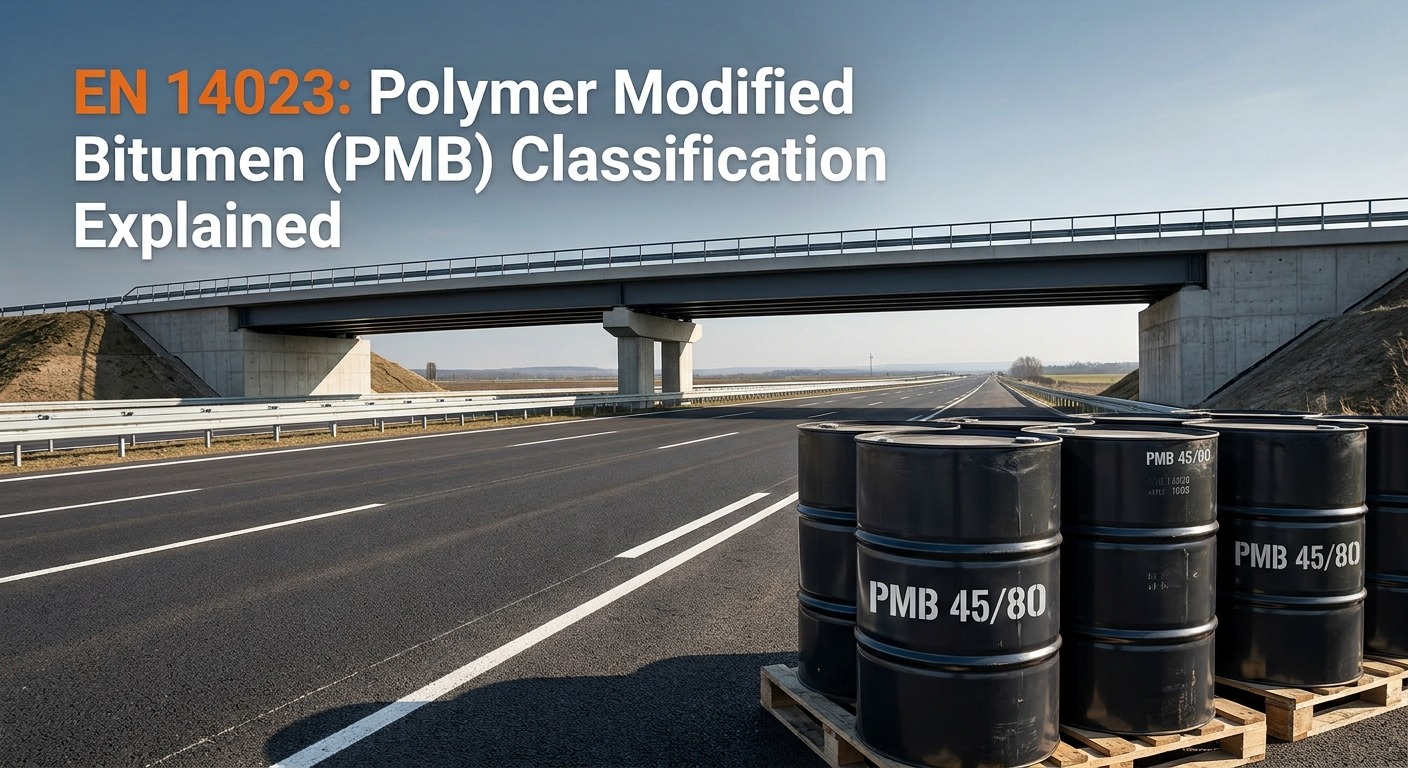
Polymer Modified Bitumen (PMB) does not use a single number in the same way as unmodified penetration grade bitumen. Instead, EN 14023 PMB (Polymer Modified Bitumen uses a framework of characteristics and classification classes to describe modified binders.
CEN developed EN 14023 as a European framework for polymer modified bitumen used in roads, airfields and other paved areas. Therefore, buyers need to look beyond the penetration range and confirm the complete designation and required performance characteristics.
This guide explains what EN 14023 covers, how the framework classifies PMB, which properties and test methods buyers should check, and what information to confirm before ordering.
What Is EN 14023?
CEN publishes EN 14023 as a European Standard titled “Bitumen and bituminous binders Specification framework for polymer modified bitumen.” The framework covers polymer modified bitumen for roads, airfields and paved areas.
The current published edition is EN 14023:2010, which superseded the 2005 edition. A later revision process, known as prEN 14023, closed in 2022.
EN 12597 provides terminology for bitumen and bituminous binders, while EN 14023 provides the specification framework for polymer modified bitumen. In other words, EN 14023 does not represent one fixed PMB product or one universal grade.
Instead, the framework allows the applicable properties and classes to match project requirements. Consequently, buyers should confirm the complete PMB designation and the specific values required by the project specification.
What Does EN 14023 Cover?
Key Characteristics the Framework Specifies
EN 14023 uses several characteristics to describe the performance of polymer modified bitumen. The framework addresses intermediate consistency, elevated consistency, cohesion, durability of consistency, low-temperature brittleness and strain or elastic recovery.
Therefore, a buyer should not assess PMB from its penetration range alone. Instead, the technical data sheet should show the applicable characteristics, declared values and test methods required for the project.
How EN 14023 Classifies PMB
Nominal Penetration Range
EN 14023 defines nominal penetration ranges that help identify the consistency range of a PMB. The framework includes the following ranges:
- 10/40
- 25/55
- 45/80
- 40/100
- 56/105
- 75/130
- 90/150
- 120/200
- 200/300
These ranges do not represent complete PMB designations by themselves. Buyers should also confirm the applicable minimum softening-point class and other required characteristics.
Minimum Softening Point
The framework also defines minimum softening-point classes, with classes ranging approximately from ≥40°C to ≥80°C. These classes provide a way to specify the elevated-temperature consistency required for the binder.
However, the appropriate combination depends on the project specification. For this reason, buyers should confirm the required penetration range and minimum softening-point class before placing an order.
Why a Penetration Range Alone Isn’t the Complete Classification
A complete EN 14023 PMB designation combines the nominal penetration range with the applicable minimum softening-point class. For example, a designation can combine the 45/80 penetration range with a minimum softening point of 60°C.
The standard can write this example as PMB 45/80 60. Therefore, a reference to “PMB 45/80” alone does not provide the complete classification.
Before ordering, confirm the complete designation together with the declared properties and applicable test methods.
Key Properties and Test Methods Buyers Should Know
When reviewing an EN 14023 Polymer Modified Bitumen technical data sheet, buyers should check the relevant property and the test method used to determine it.
| Property | What It Tells the Buyer | Test Method |
| Penetration | Consistency / hardness at intermediate (25°C) service temperature | EN 1426 |
| Softening point | Consistency at elevated service temperature; relevant to heat resistance | EN 1427 |
| Elastic (strain) recovery |
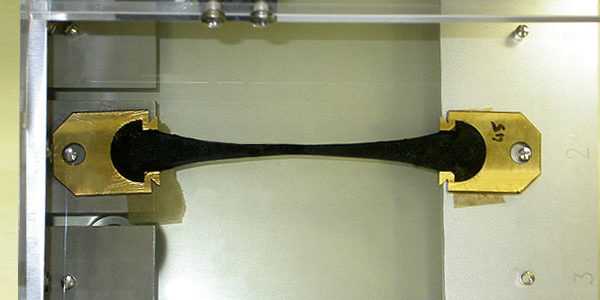
How much deformation the binder recovers after stretching central to the benefit of polymer modification | EN 13398 |
| Storage stability | Whether the ploymer stays evenly dispersed in the bitumen during storage, rather than separating | EN 13399 |
| Resistance to hardening (durability) | How much the binder’s properties change after simulated short term ageing (RTFOT) | EN 12607-1 |
| Cohesion | Internal strength of the binder under load | EN 13587 / EN1 3588 |
| Fraass breaking point | The temperature at which the binder becomes brittle in cold conditions | EN 12593 |
| Flash point | A safety related property, relevent to handling and transport | EN ISO 2592 |
The applicable tests depend on the product specification and project requirements. Therefore, buyers should compare the supplier’s technical data sheet with the exact requirements stated in the project specification.
Reading a PMB Technical Data Sheet Against EN 14023
A PMB technical data sheet should provide enough information for the buyer to compare the product with the project specification. Use the following checklist:
- Check the nominal penetration range. Confirm that the stated range matches the project requirement.
- Check the minimum softening point. Confirm the applicable class and declared value.
- Review the other characteristics. Check cohesion, elastic recovery, durability and low-temperature properties where applicable.
- Check the test methods. Make sure the supplier reports the relevant properties using the required standards.
- Compare the TDS with the project specification. Do not rely only on the product name or penetration range.
- Confirm the standard and edition. Check which EN 14023 edition and other referenced standards apply to the project.
- Confirm product and shipment documents. Check the required technical and quality documents before shipment.
For projects that specify performance-based binder classification, buyers can also review Performance Grade Bitumen.
EN 14023 and Other PMB Standards
Different standards use different classification systems for modified bitumen. For example, EN 14023, IS 15462 and AASHTO Performance Grade (PG) systems do not use identical designation logic.
As a result, buyers should not treat designations from different systems as directly interchangeable. Instead, compare the applicable performance requirements, test methods and project specification.
If a project requires unmodified paving bitumen rather than polymer modified bitumen, review the Penetration Bitumen range and the applicable grade-selection requirements.
What to Confirm Before Ordering PMB
Before ordering Polymer Modified Bitumen under the EN 14023 framework, confirm the following information:
- The complete PMB designation.
- The required additional characteristics and declared values.
- The applicable standard and edition.
- The required technical and quality documents.
- The required quantity, packing and delivery terms.
For grade selection, buyers can also review Tiger Bitumen’s guide to choosing the right bitumen grade when the project specification does not clearly identify the required binder.
Explore Tiger Bitumen’s Polymer Modified Bitumen Range
Tiger Bitumen supplies Polymer Modified Bitumen (PMB) for international road, highway, airport and paving projects. The applicable PMB designation, standard and technical requirements should be confirmed for each enquiry.
Frequently Asked Questions
What is EN 14023?
EN 14023 is a European Standard (CEN) that provides a framework for specifying the characteristics and test methods for Polymer Modified Bitumen used in roads, airfields and other paved areas. The current edition is EN 14023:2010.
Is EN 14023 the same as a PMB grade?
No. EN 14023 is the classification framework; a specific PMB grade is a complete designation produced by applying that framework a nominal penetration range combined with a minimum softening point class.
What does PMB 45/80 mean?
45/80 is one of the nominal penetration ranges defined in EN 14023’s Table 1 a binder with penetration between 45 and 80 (0.1 mm). On its own, it identifies the penetration range only.
Is 45/80 a complete PMB designation?
No. The complete designation also requires the applicable minimum softening point class. The standard’s own informative example, combining the 45/80 range with a softening point class of 60, is written as PMB 45/80 60.
What is the role of softening point in EN 14023 classification?
Softening point represents consistency at elevated service temperature. Combined with the penetration range, it forms the complete designation, and the appropriate class is selected according to the project’s climate and service conditions.
How many nominal penetration ranges are defined?
EN 14023’s Table 1 defines nine nominal penetration ranges, from 10/40 up to 200/300.
What tests are associated with EN 14023?
Key tests include penetration (EN 1426), softening point (EN 1427), elastic recovery (EN 13398), storage stability (EN 13399), resistance to hardening (EN 12607-1), cohesion (EN 13587/EN 13588), Fraass breaking point (EN 12593) and flash point (EN ISO 2592).
Is EN 14023:2010 still current?
Yes. EN 14023:2010 is the current published edition. A later revision project was opened but formally closed without being adopted in 2022, so no newer edition has replaced it.