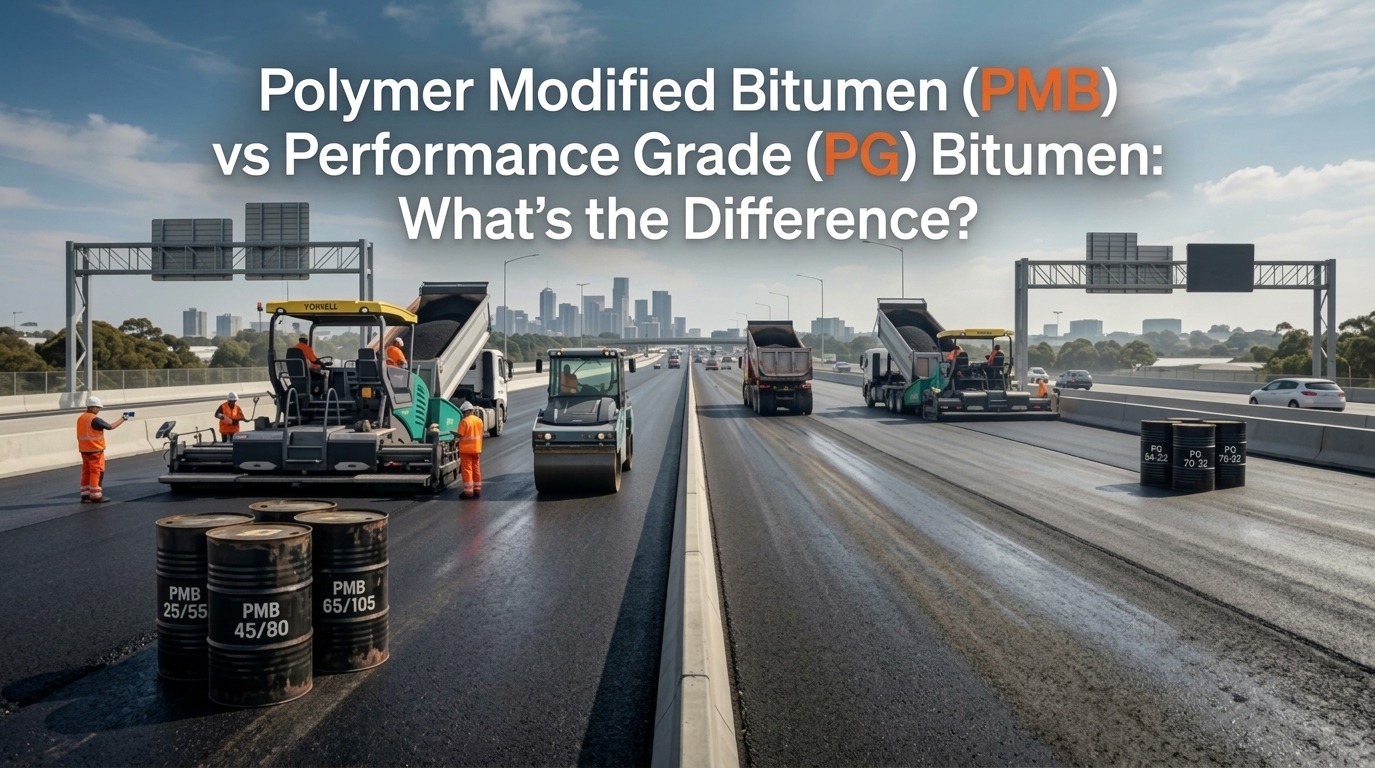
PMB vs PG bitumen is one of the most common comparisons in bitumen specifications, and one of the easiest to misread, because the two terms do not describe the same kind of thing. Polymer Modified Bitumen (PMB) names a type of binder: bitumen that has been modified with polymer. Performance Grade (PG) names a grading system: a way of classifying a binder by how it performs across the pavement temperatures a project will experience. A binder can be described by one, both, or neither, depending on the specification it is supplied against.
This article explains the PMB vs PG bitumen difference, where the two systems overlap, why similar-looking designations can mean different things, and what to confirm before ordering. For background on the binder itself, see our article on what polymer modified bitumen is.
PMB vs PG Bitumen: The Short Answer
- PMB describes what the binder is: bitumen modified with one or more polymers.
- PG describes how the binder is graded: by performance at the pavement design temperatures of a project.
- They are not alternatives. A PG-graded binder may or may not be polymer modified, and a PMB classified under one standard is not automatically graded under another.
- Neither is “better.” The governing project specification decides which system applies and which designation is required.
What PMB Describes
Polymer Modified Bitumen is bitumen blended with one or more polymers to alter selected performance characteristics compared with the base bitumen. It is a family of binders rather than one material, and how a given PMB is classified depends on the specification it is supplied against.
Under EN 14023, for example, PMB is classified by a nominal penetration range combined with a minimum softening point (the standard’s own informative example is PMB 45/80 60), alongside other characteristics such as elastic recovery, cohesion, durability, low-temperature brittleness and storage stability. We cover that framework in full in our EN 14023 classification article.
What Performance Grade (PG) Describes
Performance Grade classification, set out in AASHTO M 320 and the corresponding ASTM D6373, grades a binder by its performance relative to pavement design temperatures rather than by penetration. The question it answers is: across the temperature range this pavement will experience, does the binder meet defined performance requirements?
How to Read a PG Grade
A PG designation such as PG 64-22 carries two numbers:
- The first (64) relates to the average seven-day maximum pavement design temperature, in °C.
- The second (-22) relates to the minimum pavement design temperature, in °C.
Grades move in 6 °C steps on both sides. Compliance is assessed with rheometer tests rather than penetration: the Dynamic Shear Rheometer (DSR) for high and intermediate temperature behaviour, and the Bending Beam Rheometer (BBR) for low-temperature behaviour, on binder in its original state and after simulated short- and long-term ageing.
MSCR Traffic Grades Under AASHTO M 332
AASHTO M 332 (with the ASTM counterpart D8239) grades binders using the Multiple Stress Creep Recovery (MSCR) test and adds a traffic letter to the designation: S, H, V or E, for standard, heavy, very heavy and extremely heavy traffic loading. The letter sits between the two temperature numbers, as in PG 64E-22. Whether a project specifies M 320, M 332 or neither is a decision for the project specification.
PMB vs PG at a Glance
| Polymer Modified Bitumen (PMB) | Performance Grade (PG) Bitumen | |
| What the term describes | A type of binder: bitumen modified with polymer | A grading system: binder classified by performance at pavement design temperatures |
| Is polymer modification part of the definition? | Yes | No. A PG binder may be unmodified or modified; the designation does not say which |
| TYical governing specifications | EN 14023; 15462; other national specifications | AASHTO M 320; AASHTO M332; ASTM D6373; ASTM D8239 |
| Designation format | Depends on the specification, e.g. nominal penetration range plus minimum softening point under EN 14023 | Two pavement-temperature number (PG 64-22), plus a traffic letter under M 332 (PG 64E-22) |
| Properties emphasised | Penetration, softening point, and characteristics such as elastic recovery, cohesion, durability, low–temperature brittleness and storage stability (EN 14023) | Rheological performance by DSR and BBR at pavement design temperatures, before and after ageing; MSCR under M332 |
| How climate is reflected | Through the classes the specification selects | Directly, through the pavement temperatures in the designation |
Where PMB and PG Overlap
PG grading describes performance, not composition. A binder can meet a PG grade without polymer, or with it. Transport-agency guidance illustrates the pattern: the Texas DOT’s PG binder FAQ describes PG 64-22 as typically not polymer modified, PG 70-22 and PG 76-22 as typically polymer modified, and notes that the PG system makes the highest grades difficult to meet without some type of modifier. “Typically” is not “always,” and the grade designation itself does not tell you how the performance was achieved.
The MSCR test was developed as a performance-based measure that does not depend on the type of modification used. Even so, agencies working with AASHTO M 332 have used the relationship between MSCR percent recovery and non-recoverable creep compliance to help indicate whether polymer modification is present. Some specifications therefore ask for both: a PG grade plus an additional requirement that confirms polymer modification.
The reverse also holds. A PMB classified under EN 14023 is classified by its own properties. It has not been graded under AASHTO M 320 or M 332 unless it has been tested and reported that way.
When the Names Collide: IS 15462:2019
Overlap is not only conceptual. The 2019 edition of the Indian Standard for polymer modified bitumen, IS 15462:2019, designates five grades: PMB 64-10, PMB 70-10, PMB 76-10, PMB 82-10 and PMB 76-22. These are built from pavement temperatures in a format that looks like a PG designation, and the main requirements table does not use penetration. The superseded 2004 edition worked differently, grading PMB 40, PMB 70 and PMB 120.
Similar format does not make the designations interchangeable. “PMB 76-10 to IS 15462:2019” and “PG 76-10 to AASHTO M 320” are statements about two different standards, each with its own requirements and test methods. When a specification or offer uses a PG-style name, confirm which standard and which edition it refers to.
Can an EN 14023 Designation Be Converted to a PG Grade?
Not by designation alone. EN 14023 classifies by penetration range, softening point and related characteristics; PG classifies by rheometer-based performance at pavement design temperatures. The two sets of tests do not map one-to-one, so a conversion table cannot be relied on.
If a project specification allows an alternative to the system it names, equivalence has to be demonstrated with test data reported against the governing specification, not assumed from a cross-reference. A supplier claiming “equivalence” without that data has not answered the question.
Which System Does Your Project Need?
The governing specification decides. In practice:
- The specification calls for a PG grade: request a binder graded and reported under the named specification (M 320, M 332 or ASTM D6373), with the high- and low-temperature numbers and, under M 332, the traffic letter.
- The specification calls for EN 14023 PMB: request the complete designation (nominal penetration range and minimum softening point) and the other characteristics the specification requires.
- The specification names IS 15462: confirm which edition applies, since the 2004 and 2019 editions use different designations.
- The specification says only “polymer modified”: ask the specifier to name the standard and the designation before requesting quotations.
A higher number is not automatically a better answer. Texas DOT guidance notes that a very stiff grade such as PG 76-22 is not necessarily needed for every pavement and that, on a pavement with an unusually flexible structure, a stiffer binder can be more susceptible to cracking. The right choice is the one the project specification requires. For the wider selection process, see our guide to choosing the right bitumen grade.
What to Confirm Before Ordering?
- The governing specification and its edition
- The designation exactly as written in that specification
- For PG: the high- and low-temperature grade, the traffic letter if M 332 applies, and whether polymer modification is separately required
- For EN 14023: the nominal penetration range, the minimum softening point and the other required characteristics
- Whether the specification allows alternatives, and how equivalence must be demonstrated
- Documentation: a technical data sheet and a shipment-specific certificate of analysis reported against the same specification, and whether third-party inspection is required
- Packaging, quantity and delivery terms
Tiger Bitumen’s PMB and PG Ranges
Tiger Bitumen lists Polymer Modified Bitumen and Performance Grade Bitumen as separate product ranges because the specification systems behind them differ. The Performance Grade grade pages set out requirements against AASHTO test methods, such as the DSR and BBR methods described above. The PMB range is offered across the EN 14023 nominal penetration range framework, with the complete designation and applicable standard confirmed against each project’s specification at the quotation stage.
If your specification combines requirements, for example a PG grade together with a requirement for polymer modification, send it with your enquiry so the requirements can be reviewed against it at quotation stage.
Explore Tiger Bitumen’s PMB and Performance Grade Ranges
To request a quotation or technical documentation, get in touch for a quotation with your project specification.
Frequently Asked Questions
Is PMB the same as PG bitumen?
No. PMB describes a type of binder, bitumen modified with polymer. PG describes a grading system based on performance at pavement design temperatures. They answer different questions and are not alternatives.
Is PG bitumen polymer modified?
Not necessarily. A PG binder may be unmodified or polymer modified. Higher PG grades are often achieved with polymer modification, but the PG designation does not state whether a binder is modified.
Can a polymer modified bitumen be PG graded?
Yes, if it is tested and meets the requirements of the PG specification in question. The grade then describes its performance, not its composition.
What does PG 64-22 mean?
The first number relates to the average seven-day maximum pavement design temperature in °C, and the second to the minimum pavement design temperature in °C, as defined in AASHTO M 320 and ASTM D6373.
What do S, H, V and E mean in a PG grade?
Under AASHTO M 332, the letter denotes standard, heavy, very heavy or extremely heavy traffic loading, assessed with the MSCR test and written between the temperature numbers, as in PG 64E-22.
Is an IS 15462:2019 PMB grade the same as an AASHTO PG grade?
Not by default. IS 15462:2019 uses PG-style names such as PMB 76-10, but they are defined by an Indian standard with its own requirements. Confirm which standard and edition a specification or offer refers to.
Is there a direct equivalent between an EN 14023 PMB designation and a PG grade?
No direct conversion exists by designation alone. Equivalence, where a specification permits it, has to be shown with test data reported against the governing specification.
Which is better, PMB or PG?
Neither. They are different kinds of description, and the right choice is the designation your project specification requires.
Standards referenced in this article?
AASHTO M 320; AASHTO M 332; ASTM D6373; ASTM D8239; EN 14023:2010; IS 15462:2019 (and the superseded 2004 edition).