
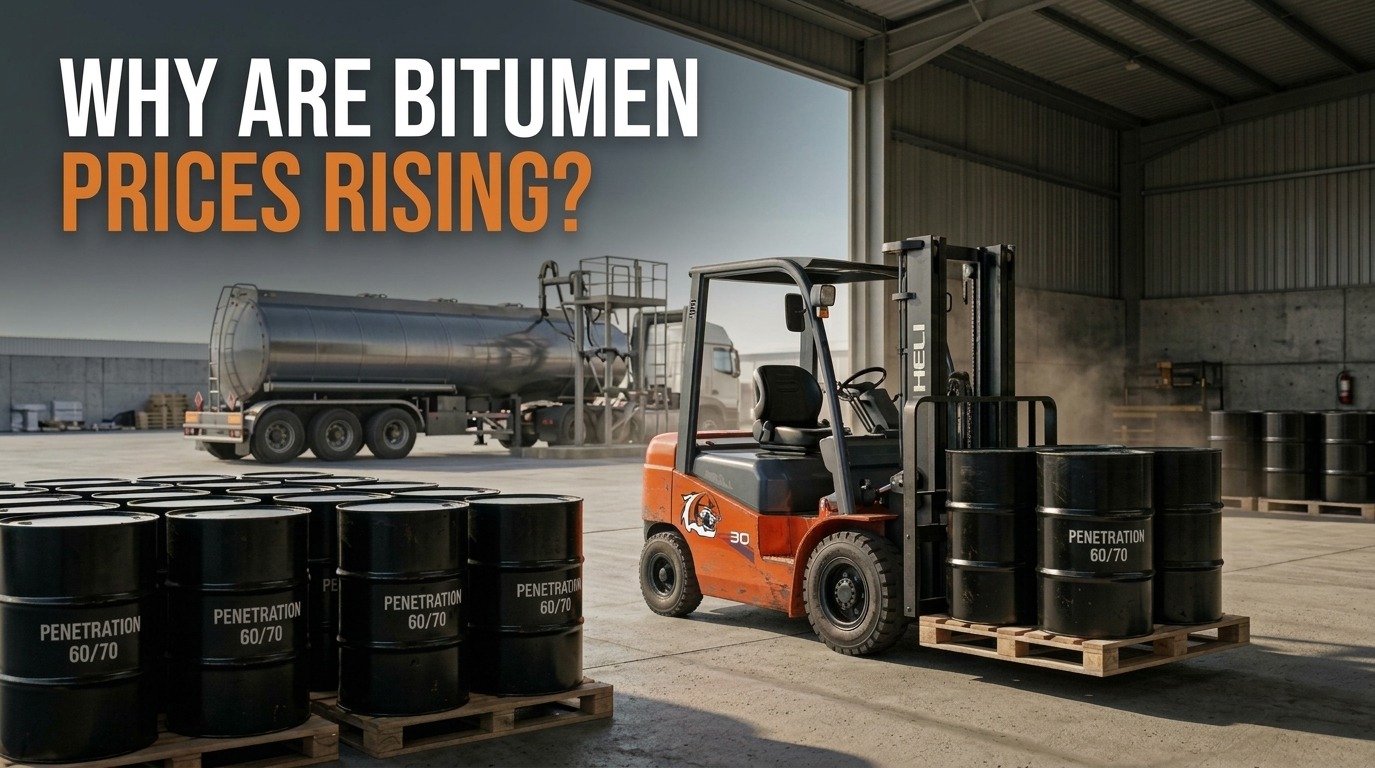
Bitumen prices have risen in many markets during 2026, including some where road construction demand has been weak. That can seem surprising, but bitumen pricing is shaped mainly by supply-side factors: the crude oil refineries process, the value of fuel oil, refinery decisions and the cost of moving product to market.
Understanding these drivers helps buyers anticipate price movements and plan purchases with more confidence. This guide explains the main factors and what they mean for your buying decisions.
The short answer
Bitumen prices are rising mainly because supply has tightened. Refineries have been processing crude grades that produce less bitumen, fuel oil prices have climbed, some producers face higher feedstock costs, and freight on longer supply routes has added to delivered costs.
1. Crude quality determines how much bitumen is made
Bitumen comes from the heaviest part of the crude oil barrel, the residue left after lighter fuels have been extracted. Heavy, high-sulphur crude grades yield much more bitumen than light, low-sulphur grades.
During 2026, disruption to supplies of heavier crude grades has led several refineries, particularly in Europe, to switch to lighter, sweeter crudes. These grades produce more diesel and gasoline but far less bitumen. Lower output in parts of central Europe pushed local truck prices sharply higher in mid-October, and reduced refinery output also curbed exports from parts of Asia.
2. Fuel oil prices set the reference point
In many international markets, bitumen cargo prices are quoted as a premium or discount to high-sulphur fuel oil, and long-term supply contracts often use fuel oil-linked price formulas. When fuel oil rises, bitumen prices tend to follow, even if bitumen demand has not changed.
This was clear in mid-October 2026. High-sulphur fuel oil prices rose sharply again, and bitumen cargo prices in Europe, the Mediterranean and Africa rose with them, while bitumen’s premium over fuel oil stayed broadly unchanged in most of those markets.
3. Refiners can choose between bitumen and fuel oil
Refinery residue can be sold as bitumen or used to make fuel oil. When fuel oil is valuable, refiners have a reason to produce more fuel oil and less bitumen.
In Singapore, the premium of seaborne bitumen over fuel oil narrowed in mid-October. Market participants noted that strong fuel oil margins could encourage refiners to cut bitumen production, although this had not yet been seen in the market. Some market participants also expect more residue to be directed to fuel oil ahead of winter, which could further reduce bitumen supply.
4. Higher feedstock costs for producers
Some bitumen producers buy residue feedstock rather than refining crude themselves. In some producing countries, feedstock prices have become more closely tied to fuel oil values, raising production costs. Where producers cannot pass these costs on, some have reduced or stopped production, removing supply from the market.
5. Refiners are rebuilding margins
When crude and fuel oil prices rose sharply earlier in the year, bitumen prices did not keep pace in some markets, and refiners’ bitumen margins were squeezed. Refiners in parts of central Europe have since raised prices to recover those margins, even where construction demand has been disappointing.
6. Freight and logistics add to delivered costs
The price a buyer pays includes getting the product to site. In 2026, several importing regions have shifted to longer-haul supply sources. Southern Africa, for example, has relied more on European cargoes, and higher freight on those routes has raised delivered prices. Container freight for drummed bitumen is expected to rise on some routes, adding further pressure.
7. Seasonal demand adds pressure in some markets
Demand also plays a role. Bitumen demand rises when paving seasons begin, as it has in South Africa, Australia and New Zealand this spring and in West Africa as the dry season starts. In South Africa and Nigeria, rising seasonal demand has coincided with higher local prices. In parts of Southeast Asia, year-end project deadlines are keeping buyers active.
By contrast, budget constraints have held back demand in some markets. That is why prices can rise in one region while buyers elsewhere wait on the sidelines.
What rising bitumen prices mean for buyers?
- Track crude and fuel oil prices. They are among the most useful early indicators of where bitumen prices may move.
- Understand your price basis. Know whether your contract uses a fixed price, a fuel oil-linked formula, or a floating index, and how each affects your risk.
- Compare landed costs. Freight, insurance, packaging, and handling can change the true cost of each supply option.
- Plan around seasons. Buying ahead of local peak demand can reduce exposure to shortages and short-notice price increases.
- Diversify supply. Having more than one source or format available improves resilience when one route tightens.
Frequently asked questions
Do bitumen prices follow crude oil prices?
Bitumen prices are closely linked to crude and fuel oil, but not perfectly. Crude quality, refinery choices, freight and local demand can all cause bitumen to move differently from crude.
Why can bitumen prices rise when demand is weak?
Because supply-side factors, such as lower refinery output, higher fuel oil values and higher freight, can outweigh weak demand.
Will bitumen prices fall?
That depends mainly on crude supply, fuel oil prices and refinery output. If heavier crude supplies recover and fuel oil eases, bitumen supply could improve. Buyers should treat any outlook with caution, as conditions can change quickly.
Stay informed with Tiger Bitumen
Tiger Bitumen is a brand of HY International Group. If you are planning bitumen purchases and want to discuss grades, packaging or delivery options in the current market, contact the Tiger Bitumen team.
Contact the Tiger Bitumen team
This article reflects market conditions in mid-October 2026, which can change quickly. It is for general information only and is not trading or investment advice.