Bitumen drum specifications explained in a purchase document usually fit in a short table: a net weight with a tolerance, a steel grade, a plate thickness, a height, a diameter and an empty drum weight. Each line answers a different question about what you are buying. However, several important questions are not on the table at all.
This guide explains what each line means, how bitumen drums differ from ordinary industrial drums, and what to confirm with a supplier before drum packaging goes into a contract. If you are still deciding between drums and other formats, start with our Bitumen Packaging Guide for International Buyers.
What Bitumen Drum Specifications Describe
A drum specification covers three things:
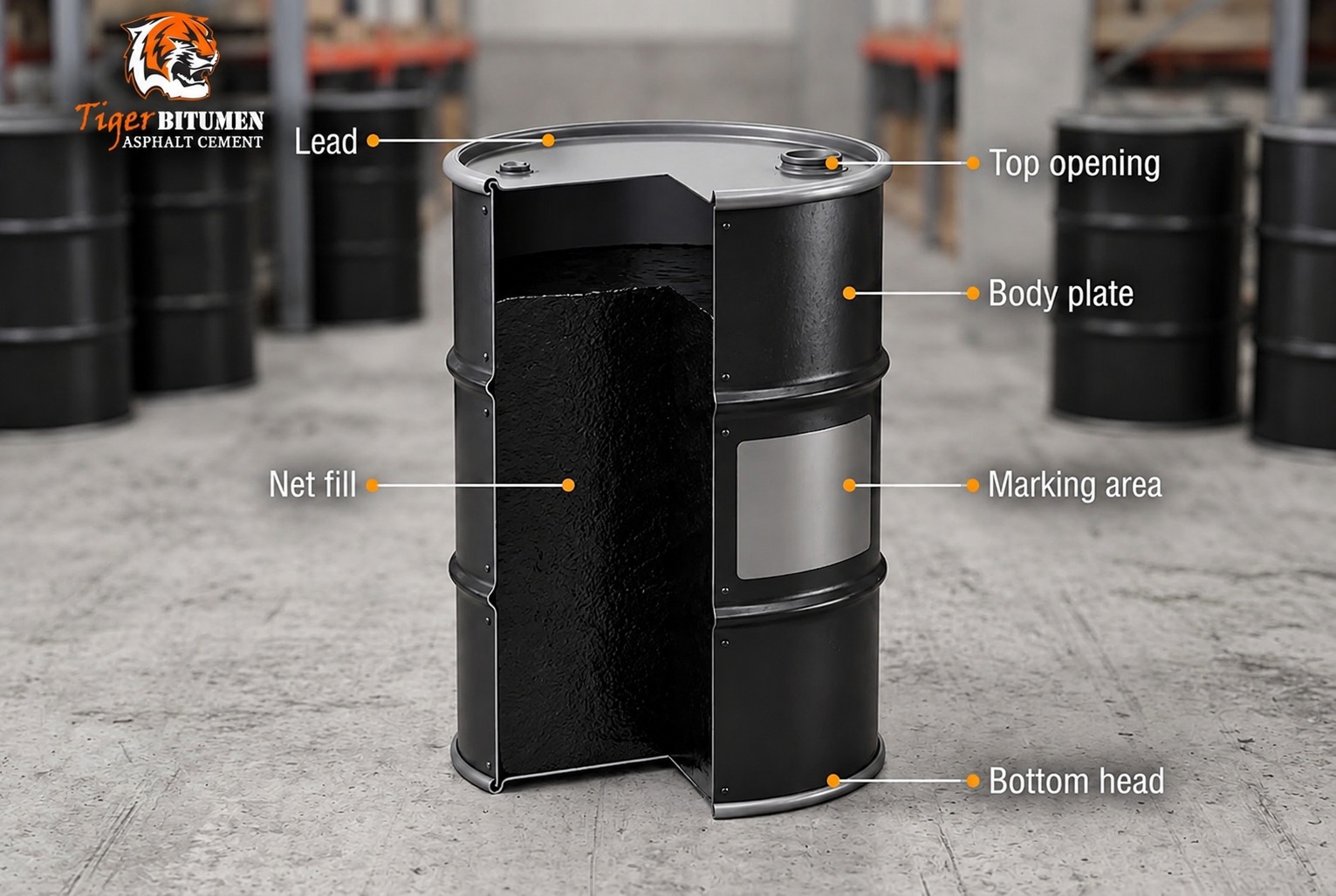
- The contents by weight: How much bitumen each drum holds and how much that weight may vary.
- The container: The steel, its thickness, the drum’s dimensions, and its empty weight.
- Identification: What the supplier prints or marks on the drum.
However, a drum specification does not describe the bitumen itself. The grade, its test results, and its compliance with your project specification come from separate documents. Therefore, a complete purchase needs both the drum specification and the product specification.
Why Bitumen Drum Specifications Differ from General-Purpose Steel Drums
Bitumen is solid at ambient temperature and must be heated to become a liquid for handling, as Eurobitume’s safe-handling guidance explains.
This property shapes how buyers use bitumen drums:
- The bitumen solidifies inside the drum. Therefore, buyers cannot simply pour or pump it out at the destination in the same way as an ordinary liquid product.
- Getting it out requires heating or breaking it out. Drummed bitumen is usually either broken out of the drum or heated until it flows.
For this reason, buyers should consider the drum’s construction and opening alongside its net weight. The receiving facility’s equipment and unloading method also matter.
Bitumen Drum Sizes: Sold by Weight, Not Volume
International steel drum standards ISO 15750-1 and ISO 15750-2 describe steel drums by total capacity in litres. Part 1 covers removable-head drums with capacities of 208, 210 and 216.5 litres. Part 2 covers non-removable-head drums with capacities of 212, 216.5 and 230 litres.
However, bitumen suppliers often quote drums by the net weight of bitumen inside rather than by total drum capacity, as Tiger Bitumen does. For buyers, weight is often the more practical unit because bitumen is commonly quoted and invoiced per metric ton, while container and road limits are also based on weight.
How Weight Relates to Litres
Density links the two measurements. Tiger Bitumen’s published specifications for its 50/70 and 60/70 grades give a specific gravity of 1.01 to 1.06 at 25 °C.
At those values, 180 kg of bitumen occupies roughly 170 to 178 litres at 25 °C. Consequently, buyers should remember two practical points:
- A drum named in kilograms is not interchangeable with a drum named in litres. Always ask which unit a quotation uses.
- A “200-litre drum” on a quotation does not tell you how many kilograms of bitumen you will receive. Ask the supplier to confirm the net weight.
Tiger Bitumen’s Published Drum Sizes
Tiger Bitumen publishes three new steel drum sizes: 150 kg, 180 kg and 200 kg. You can review the general bitumen drum packing and specifications page, along with the individual specifications for the 150 kg, 180 kg and 200 kg new steel drums.
The published specifications differ by drum size. For example, the 150 kg drum has an empty weight of 8.3 ± 0.2 kg, while the 180 kg drum has an empty weight of 9.3 ± 0.2 kg. The published 200 kg drum has a different construction, with a 55 cm diameter, 0.8 mm plate thickness, and an empty weight of 16.0 ± 0.2 kg.
Container quantities are also specific to drum size. Tiger Bitumen’s published prices state 110 drums of 180 kg net in each 20 ft container. That figure applies to 180 kg drums only. A different drum size changes both the footprint and the filled weight. Therefore, its container quantity must be confirmed separately and never scaled from the 180 kg figure.
What to Weigh Up When Choosing a Size
The right size depends on the receiving end as much as the shipping end. Consider these points before choosing:
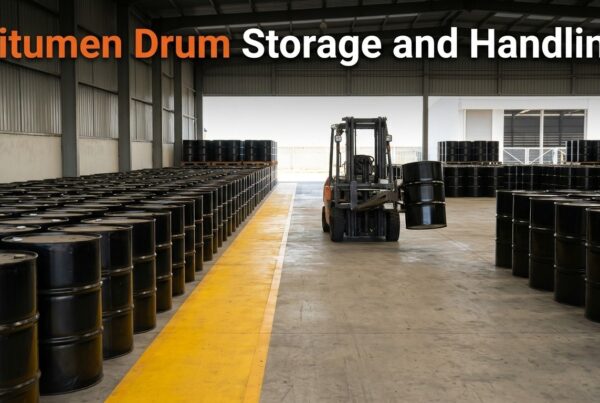
- Filled drum weight. The weight your team or equipment must lift includes the net bitumen plus the empty drum. Check it against forklift attachments, drum handlers and any manual-handling rules on site.
- Decanting equipment. Confirm that your existing equipment, or the equipment you plan to buy, accepts the selected drum size.
- Tender requirements. Some tenders and importers specify the packaging format. Check those requirements before requesting quotations.
Types of Bitumen Drums
Tight-Head and Open-Head Drums
ISO 15750 separates steel drums into two families:
- Removable-head (open-head) drums, where the top is a lid that can be removed. ISO 15750-1 covers these drums.
- Non-removable-head (tight-head) drums, where the top is fixed, and the drum is filled and emptied through an opening. ISO 15750-2 covers these drums.
For bitumen, ask how the drum is closed and how the receiving team should open it at the destination. A fixed top with a small opening behaves differently in a decanter from a lid that comes off. The opening size often appears on specifications as “lid diameter” or a similar description.
New and Reconditioned Drums
A reconditioned drum is a used drum that has been cleaned, repaired, and repainted for further use.
For bitumen buyers, the question is simple: does the contract specify “new steel drums”? If it does not, ask the supplier to clarify. If a supplier offers reconditioned drums, ask what they previously contained and how they were cleaned.
Tiger Bitumen’s published drum packaging specifications describe new steel drums.
Reading Bitumen Drum Specifications Line by Line
Net Fill and Tolerance
A line such as “180 ± 3 kg” means each drum has a nominal bitumen fill of 180 kg, with a permitted variation of up to 3 kg above or below that amount. The tolerance applies to each drum. It is not a promise about the average weight of the shipment.
Tolerances add up across a shipment. For example, across 110 drums with a ±3 kg tolerance each, the total could differ by up to 330 kg in either direction in a worst-case calculation. Therefore, ask the supplier:
- Is the invoice based on nominal net weight or weighed weight?
- How is the net weight on the bill of lading and packing list calculated?
- Is the shipment weighed, and who performs the weighing?
Empty Drum Weight and Gross Weight
The empty drum weight, also called tare, is the weight of the drum without its contents. Gross weight is the net bitumen weight plus the tare weight. Shipping and customs documents use both measurements.
Tare matters for three reasons:
- Freight and limits. Container payload and road weight limits apply to gross weight, not just to the bitumen.
- Handling equipment. Forklift attachments and drum handlers must support the weight of the filled drum.
- Product cost. You pay for bitumen, not steel. A heavier drum does not carry more product automatically.
If a specification gives net weight but no tare, ask the supplier to provide it before confirming the order.
Sheet Grade
Sheet grade identifies the steel used to manufacture the drum. A common entry is ST-12, an older German designation associated with DIN 1623-1 for cold-rolled low-carbon steel used in cold forming. DC01 under EN 10130, material number 1.0330, is its commonly referenced modern designation.
You may therefore see either name on a specification. However, the sheet grade identifies the steel type; it does not by itself establish the complete strength or performance of the drum. Thickness and construction also matter.
Plate Thickness
Plate thickness is given in millimetres, usually separately for the body and for the top and bottom. Check that the supplier states both measurements.
When comparing two offers, compare the same parts of each drum. A figure for the body alone says nothing about the thickness of the heads.
Thicker steel generally means a heavier empty drum. Therefore, weigh that difference against the handling and transport conditions your shipment will face.
Height and Diameter
Dimensions determine how drums fit inside containers, warehouses and decanting equipment. Use them to check compatibility with your equipment and storage arrangements.
However, do not use dimensions alone to calculate how many drums fit in a container. Weight limits, stowage patterns and load securing also affect the answer. Ask the supplier for a confirmed figure for the exact drum size you are ordering.
Opening or Lid Diameter
This measurement describes the size of the opening at the top of the drum. It matters for filling at origin and for opening and emptying the drum at its destination.
If your decanting method depends on a particular opening size, specify that requirement in your enquiry and ask the supplier to confirm compatibility.
Drum Marking
Marking identifies the drum’s contents and destination. Buyers commonly request the following information:
- Product name and grade;
- Net weight per drum;
- A batch, lot or production reference;
- The consignee name or a project or contract reference;
- Any additional marks required by the importer or local authorities.
Agree on the exact wording and language in writing. Tiger Bitumen states on its bitumen drum packing page that it prints the customer’s required marking on its new drums.
What Bitumen Drum Specifications Do Not Tell You
A drum specification describes the package, but it leaves several important questions open:
- Bitumen quality. The grade and its test results come from the product specification and test or inspection reports, not from the drum sheet. See the penetration grades supplied in drums and the published SGS inspection reports for examples of these documents.
- Container quantities for other drum sizes. A count confirmed for one size does not automatically transfer to another.
- A performance rating. ISO 15750 specifies characteristics and dimensions for steel drums. It does not establish every detailed performance requirement a buyer might need. If your goods or route require rated packaging, specify that separately.
- Transport classification. Check the transport information section of the product’s safety data sheet and confirm the requirements with your freight forwarder.
- Loading and securing. The loading plan, rather than the drum specification alone, sets out how drums are stowed and secured inside the container.
Questions to Ask a Supplier Before Confirming Drum Packaging
Use the following checklist before approving drum packaging for an order:
- Which drum size will be used, stated as net kilograms of bitumen?
- What is the fill tolerance, and does it apply to each drum?
- Is the invoice based on nominal or weighed net weight?
- What is the empty drum weight, and what is the gross weight per drum?
- Are the drums new? If not, what did they previously contain?
- What sheet grade and plate thickness are used for the body and the heads?
- How is the drum closed, and how large is the opening?
- What marking will be printed, in which language and where on the drum?
- How many drums of this exact size fit in each container, and is that figure confirmed in writing?
- Which product documents accompany the shipment?
Warning Signs in a Drum Specification
Watch for these warning signs when reviewing a supplier’s quotation or packaging specification:
- A net weight with no stated tolerance.
- A drum size given only in litres for a solid bitumen grade.
- A container quantity quoted without identifying the drum size it applies to.
- “Steel drums” with no mention of whether they are new or reconditioned.
- No empty drum weight, which leaves the gross weight unknown.
- Figures that differ between the quotation, pro forma invoice and supplier’s published specification.
A clear drum specification protects both sides. When the buyer and supplier confirm every relevant detail in writing, they work from the same figures before the first drum is filled.
FAQ
Are bitumen drums sold by weight or by volume?
Often by weight, such as 150 kg, 180 kg or 200 kg net, because bitumen is priced and invoiced per metric ton. Some sources describe bitumen drums in liters. Ask for the net weight if a quote gives only liters.
What does "180 ± 3 kg" mean on a drum specification?
Each drum is filled to 180 kg of bitumen, and any one drum may be up to 3 kg over or under. The tolerance applies per drum, so confirm how the total invoiced weight is calculated.
What is the difference between tight head and open head drums?
An open head drum has a removable lid. A tight head drum has a fixed top and is filled and emptied through an opening in it. ISO 15750 covers both types.
What does ST-12 mean on a drum specification?
ST-12 is an older German designation (DIN 1623-1) for cold-rolled low-carbon steel. Its current European equivalent is DC01 under EN 10130. It describes the steel type, not the drum’s strength.
Does a drum specification confirm the bitumen grade?
No. The drum specification covers the packaging only. The grade and its test results come from the product specification and test or inspection reports.