Choosing the wrong bitumen grade doesn’t just create a paperwork mismatch it can mean pavement that ruts and deforms in summer heat or turns brittle and cracks in winter cold. Understanding bitumen grades and standards in Turkey matters before placing any order, because grade selection, applicable technical standards, and project specification all interact to determine whether the material you receive actually performs as intended once it’s laid or applied.
International buyers sourcing bitumen for projects in Turkey, or evaluating suppliers connected to the Turkish market, typically need to work with penetration grade classifications and the European derived technical standards that Turkey’s road and infrastructure sector references. Tiger Bitumen, part of HY International Group, supports procurement teams navigating this as an international supply partner offering technical guidance alongside its penetration, viscosity, oxidized, cutback, and emulsion bitumen product range. This guide walks through the grades and standards buyers are likely to encounter, and how to evaluate them against a specific project’s requirements.
Understanding Bitumen Grades in Turkey
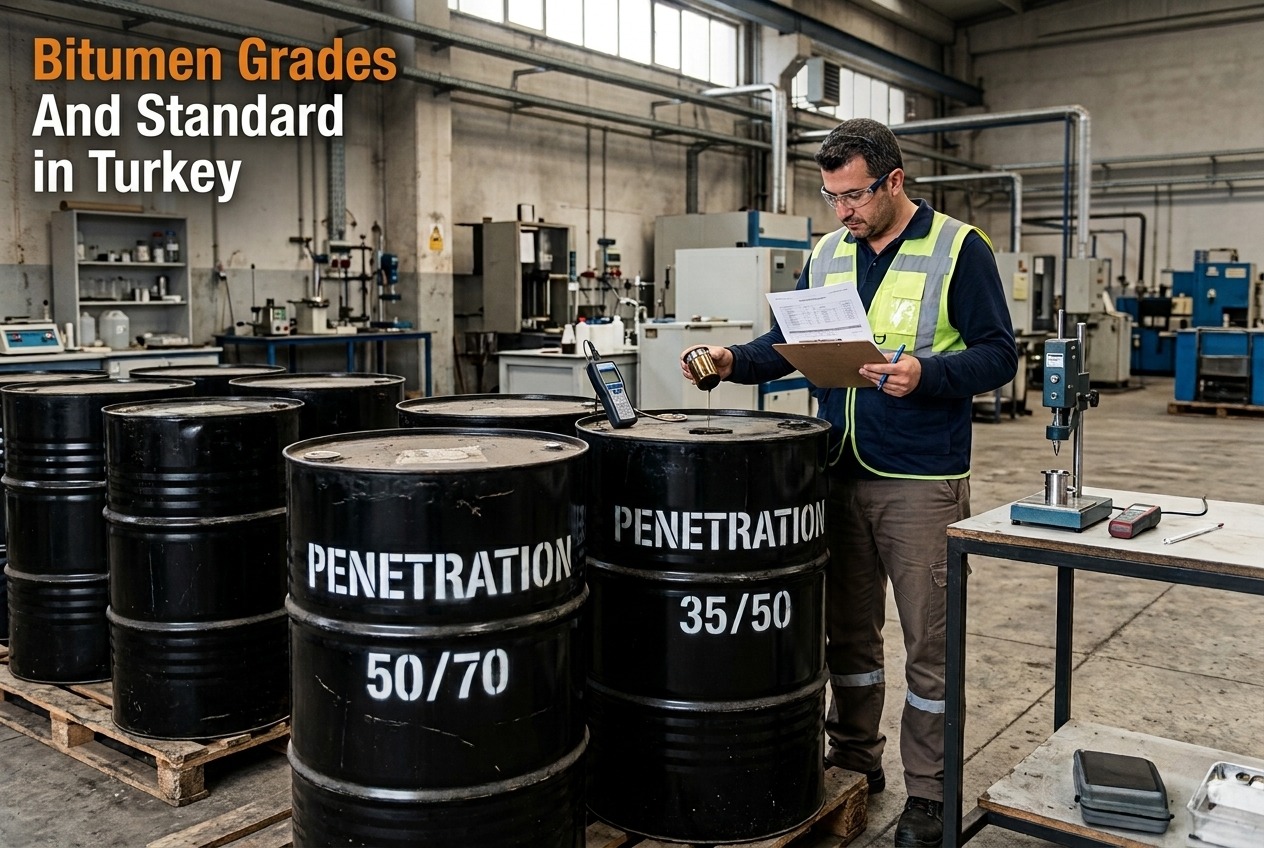
A bitumen “grade” is a classification that describes the material’s consistency specifically, how hard or soft it is at a given temperature. The most widely used classification method internationally, including across Turkey and Europe, is the penetration grade system, which measures how far a standard needle penetrates a bitumen sample under controlled temperature and load conditions. A lower penetration number indicates a harder, stiffer bitumen; a higher number indicates a softer, more flexible material.
This matters practically because pavement performance depends on matching bitumen stiffness to the conditions it will face: traffic loading, ambient temperature range, and pavement design all shift what “correct” looks like from one project to the next. There’s no single grade that performs best everywhere grade selection is a project specific engineering decision, not a default choice.
Bitumen Standards Relevant to the Turkish Market
Technical standards give buyers and engineers a shared reference point for what a given bitumen grade actually means in measurable terms penetration range, softening point, and other test parameters that a supplier’s product must meet to be sold under that grade designation.
EN 12591 is the European standard covering paving grade (penetration grade) bitumen’s, defining the requirements for common grades used across road construction in Europe. Turkey, through its national standards body, generally adopts European Norms under a TS EN designation indicating a Turkish national standard that mirrors the corresponding EN standard. This harmonization is common practice for a country with close regulatory and trade ties to European technical frameworks, though buyers should not assume every detail of a Turkish specification is identical to its European counterpart without confirming the specific standard cited in their project’s contract documents.
It’s worth being precise here: not every project connected to Turkey references the same standard, and public infrastructure contracts, private developers, and different regional authorities may specify their own requirements. Buyers should always confirm the exact standard and grade required by their specific project or contracting authority rather than assuming a default.
Common Penetration Bitumen Grades
Several penetration grades appear regularly in international bitumen procurement connected to Turkey and similar markets:
Bitumen 35/50
A harder penetration grade, generally considered where higher stiffness is beneficial for instance, in warmer climates or under heavier traffic loading, where a softer bitumen might be more prone to deformation. It’s used in road construction and asphalt mixture production where the project specification calls for this harder classification.
Bitumen 50/70
One of the more commonly referenced penetration grades in international road and asphalt procurement generally, including projects connected to Turkey and Europe. It sits in a middle range of stiffness suited to a broad range of standard road construction, highway paving, and general infrastructure applications.
Bitumen 80/100
A softer penetration grade, sometimes considered where climate, pavement design, or engineering specification call for greater flexibility for example, in cooler climates or specific pavement designs where increased low temperature flexibility is prioritized.
None of these three grades is universally “better” each represents a different point on the hardness softness spectrum, and the right one depends entirely on the project’s climate, traffic, and engineering specification. Buyers shouldn’t select based on price or availability alone without first confirming which grade the project actually calls for.
How Bitumen Grades Are Selected for Turkish Projects
Grade selection for a specific project should account for:
- Climate conditions at the project location
- Pavement temperature range expected across seasons
- Traffic loading volume and vehicle weight
- Road type highway, urban road, rural road, or specialized pavement
- Asphalt mix design, which interacts with binder grade selection
- Engineering specifications set by the project’s design documentation
- Applicable standards referenced in the contract
- Construction method planned for the project
- Project location, including regional climate variation within Turkey or neighboring markets
- Required performance characteristics for the pavement’s intended service life
The core principle: select the grade based on the project’s documented technical specification, not on which grade happens to be quoted at the lowest price. A lower cost grade that doesn’t match the project’s engineering requirements can cost significantly more in premature maintenance or pavement failure.
Penetration Grade Vs Other Bitumen Classification Systems
Penetration grading isn’t the only classification system used internationally. Buyers researching specifications may also encounter:
- Viscosity Grade (VG) classifies bitumen by absolute viscosity rather than penetration depth, used in certain regional and project specific specifications.
- Performance Grade (PG) a system that classifies bitumen according to expected performance across a specified temperature range, more commonly associated with North American specification practice.
These systems are not directly interchangeable labels a VG grade and a penetration grade aren’t simply two names for the same product, and there’s no universally reliable equivalency table that substitutes for the project’s actual specified standard. If a project specification calls for a particular classification system, buyers should source product tested and certified against that specific system, not assume a rough equivalent from a different system will satisfy the requirement.
Other Bitumen Products Used in Infrastructure and Industry
Penetration grade bitumen covers road paving, but several other bitumen products serve different applications entirely:
- Oxidized Bitumen used for waterproofing, roofing, and selected industrial applications, produced through a controlled air blowing process that raises softening point.
- Bitumen Emulsion bitumen dispersed in water, relevant to road maintenance, surface treatments, and selected cold application work.
- Cutback Bitumen blended with a solvent to reduce viscosity, used in selected road construction, prime coat applications, and pavement maintenance.
- Polymer Modified Bitumen (PMB) bitumen modified with polymers for high performance pavement and heavy traffic infrastructure, or specialized engineering applications requiring enhanced flexibility or durability.
- VG Bitumen used in asphalt production and road infrastructure where viscosity based grading is the specified classification.
Each of these products has its own specification and testing framework they aren’t substitutes for one another, and product selection should follow the project’s documented requirement rather than general familiarity with one product type.
Technical Specifications Buyers Should Check
Before finalizing a purchase, buyers should confirm the relevant technical parameters for their specific grade and standard, which may include:
- Grade the specific penetration or classification designation
- Penetration characteristics as tested under the applicable standard
- Softening point, where specified for the product or application
- Viscosity, where applicable to the classification system used
- Flash point, where relevant to handling and safety requirements
- Solubility, where specified as a purity/quality indicator
- Ductility, where specified for the application
- Testing standard used to verify the above parameters
- Certificate of Analysis (COA) for the specific batch or shipment
- Batch information, supporting traceability
- Product consistency across the order
- Packaging specifications appropriate to the product
The exact parameters that matter depend on the applicable product standard and the buyer’s own project specification a supplier’s technical data sheet should be reviewed against the actual contract requirements rather than assumed to automatically match.
Quality Control and Inspection
Because bitumen performance depends on meeting specific technical parameters, quality verification is a meaningful part of international procurement, not a formality. Relevant elements include:
- Supplier quality control processes during production and packaging
- Batch consistency, particularly important for larger or recurring orders
- Certificate of Analysis (COA), provided for the specific shipment
- Pre shipment inspection, confirming the product matches specification before departure
- SGS quality inspection, where applicable to the order this isn’t mandatory for every shipment, but buyers can request it for additional independent verification
- Quantity inspection, where applicable, confirming shipped volume matches the order
- Packaging inspection, verifying condition and labeling accuracy
- Documentation review, ensuring paperwork matches the physical shipment and confirmed specification
Third party inspection adds a layer of independent verification that buyers may find useful, particularly for larger orders or first time supplier relationships, though it’s an optional addition rather than a universal requirement.
How to Compare Bitumen Suppliers for Turkey?
When evaluating suppliers for Turkey connected bitumen sourcing, buyers should weigh:
- Product specifications and whether they genuinely match the project’s documented requirements
- Applicable standards the supplier tests and certifies against
- Quality documentation the completeness and clarity of COAs and technical data sheets
- Inspection options available, including third party inspection
- Packaging suited to the buyer’s handling and storage capability
- Export experience and track record with international shipments
- Logistics capability and reliability
- Incoterms offered, and what’s included at each level
- Technical support availability for grade selection and specification questions
- Supply consistency across repeat or recurring orders
- Commercial terms, evaluated alongside not instead of the factors above
The lowest quoted price shouldn’t be the only, or even the primary, procurement criterion a cheaper product that doesn’t match the required grade or lacks adequate documentation can create far greater costs later in a project.
Packaging Options for International Bitumen Supply
Bitumen shipments connected to Turkey and similar markets typically use one of the following formats:
- 185 kg new steel drums a widely used format offering controlled handling and straightforward storage
- Jumbo bags suited to certain bulk handling setups, where appropriate for the specific product
- Bitutainers flexible bulk packaging for particular logistics arrangements
- Bulk vessel supply for larger orders where destination infrastructure supports bulk unloading
Not every product can be supplied in every format a solvent containing cutback product, for example, has different handling requirements than a straight penetration grade. Packaging selection depends on product type, order quantity, destination, handling capability, shipping method, and the buyer’s own requirements, and should be confirmed directly with the supplier.
Documentation for Bitumen Procurement
International bitumen procurement generally involves some combination of:
- Commercial Invoice
- Packing List
- Certificate of Origin, where applicable
- Certificate of Analysis (COA)
- SGS Inspection documents, where applicable
- Shipping documentation
- Export documentation supporting customs clearance
Exact documentation requirements depend on the specific transaction, destination, agreed Incoterm, and applicable regulations buyers should confirm precisely which documents apply to their order rather than assuming a fixed universal list.
Why Correct Grade Selection Matters
Selecting an unsuitable grade has practical, measurable consequences for a project:
- Pavement performance can suffer if the bitumen’s stiffness doesn’t match traffic and temperature conditions
- Workability during construction is affected by whether the grade suits the intended construction method
- Temperature response a grade too soft for the climate can deform under heat; one too hard can crack in cold conditions
- Durability over the pavement’s service life depends on appropriate grade to condition matching
- Maintenance requirements tend to increase when the original grade selection was a poor fit
- Project lifecycle performance the cumulative effect of the above over years of service
The underlying logic is straightforward: correct specification leads to an appropriate product choice, which leads to better long term project suitability. Skipping the specification step to save time on procurement rarely saves money over the life of the project.
Why Choose Tiger Bitumen for International Bitumen Supply
Tiger Bitumen, operated by HY International Group, supports buyers sourcing bitumen for projects connected to Turkey and other international markets with a product portfolio spanning penetration bitumen, VG bitumen, oxidized bitumen, cutback bitumen, bitumen emulsion, and PMB. The company’s approach includes:
- Quality control and SGS inspection where applicable to the shipment
- Export documentation prepared to support customs clearance
- Flexible packaging, including new steel drums where suited to the order
- International logistics coordination from an export oriented facility with access to Karachi Port and Port Qasim
- Technical guidance to help buyers match grade and product selection to their project’s documented requirements
- FOB, CFR, and CIF supply options, where applicable
- Customer support through enquiry, quotation, and shipment stages
Tiger Bitumen is not a Turkish manufacturer and does not operate refineries or production facilities in Turkey. It supplies its product range as an international export partner, offering buyers a point of technical comparison when sourcing for Turkey connected projects.
How to Choose the Right Bitumen Grade?
A structured selection process:
- Identify the project application road paving, waterproofing, industrial use, or another category
- Review the project specification for any stated grade or standard requirement
- Confirm the applicable standard EN 12591, TS EN, or another referenced framework
- Determine the required grade based on that specification
- Consider climate and traffic conditions specific to the project location
- Confirm technical parameters against the supplier’s data sheet
- Request the supplier’s COA for the specific batch or shipment
- Arrange inspection if required, including SGS inspection where the order warrants it
- Confirm packaging suited to your handling and storage capability
- Finalize commercial and shipping terms, including Incoterm and documentation requirements
Partner with a Reliable Bitumen Supplier
Sourcing the right bitumen grade for a Turkey connected project depends on more than finding a competitive quote it requires confirming the applicable standard, matching grade to the project’s actual technical requirements, verifying quality through proper documentation and inspection, and working with a supplier whose packaging and logistics support your specific order. Tiger Bitumen offers international buyers a professional, technically informed supply partnership built around these fundamentals, whether comparing Turkish sourcing channels or evaluating international alternatives.
Contact Tiger Bitumen
To move forward, provide Tiger Bitumen with:
- Required product
- Grade
- Quantity
- Application
- Destination
- Packaging preference
- Required delivery schedule
Tiger Bitumen’s team can then confirm technical fit and prepare a formal quotation. Contact Tiger Bitumen to request a quotation and technical information for your project.