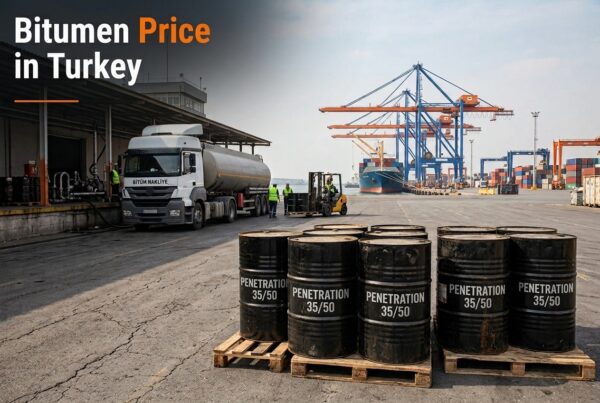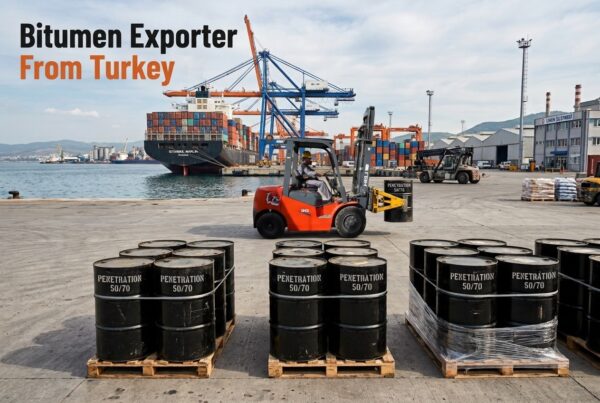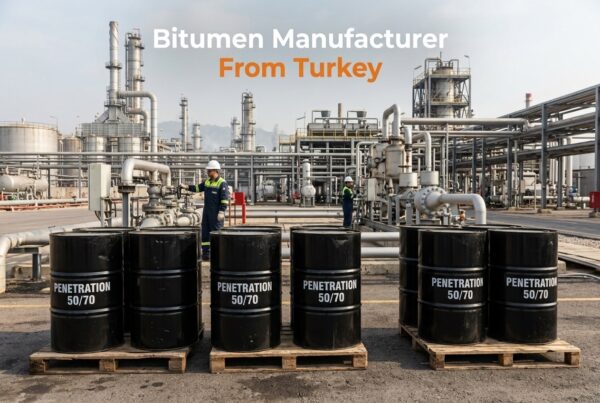

Few bitumen-producing countries occupy a position like Turkey’s. It straddles the land bridge between Europe and Asia, with coastlines on the Mediterranean, Aegean, Black Sea, and Marmara, putting Turkish bitumen within relatively easy reach of Southern Europe, North Africa, the Eastern Mediterranean, and the Middle East. Combine that geography with an active domestic refining base and a mature petroleum products export trade, and it’s clear why international buyers building a sourcing strategy routinely put Turkey on the list.
This guide explains how the Turkish bitumen market is structured, which grades and packaging formats buyers typically encounter, what the export process looks like in practice, and how to evaluate a Turkish supplier alongside other international options the kind of working knowledge a procurement team needs before issuing an RFQ.
Understanding the Bitumen Market in Turkey
Turkey’s bitumen supply doesn’t run through a single centralized pipeline. It’s a layered market made up of refiners, independent blenders, trading companies, and export/packaging specialists, each playing a different role.
At the base of the market are Turkey’s domestic refineries, which process crude oil into a slate of products that includes bitumen alongside fuels and other refined outputs. Turkey’s own highway, airport, and urban infrastructure programs create steady domestic demand for penetration grade and modified bitumen, and that demand is a key reason the country maintains meaningful refining and blending capacity in the first place production isn’t built for export alone.
Sitting alongside the refiners are blenders and traders who take refinery grade bitumen and prepare it for specific export markets: adjusting packaging, arranging inspection, and managing the documentation an international shipment requires. Some of these companies operate their own drum filling and loading facilities; others work through third party terminals. This matters directly to a buyer’s due diligence, because Turkish bitumen supplier can describe a refinery, a blender with no refining assets of its own, or a trading intermediary reselling product sourced from one of the refiners and each comes with a different risk and pricing profile. Knowing which type of company you’re dealing with is one of the first things to establish in any supplier conversation.
Export volumes and rankings for Turkish petroleum bitumen shift from year to year with refinery output, domestic demand, and global freight conditions, and different trade data providers report inconsistent figures for the same period. Rather than quote a specific number that may already be stale, the more reliable approach is to verify current volumes directly with a supplier or through official trade statistics at the time of inquiry.
Why Turkey Matters to International Bitumen Buyers
A few concrete factors explain why Turkey earns a place in most international bitumen sourcing comparisons:
Geographic Accessibility
Mediterranean and Aegean ports offer short sea legs to Southern and Eastern Europe, North Africa, and parts of the Middle East, while Black Sea ports open routes toward Eastern Europe, the Caucasus, and Central Asia.
Mature export infrastructure
Because Turkey already trades a wide range of refined petroleum products internationally, the surrounding logistics ecosystem tank storage, drum filling lines, port handling, freight forwarding, and export documentation tends to be more developed than in markets where bitumen export is a newer activity.
Multiple loading points
Buyers aren’t limited to one gateway port; loading location can be matched to destination to optimize freight and transit time.
A Market With Real Supplier Variety
Refiners, blenders, and trading companies give buyers room to compare specifications, packaging, and commercial terms rather than negotiating with a single dominant source.
None of this makes Turkey automatically the cheapest, fastest, or best quality origin for every shipment freight cost, grade availability, and seasonal demand can make another origin more competitive on a given route. Turkey is best treated as a strong candidate to weigh within a wider sourcing comparison.
Common Bitumen Grades Relevant to International Trade
Buyers sourcing from Turkey most often encounter penetration grade bitumen, sometimes alongside oxidized or polymer modified product depending on the supplier.
Penetration Grade Bitumen
Penetration grade describes straight run bitumen classified by how deeply a standard needle penetrates the material under controlled test conditions a lower number means a harder bitumen, a higher number a softer one. This classification underpins most road construction bitumen traded internationally and is referenced, with some variation, in the major standards used by importing countries, such as EN 12591 in Europe or ASTM D946 in the United States.
Bitumen 35/50
A harder penetration grade generally suited to higher temperature climates and heavy traffic roads, where resistance to deformation under sustained load is the priority. Whether it’s the right grade for a given project depends on climate, traffic loading, and asphalt mix design always confirm against the applicable standard and the project’s paving specification rather than the grade name alone.
Bitumen 50/70
A widely specified mid-range penetration grade used in general road paving across a broad range of climates, and one of the more frequently requested grades in international trade. As with 35/50, suitability comes down to the specific project’s climate and loading conditions, not the grade number in isolation.
Other Penetration Grades
Softer grades for cooler climates, oxidized (blown) bitumen for industrial and waterproofing applications, and polymer modified bitumen for high performance paving round out what most Turkish suppliers offer. In every case, the supplier’s specification sheet checked against the standard your project or destination requires is the working reference document, not a generic grade label.
Applications of Bitumen in Turkey and International Markets
Bitumen’s largest use, in Turkey and globally, is as the binder in asphalt for road construction and maintenance highways, municipal streets, and airport runways and taxiways, where consistent performance under heavy, repeated loading is essential. Beyond paving, bitumen and bitumen derived products go into waterproofing membranes for roofs, foundations, and below grade structures, industrial coatings and linings, and pavement maintenance work such as crack sealing, surface dressing, and resurfacing.
Each application has different performance requirements. A contractor paving a hot climate highway needs different properties than a roofing membrane manufacturer, which is why grade and modification should be matched to the actual end use rather than defaulting to whatever product is most readily available.
Bitumen Export from Turkey: What International Buyers Should Know
Exporting bitumen from Turkey follows a sequence that’s fairly consistent across suppliers, even though the specific documents and timelines vary:
- Specification and quantity. The buyer defines the grade, applicable standard, and required volume; the supplier confirms availability and lead time.
- Packaging. Product is prepared as drummed or bulk shipment based on order size and the buyer’s receiving infrastructure.
- Inspection and documentation. The supplier issues a Certificate of Analysis for the batch; buyers wanting an independent check can arrange third party inspection at loading.
- Loading. Drums are loaded into containers, or bulk product is loaded into heated tankers or ISO tank containers, at the agreed port.
- Incoterm and shipping. Commercial terms commonly FOB or CFR determine who books and pays for ocean freight; the shipping line issues a bill of lading.
- Destination clearance. Customs classification, certification, and standards compliance are handled on the buyer’s side and differ by country, so they’re best confirmed with a local customs broker rather than assumed from general guidance.
This sequence specification, packaging, inspection, loading, Incoterm, shipping, documentation, clearance is the practical backbone of most Turkish bitumen export transactions, though the specific process a given supplier follows should be confirmed directly rather than treated as legally identical across every company and destination.
Bitumen Export Packaging from Turkey
Packaging choice affects handling cost, product protection, and how easily a shipment fits the buyer’s existing storage and dispensing setup.
Steel drums, including commonly used export sizes such as 185 kg drums, are a practical format for smaller or mid-sized export quantities…, particularly to markets where bulk heated storage or tanker receiving infrastructure at the destination is limited. The practical advantages are straightforward: drums move with standard forklifts and load into general purpose containers without specialized bulk liquid receiving equipment; they can be stored at ambient conditions for extended periods without the ongoing heating and circulation bulk tanks require; sealed steel construction protects the product from contamination and moisture over multi leg shipping routes; and drums let buyers receive volumes too small to justify a dedicated bulk tanker shipment.
185 kg drums are common, not mandatory; they’re one packaging option among several, not the only one or a legal requirement. Bulk shipment in heated tankers or ISO tank containers remains the more efficient choice for larger, repeat volume buyers with the receiving infrastructure to handle it. The right format comes down to order size, destination port capability, and the buyer’s own storage setup.
FOB and CFR in Turkey Bitumen Procurement
Two Incoterms dominate Turkish bitumen export contracts.
FOB (Free on Board) transfers cost and risk to the buyer once goods are loaded onto the vessel at the named Turkish port. From that point, the buyer books and pays for ocean freight and, if desired, insurance. FOB suits buyers with an established freight forwarding relationship who want direct control over carrier, routing, and shipping cost.
CFR (Cost and Freight) shifts freight cost to the seller, who books and pays for carriage to the named destination port but risk still transfers to the buyer at the same point, once goods are loaded on the vessel at origin. Insurance remains the buyer’s responsibility under CFR, just as under FOB; the term only covers who pays for freight, not risk or insurance. CFR can simplify logistics for buyers without an existing freight arrangement, at the cost of less direct control over carrier selection and schedule.
Neither term is inherently better the right choice depends on the buyer’s own logistics capability and how much control they want over the shipping leg. This is a commercial decision, and buyers with specific contractual questions should consult their own trade counsel.
How to Evaluate Bitumen Suppliers in Turkey?
A structured comparison keeps procurement decisions from defaulting to price alone. Each of these factors carries real weight:
- Grade and applicable standard confirms the product is fit for the destination’s specification, not just correctly labeled.
- Technical specification and Certificate of Analysis the documented basis for accepting or rejecting a shipment.
- Batch consistency a supplier’s ability to deliver the same quality shipment after shipment, not just a strong first sample.
- Third party inspection availability an independent check on quantity and quality when the buyer can’t inspect in person.
- Packaging quality drum condition and sealing, or tanker/ISO tank suitability for bulk product.
- Loading port determines freight routing, transit time, and cost to your destination.
- Export experience a track record shipping to your region signals familiarity with the documentation your customs process will require.
- Lead time realistic production and loading timelines, including seasonal demand effects.
- demand effects.
- Documentation CoA, bill of lading, packing list, and any destination specific certificates, prepared correctly and on schedule.
- Incoterms offered FOB, CFR, or others, and how much flexibility the supplier allows.
- Payment terms standard and reasonable for the trade, without red flags on either side.
- Destination compatibility whether the supplier has actually shipped compliant product to your country before.
- Total landed cost the number that actually determines value, once freight, packaging, inspection, and destination costs are added to the quoted price.
Working through this list, rather than comparing quotes side by side, is what separates suppliers who can deliver a consistent, well documented shipment from those who simply quote the lowest number.
Turkey Bitumen Vs Other International Supply Markets
Turkey is one of several origins buyers typically weigh against Middle Eastern, Asian, African, and European suppliers. Rather than ranking origins in the abstract, the more useful comparison runs through the same factors that determine any procurement outcome: product quality and consistency, grade availability, FOB or CFR pricing, freight and transit time to your specific destination, packaging, inspection availability, lead time, documentation reliability, and total landed cost.
The lowest quoted FOB price rarely produces the lowest total landed cost on its own longer transit, higher freight, or weaker documentation can outweigh a cheaper unit price once a shipment actually clears customs. A like for like comparison across a short list of suppliers, run through the same checklist, tells you more than any single origin’s reputation.
Export Opportunities for Turkey Bitumen
Turkey’s port access supports trade relevance across several regions:
- Europe, particularly Southern and Southeastern Europe, via relatively short Mediterranean and Black Sea shipping legs.
- North Africa, a strong fit for Mediterranean facing markets with active road construction demand.
- West Africa, reachable via longer Atlantic facing routes, serving a region with substantial ongoing infrastructure investment.
- Middle East, accessible via Mediterranean routes and, on some lanes, overland or short sea options.
- Central Asia and the Caucasus, reachable via Black Sea ports and existing regional trade corridors.
These are logistics and trade relevance connections, not guaranteed volumes or claims of market leadership on any specific route actual freight rates, current supplier capacity, and project timing should be confirmed for the specific shipment in question.
Choosing the Right Bitumen Supply Partner
Whether a project ultimately sources from Turkey or elsewhere, a reliable bitumen supply partner shares the same core traits: verifiable specifications, consistent batch quality backed by proper documentation, packaging suited to the buyer’s actual receiving conditions, transparency about how the product is sourced, and realistic communication on lead times and shipping terms.
Turkish origin is one variable among several in that evaluation. Many procurement teams compare Turkish suppliers alongside other international supply channels as part of the same sourcing process, weighing grade availability, packaging, inspection support, and shipping arrangements across options before committing.
Tiger Bitumen operates as one such international bitumen supply channel, working with buyers to compare specifications, export packaging including drummed and bulk options, inspection arrangements, and shipping terms across sourcing options, Turkish or otherwise, as part of a broader procurement evaluation. For a buyer building out a supplier shortlist, having a channel that can speak to specification and logistics questions across multiple origins simplifies the comparison this guide has walked through.
Frequently Asked Questions About Bitumen in Turkey
Is Turkey a major bitumen export market?
Turkey has an active domestic refining base and participates in both bitumen import and export trade, supported by its position between Europe, the Middle East, and North Africa. Exact export standing shifts year to year, so check current trade data rather than relying on a fixed figure.
What bitumen grades are commonly traded from Turkey?
Penetration grades such as 35/50 and 50/70 are among the most requested, alongside other penetration grades and, depending on the supplier, oxidized or polymer modified bitumen.
What is Bitumen 35/50 used for?
A harder penetration grade generally used for higher temperature climates and heavy traffic roads, subject to confirmation against the project’s paving specification.
What is Bitumen 50/70 used for?
A widely specified mid-range penetration grade used in general road paving across a broad range of climates.
How is bitumen packaged for export from Turkey?
Mainly new steel drums, often in the 185 kg range, for smaller or split shipments, and bulk shipment in heated tankers or ISO tank containers for larger, repeat volume orders.
What should buyers check before purchasing bitumen from Turkey?
Grade and standard match, a Certificate of Analysis, packaging quality, export experience, Incoterms, lead time, complete documentation, and destination requirements evaluated together rather than on price alone.
What is the difference between FOB and CFR for bitumen?
Under FOB, the buyer books and pays for ocean freight from the Turkish port; under CFR, the seller pays for freight to the destination port, though risk transfers to the buyer at origin loading in both cases.
Can Turkish origin bitumen be shipped to African markets?
Yes, Mediterranean port access supports routes to North Africa directly and to West Africa via longer Atlantic legs, though specific routing, transit time, and cost depend on the port pair involved.
Conclusion
Turkey’s relevance to international bitumen trade comes from the combination of its strategic geography, established petroleum products infrastructure, and diverse supplier base of refiners, blenders, and trading companies. For international buyers, however, choosing the right supplier requires more than looking at the country of origin or the lowest quoted price. Buyers should confirm the grade against the applicable standard, verify quality through proper documentation and independent inspection where required, select packaging that matches their receiving facilities, and understand the cost and risk implications of FOB or CFR terms.
Turkey is a strong market to include in an international bitumen sourcing strategy, particularly for buyers serving Europe, North Africa, the Eastern Mediterranean, and nearby regions. The final purchasing decision should be based on product quality, grade availability, documentation, logistics, lead time, and total landed cost rather than headline price alone.