November 2026 | Tiger Bitumen, a brand of HY International Group
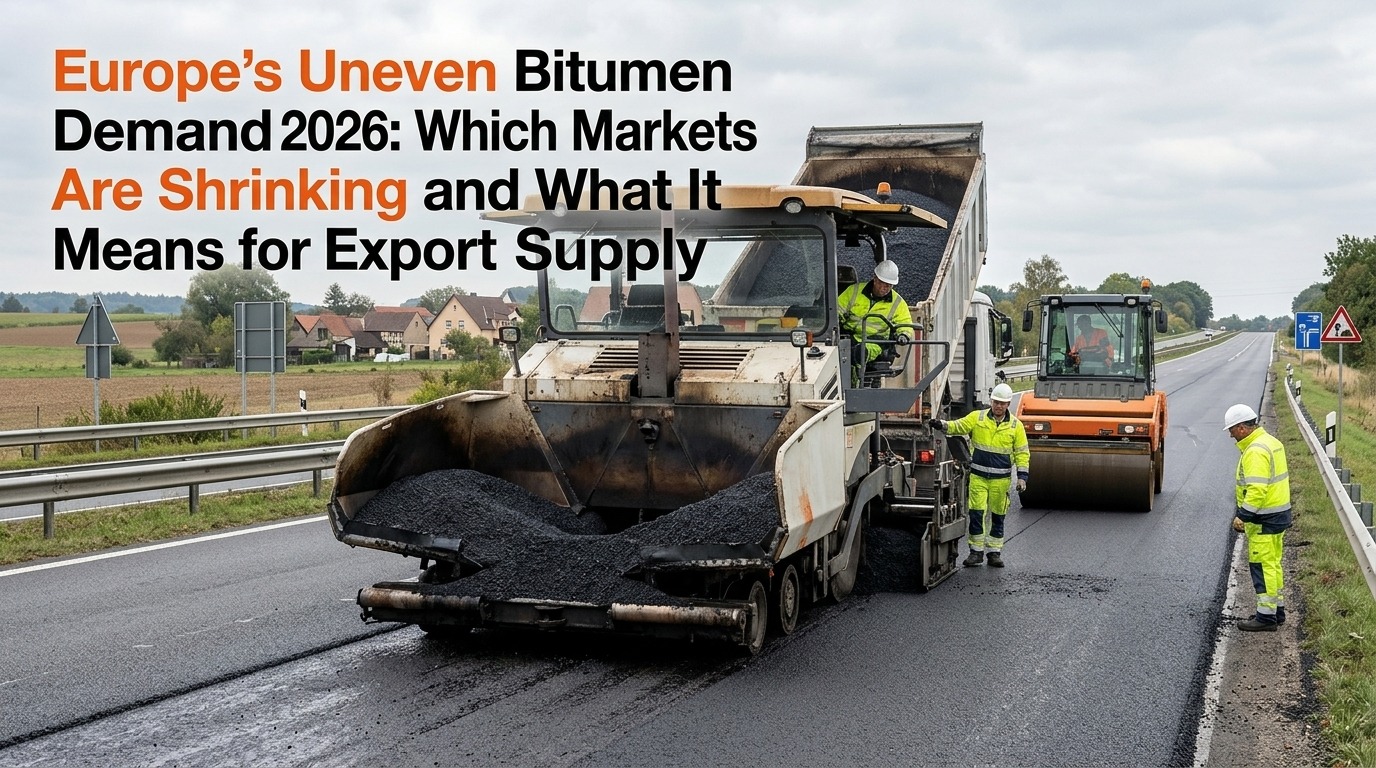
Europe bitumen demand 2026 has varied significantly across the continent. Some of Europe’s largest consumers have used noticeably less bitumen than last year, while several southern markets have experienced one of their busier construction seasons in recent years.
For international buyers, these differences matter more than any regional average. Europe bitumen demand in 2026 affects how much product European refineries can offer for export, when that product becomes available and where it is likely to go. This article examines which markets are weakening, which are holding up, and what these changes mean for buyers sourcing from Europe.
Europe Bitumen Demand 2026: A Divided Picture
Bitumen demand in Europe depends mainly on public road budgets, the pace of contract awards and weather conditions during the paving season. In most parts of the continent, this season runs roughly from spring to late autumn. In 2026, several pressures affected demand at the same time:
- Higher energy and financing costs have weighed on construction activity in several countries. Major building materials producers also expect these costs to restrain demand into next year.
- Higher bitumen and asphalt costs have led some contractors to delay or slow work, particularly where they set budgets before prices increased.
- Different public spending decisions have created sharply different outcomes across countries, despite similar cost pressures.
The result is a divided European market. Weakness in large northern and western markets sits alongside stronger demand in parts of the south.
Where European Bitumen Demand Is Weakening
United Kingdom
UK bitumen consumption has remained below 2025 levels for most of the year, according to official data. Suppliers estimate that full-year demand will also finish clearly lower.
UK end-users increased imports in November, the final month of seasonal demand before the winter slowdown. However, much of this volume moves under term agreements rather than spot purchases.
Germany
German bitumen output during the first eight months of 2026 was well below the same period in 2025, according to official data. Market participants expect demand to remain below last year’s level.
Conditions also vary within the country. Late-season demand remained firm in southern and southwestern Germany, while higher production in the north freed more volume for export.
France
French market participants estimate that bitumen output has fallen this year. They also report that domestic demand in the third quarter remained below 2025 levels.
Temporary refinery work in northern France has reduced local truck supply. This has increased imports from neighbouring countries and Spain.
Romania and Southeast Europe
Romania, the region’s largest bitumen import market, has seen demand held back by restrictions on government infrastructure spending. Contractors are still waiting for emergency road funds.
Adverse weather has also slowed project work in Romania, Serbia and Bulgaria. Demand remains weak, while regional supply is improving. As a result, product availability in the area now exceeds requirements.
For the supply and price situation in this region, see our analysis of Central Europe bitumen prices.
Where European Bitumen Demand Is Holding Up
Italy
Italy stands out among Europe’s large markets. Industry data show that bitumen consumption during the first nine months of 2026 exceeded the same period last year.
Demand in the fourth quarter has also been the strongest of the year. Contractors delayed some purchases while prices were high. They are now buying to complete projects before year-end, helped by favourable autumn weather.
Turkey
Turkish domestic demand has risen strongly this year, supported by increased road and highway construction. Production has also been higher than last year.
Even in Turkey, sharp price increases in October discouraged some buying. This briefly freed spot cargoes for export.
Ireland
Irish suppliers report that demand has remained stable compared with last year. They expect this trend to continue in 2027, as the construction sector has proved resilient to higher bitumen and energy costs.
Spain
Spanish bitumen consumption has remained strong this year, supported by high levels of public road investment. Contractors also accelerated paving in October.
This activity has reduced Spain’s export surplus, a subject covered in our article on Spain’s bitumen export surplus.
Domestic demand weakened in early November, and exporters are already reporting more orders from abroad.
Regional Patterns in Europe Bitumen Demand 2026
Looking across the continent, four broad patterns stand out:
- Northern Europe (Nordics and Baltics): The paving season is short and had largely ended by the close of October. Demand is highly predictable, and buyers secure most of their requirements under term contracts. Many have already agreed their 2027 contracts, leaving little room for spot supply.
- Western Europe (UK, France, Benelux and Germany): The largest consumers are weaker than last year. Many contractors bought ahead of November price revisions, so demand fell early in the month. Asphalt plants will also begin closing for winter towards the end of November.
- Central and Southeast Europe: This is a divided region. Southern Germany, Poland and the Czech Republic face mainly supply constraints, while Romania and neighbouring markets have suffered from weak, funding-limited demand.
- Southern Europe and the Mediterranean (Italy, Spain and Turkey): Demand has been comparatively strong, but the season is now ending as winter approaches. Greek refinery supply has also remained limited this autumn.
The key distinction is between markets with weak demand and markets with tight supply. Both conditions can produce similar headlines, but they have opposite effects on export availability.
How Domestic Demand Shapes European Bitumen Export Supply
Refiners Serve Home Markets First
European refiners that produce bitumen usually serve local truck customers and term buyers first. Export cargoes come from the remaining production.
When domestic demand weakens during the year or through seasonal changes, more output can become available for export. When home-market demand remains strong, export availability shrinks, even if production stays unchanged.
Winter Turns Demand Into Surplus
The end of the northern paving season provides the clearest example. As demand fades across the Nordics, Baltics and northwest Europe, refineries continue producing. Surplus cargoes then look for buyers in other regions.
This autumn, northwest European cargoes have again moved south to Morocco and, less typically, on long-haul voyages to South Africa. Mediterranean surplus is heading to West Africa, where the dry season is under way, and to southern Africa’s summer construction market.
Supply Constraints Can Offset Weak Demand
Weak demand does not always lead to higher exports. In parts of Europe this year, refinery output has been limited by restricted access to bitumen-rich crude and refinery outages.
When both demand and output fall, export availability may barely change. Our article on bituminous crude oil explains why crude supply matters so much to bitumen production.
Term Contracts and Freight Shape Where Surplus Goes
- Term commitments come first. In the UK, Ireland and the Nordics, a large share of imports moves under annual or multi-year agreements. These commitments limit how much surplus reaches the spot market.
- Freight favours short routes. Higher marine fuel costs this year have raised delivered premiums. This gives shorter-haul suppliers an advantage in 2027 term negotiations and makes long-distance trades more sensitive to transport costs.
- Price gaps pull cargoes further. When prices in another region are much higher, as in Asia-Pacific this year, European surplus can justify longer voyages.
What Europe Bitumen Demand 2026 Means for International Buyers and Exporters
- More European product in winter. Buyers in North and West Africa, southern Africa and other active markets are likely to see more European offers in the coming months as northern demand fades.
- The south is a less dependable seasonal supplier. Strong demand in Italy, Spain and Turkey has reduced the export surplus from some traditional Mediterranean origins during their own construction season.
- Weak northern demand may persist into 2027. If high costs and tight budgets continue to restrain construction in large markets such as the UK, Germany and France, refiners there may continue looking abroad for buyers.
- Competition for European supply varies by season. When Europe’s paving season restarts in spring, exportable volumes are likely to tighten again.
Evaluating European-Origin Bitumen Supply
- Time purchases around the European calendar. Availability is usually better from late autumn to early spring, when European domestic demand is at its lowest.
- Distinguish weak demand from tight supply. Ask whether an origin has a surplus because local demand has fallen or because production is constrained. Only weaker domestic demand reliably frees export volumes.
- Compare delivered costs. Longer voyages and higher marine fuel costs can erase an attractive FOB price. Our guide to bitumen freight and delivered cost explains how to compare offers.
- Check specification consistency. Some European buyers have raised concerns about grade consistency as refiners process a wider range of crude oils. Request certificates of analysis and independent inspection.
- Decide between term and spot purchases early. Buyers who need dependable volumes in 2027 should start discussions while European term negotiations are still under way. See our guide to bitumen term contracts vs spot purchases.
Conclusion
Europe bitumen demand 2026 has been uneven. Weaker consumption in the UK, Germany and France, alongside funding-limited demand in Southeast Europe, contrasts with resilient demand in Italy, Turkey and Ireland.
For importers outside Europe, the main effect is seasonal. As northern demand fades, more European product becomes available for export. However, strong southern demand and supply constraints keep some traditional origins tighter than buyers might expect.
Understanding why a market has surplus is just as important as knowing that it does. Buyers should assess domestic demand, refinery output, contract commitments and freight costs before selecting a European supply origin.
At Tiger Bitumen, a brand of HY International Group, we follow these regional shifts to help international buyers plan their sourcing. We supply a range of bitumen products in new steel drums and jumbo bags. Buyers reviewing their supply options can request a quotation or contact our team.
Frequently Asked Questions
Is bitumen demand falling across Europe in 2026?
Not everywhere. Demand has been weaker in large markets such as the UK, Germany and France, and limited by funding in parts of southeast Europe. Italy, Turkey and Ireland have held up better, and Spain has been strong for much of the year.
Why is bitumen demand weaker in some European countries?
Higher energy, financing and bitumen costs have restrained construction, and in some countries public road funding has been delayed or limited. Weather and the timing of purchases ahead of price revisions also affect demand within the season.
Does weaker European demand mean more bitumen for export?
Often, but not always. Refiners supply home and term customers first, so lower domestic demand usually frees more product for export. Where refinery output is also constrained, export availability may change little.
When is European bitumen most available for export?
Usually from late autumn to early spring, when paving in northern and central Europe slows or stops and refineries look for outlets in markets where construction is still active.
What should buyers check before sourcing bitumen from Europe?
Compare delivered costs including freight, confirm the specification and request certificates of analysis, arrange independent inspection, and consider whether term supply is needed for 2027.