
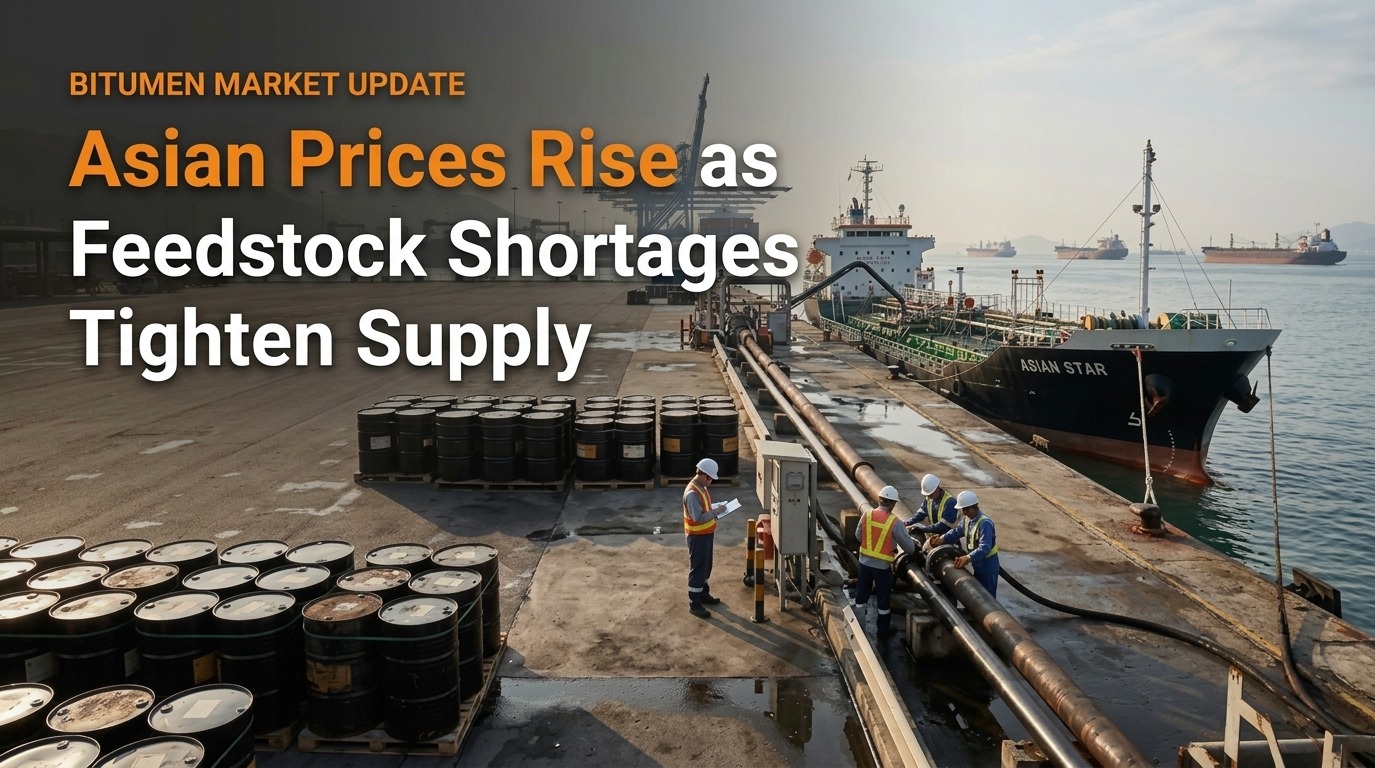
Asian bitumen export prices rose in the week ending 2 October 2026, as tighter supply in Singapore and South Korea pushed values higher. Export cargo prices in Europe and the Mediterranean were largely steady. This bitumen market update examines the main drivers behind these regional price movements.
Market reporting pointed to crude feedstock as a key factor. Refiners in Asia and elsewhere reported limited access to heavier crude grades that yield bitumen. At the same time, crude and fuel oil values remained strong.
Other regions also moved, but for different reasons. Northwest European truck prices rose as refiners passed through earlier fuel oil gains. Mediterranean cargo prices remained broadly steady amid surplus supply, while sub-Saharan African markets firmed on seasonal demand.
The Week at a Glance
The direction of bitumen prices was broadly upward this week, but the drivers differed sharply by region. In Asia, market reporting pointed to tight supply as the main source of support. In Europe, price increases were more closely linked to cost pass-through.
| Region | Price direction | Main driver |
| Singapore | Rose | Limited output, refinery turnaround, restricted crude feedstock |
| South Korea | Rose | Export tenders concluded at higher levels on tight supply |
| India | Rose | Short refinery supply, constrained imports, higher freight |
| Northwest Europe | Rose (truck) | Monthly revisions passing through fuel oil gains |
| Mediterranean | Cargoes steady; trucks firmer | Regional oversupply; refiners recouping margins on trucks |
| Sub-Saharan Africa | Rose | Seasonal demand and higher freight on some routes |
Summary of reported price direction for the week ending 2 October 2026.
Asian Bitumen Market Leads the Gains
Among waterborne export markets, the Asian bitumen market saw some of the largest price increases this week. Both major export benchmarks in the region, Singapore and South Korea, moved higher amid reports of limited availability.
Singapore: Limited Output and a Refinery Turnaround
Singapore bitumen prices rose as supply remained tight. Bitumen traded at a wide premium to high-sulphur fuel oil, alongside reports of limited product availability.
Market participants said Singapore output was unlikely to increase in October. They cited logistical disruption in the Middle East as a factor limiting access to suitable crude feedstock. A key refinery turnaround was also expected to reduce supply during the month.
Fixed-price export offers were scarce, while domestic selling prices were also raised for October. These conditions provided additional support to export values.
Buyer behavior was mixed. Importers and traders with immediate, project-specific requirements were reported to be willing to pay higher levels. Other buyers limited purchases because of budget constraints, while some looked for alternative origins.
For more background on recent price movements in these two markets, see our Singapore and South Korea bitumen prices update.
South Korea: Export Tenders Confirm a Firmer Market
South Korean export prices rose after refiners concluded two export tenders for October-loading cargoes at substantial premiums to fuel oil. Korean prices had been climbing since mid-August and moved above Singapore levels in September.
According to market reporting, tight supply in both domestic and seaborne markets kept bids firm. Buying interest from east China slowed during China’s week-long National Day holiday. Market participants expected buying activity to recover after the break because Chinese domestic supply remained tight.
China: Holiday Pause Amid Tight Domestic Supply
Chinese consumption slowed during the Golden Week holiday. Contractors had rushed to finish roadworks, while some buyers restocked before the holiday.
Import bids for seaborne cargoes into east China firmed because domestic supply remained tight and exports from South Korea were limited. In south China, downstream buyers resisted higher seaborne prices ahead of the holiday.
Market participants were cautiously optimistic that demand in east and south China would recover in the second half of October. Contractors were expected to continue working toward annual project deadlines.
Wider Asia Pacific: Supply Limits Spread Beyond Singapore
The supply constraint was not limited to Singapore. In Thailand, producers faced crude feedstock shortages that limited export supply. In Taiwan, restricted availability of bituminous crude reduced output, while strong domestic demand ahead of local elections further limited export volumes.
Importers across Southeast Asia and Australasia were reported to be looking for alternative supply sources. Export prices from several other Asian origins also firmed during the week.
Crude Feedstock: The Common Thread Behind Tight Bitumen Supply
Market reporting this week linked much of the tightness in Asia to crude feedstock availability. Refiners cannot easily increase bitumen output without access to suitable crude.
In general terms, bitumen is produced from the heavier fractions of the crude barrel. Output therefore depends partly on the crude grades processed by a refinery. When suitable heavier crude grades are unavailable, a refinery cannot simply increase bitumen production to meet demand, even when prices are high.
According to this week’s market reporting, restricted access to suitable crude was cited as a limiting factor in Singapore, Thailand, Taiwan and India. Logistical disruption in the Middle East was also cited as a factor.
Strong crude and fuel oil values supported prices as well. These higher feedstock and energy-related values raised the cost base against which bitumen was priced.
The effect was not confined to Asia. In Europe, some end-users linked a shift away from Middle Eastern bitumen-yielding crudes toward other grades with less consistent bitumen specifications during the year.
Taken together, these reports suggest that recent Asian price strength was driven more by supply constraints than by a broad increase in demand. Demand in several Asian markets was also described as moderate or constrained by buyer budgets.
For a broader view of how regional supply conditions can affect buyers, see our bitumen availability by region analysis.
India and the Middle East: Constraints at Source
Indian bitumen prices rose as state-controlled refiners increased listed prices for bulk and drummed VG30 and VG40 grades.
Supply remained short. According to market reporting, domestic refiners lacked suitable crude to increase output, while importers were unable to bring in enough bitumen from the Middle East.
Several vessels chartered by Indian traders were reported to be stranded in the Gulf. Importers also reported that higher war-risk premiums had increased freight costs on import routes.
Indian consumption was described as low to moderate. However, market participants expected demand to strengthen in the coming months and remain firm until Diwali in November. Contractors were also reported to be negotiating with the government over price escalation permissions.
In the Middle East, bulk export prices from Iran edged higher. Market reporting attributed the increase to higher feedstock costs and limited supply, while post-monsoon buying interest from South Asia remained healthy.
Shipowners and charterers remained cautious about loading from Iranian ports because of sanctions risk. Elsewhere in the Gulf, seaborne exports from Bahrain stayed subdued because vessels could not transit the Strait of Hormuz. Iraqi suppliers also largely stayed out of the market because of feedstock shortages and higher costs.
For additional context on how regional shipping disruptions can affect bitumen sourcing, see our Middle East shipping disruptions and bitumen sourcing analysis.
These constraints at major Middle Eastern supply sources were one factor behind reports that buyers in Asia and Africa were seeking alternative origins.
Europe and the Mediterranean: Cost Pass-Through Rather Than Shortage
Northwest European bitumen truck prices rose sharply, especially in markets where prices are revised monthly. These revisions followed increases in high-sulphur fuel oil prices during September compared with August.
In some markets, notably Germany, weak demand after the summer holidays had kept truck prices lower through September. This left bitumen prices lagging behind crude and fuel oil movements.
According to market reporting, refiners sought to recover part of that lost margin through substantial increases for October supplies. Spot cargo demand across northwest Europe and the Nordic markets remained weak, however, and cargo premiums to fuel oil stayed broadly steady.
In the Mediterranean, truck prices strengthened in several markets as refiners sought to recover lost margins. Cargo prices were broadly steady, while regional oversupply persisted.
Demand from North African and Black Sea markets was held back by political and funding issues as well as high outright prices. Spot cargoes remained readily available from Spanish export points. Strong domestic demand in Turkey, however, limited export availability there.
The contrast with Asia was notable. European increases were more closely linked to cost pass-through, while Asian markets showed tighter product availability.
Sub-Saharan Africa: Seasonal Demand Builds
Truck and cargo prices rose across sub-Saharan Africa, reflecting increasing seasonal demand and higher freight rates on some routes.
In West Africa, import demand increased ahead of the dry season. Market participants expected the season to begin during October, typically bringing a pickup in road paving activity.
In South Africa, paving activity gathered pace with the start of the southern hemisphere summer season, and domestic prices firmed. Market reporting indicated that South African inventories were well stocked from earlier imports, largely from Mediterranean origins, despite concerns about reduced flows from the Middle East.
In East Africa, delivered prices for drummed imports rose because of sharply higher container freight. Bulk import costs also firmed alongside Middle Eastern export values.
Importers were reported to be seeking more supply from outside the Gulf, mainly from the Mediterranean, to meet buoyant demand.
What This Week Means for Bitumen Buyers
The following points are our interpretation of this week’s developments, not forecasts.
- Availability appears to be a key concern alongside price in Asia. With few fixed-price offers from Singapore and limited export supply reported from several other Asian producers, buyers with immediate project needs were reported to be willing to pay higher levels. Buyers with flexibility on timing or origin may have had more room to manoeuvre.
- Asian prices reflected both cost and availability. According to market reporting, Asian bitumen values were supported by higher crude and fuel oil costs as well as indications of tighter product availability. Bitumen traded at wide premiums to fuel oil in Singapore, while South Korean tenders also concluded at firm levels.
- Logistics weighed on delivered costs. Higher war-risk premiums, stranded vessels and rising container freight were reported to affect delivered costs into India and East Africa. These factors suggest that freight and shipping risk were becoming larger considerations in landed costs for some importers.
- Regional conditions are diverging. Europe and the Mediterranean remained comparatively well supplied, with the Mediterranean market described as oversupplied. Asian markets were tighter. This divergence was consistent with reports of importers in Africa and Asia looking more widely for supply.
- Budget limits are capping some demand. In several markets, buyers whose projects faced budget constraints held back from buying at higher prices. Market participants in some markets said further price increases could push some contractors to the sidelines.
For buyers comparing offers, price alone may therefore not provide a complete picture. Availability, origin, freight, delivery terms and the timing of shipment can all affect the final procurement cost.
What Market Participants Are Watching
The following are views attributed to market participants in this week’s reporting, not established outcomes.
- Singapore supply in October and November. Participants said Singapore output was unlikely to rise in October, citing a refinery turnaround expected to reduce supply. Participants also expected another Singapore refinery to have more supply available in November.
- China after Golden Week. Participants were cautiously optimistic that demand in east and south China would recover in the second half of October. They also expected east Chinese buying of Korean cargoes to rebound after the holiday.
- India ahead of Diwali. Participants expected demand to remain strong until Diwali before tapering off in winter. Contractors’ talks with the government on price escalation were ongoing, and participants said approval could lead to increased demand.
- West Africa’s dry season. Market participants expected the dry season to begin during October, with paving activity and import demand potentially increasing with it.
- Middle East shipping risk. Importers reported caution over vessel loading times, cargo arrivals and war-risk costs for supply from the Gulf.
Regional Bitumen Price Differences and Sourcing
Regional bitumen prices can differ significantly because crude feedstock, refinery operations, freight, inventories and seasonal demand vary between markets. Buyers comparing supply options may therefore need to consider more than the headline export price.
For more information on regional pricing differences and sourcing considerations, see our regional bitumen price differences and sourcing analysis.
Bitumen Market Updates
Regional market conditions can change quickly as refinery operations, feedstock availability, freight costs and seasonal demand develop. For ongoing coverage of these factors, follow our Bitumen Market Updates.
Conclusion
This week’s bitumen market update suggests that Asian prices were supported mainly by tight supply. Export prices in Singapore and South Korea rose as market participants reported limited availability of suitable crude feedstock, while strong crude and fuel oil values lifted the cost base.
India and the Middle East reported similar constraints at source, alongside shipping risk and higher freight. These factors added pressure to delivered costs for some importers.
Elsewhere, European truck price increases were more closely linked to cost pass-through. The Mediterranean remained oversupplied, while sub-Saharan African markets firmed on seasonal demand.
For buyers, the key consideration in the weeks ahead may be not only the direction of prices but also whether suitable supply is available when projects need it. Monitoring regional availability, freight conditions and feedstock developments can therefore be important when evaluating bitumen sourcing options.