
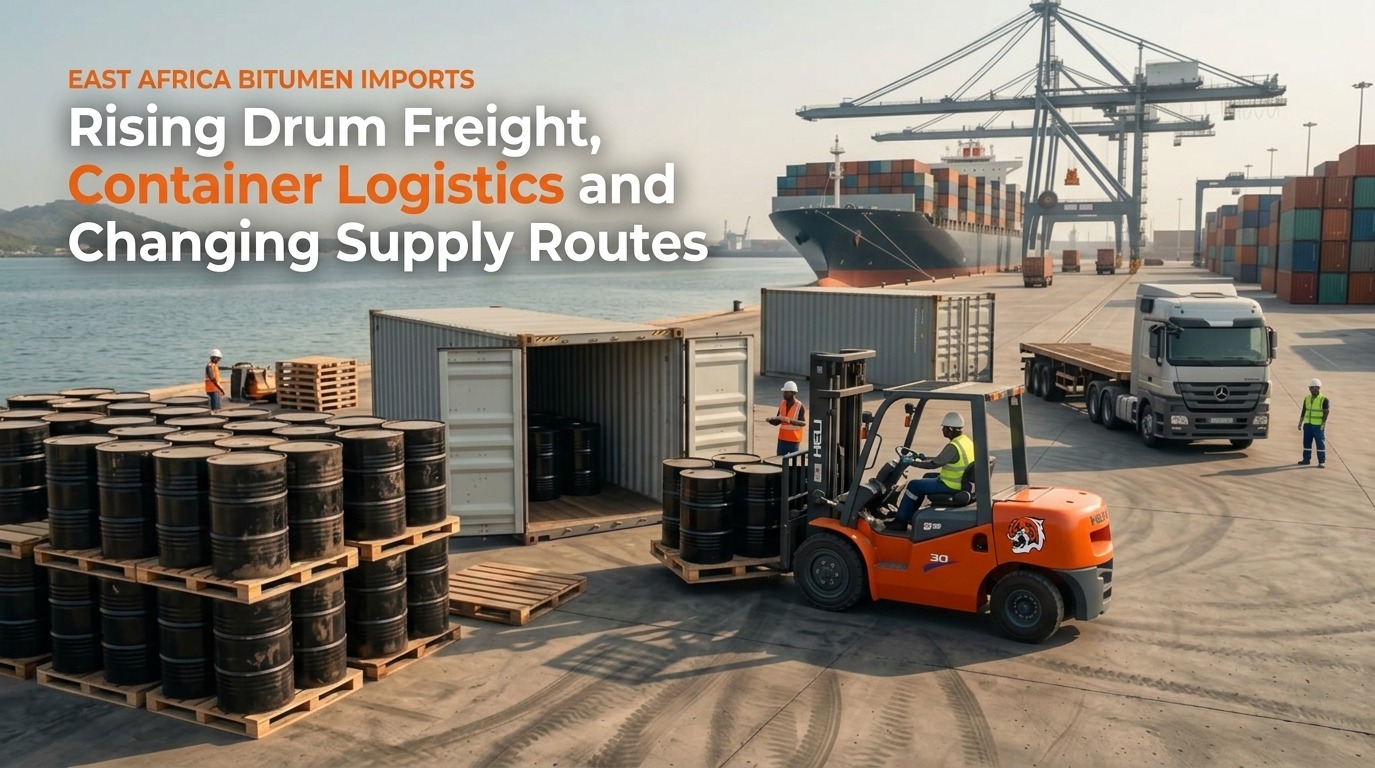
East Africa bitumen imports are becoming more expensive to deliver, even as demand for road and highway work stays firm. According to market reporting for the week ending 2 October 2026, delivered prices for both bulk and drummed bitumen into the region rose. The rise in drummed import costs was linked to sharply higher container freight indications on routes from the Gulf.
At the same time, importers are making renewed efforts to diversify supply beyond the Gulf, while regional logistics, from port gantries to bitumen-carrying containers, are adapting to keep product moving inland. This article looks at what is changing for East African buyers across drums, containers, freight, routes and delivered supply.
East Africa Bitumen Imports at a Glance
For East African buyers this week, the main change was in freight and delivered cost rather than demand, which remained firm.
| Factor | Direction this week | What was reported |
| Regional demand | Firm | Busy road and highway work; imported volumes running out quickly |
| Delivered drummed prices (Mombasa, Dar es Salaam) | Higher | Linked to sharply higher container freight indications |
| Delivered bulk prices | Higher | Linked in part to firmer Gulf export values |
| Drummed freight from the Gulf | Higher | Routes Mombasa, Dar es Salaam and Djibouti |
| Gulf drummed export prices | Steady | Suggests freight, rather than product price, drove the drum increase |
| Sourcing beyond the Gulf | Increasing interest | Renewed efforts to secure Mediterranean cargoes |
Summary of reported direction for the week ending 2 October 2026.
Demand: Busy Road Programmes in Kenya and Inland Markets
Demand is the backdrop to everything else in this article. According to the reporting, markets across the region were seeing firm demand from road and highway work, and imported volumes were quickly running out as importers responded to truck requirements.
Kenya as a Regional Hub
Kenyan project work was described as busy. Kenya also acts as a gateway for neighboring markets, with regular bitumen flows moving across its borders into Uganda, Burundi, the Democratic Republic of Congo (DRC) and South Sudan, according to the reporting.
As general context, this means demand at Kenyan import points reflects not only domestic projects but also requirements from landlocked markets further inland. Delays or cost increases at the port can therefore affect supply well beyond Kenya’s own road programmes.
New Requirements in Sudan
One international supplier pointed to fresh bitumen requirements into Sudan, which the reporting links to continued issues heavily restricting bitumen flows from Gulf sources. This is a reported observation from a single supplier, so the scale of Sudanese demand is unclear.
Why Firm Demand Matters for Logistics
When imported volumes are drawn down quickly, as the reporting describes, the timing of the next delivery becomes critical. Higher freight or slower shipping does not just raise costs; it can also leave importers short of product between cargoes. Freight and logistics conditions therefore play an important role in East African sourcing decisions.
Drum Freight and Container Costs
The sharpest change for East African buyers this week was in drummed freight.
Drum Freight from the Gulf Rose
According to the reporting, freight rates for drummed bitumen moving from Bandar Abbas and Jebel Ali to Mombasa in Kenya, Dar es Salaam in Tanzania and the Horn of Africa port of Djibouti all rose during the week. Delivered prices for drummed bitumen into Mombasa and Dar es Salaam also rose.
In contrast, Iranian drummed export prices at origin were assessed unchanged. Read together, this suggests that the increase in delivered drum costs this week was driven mainly by freight rather than by the price of the product itself.
Container Lines Signal Higher Rates
The increase came as international container shipping lines indicated that potential flows from Jebel Ali to East African destinations could command significantly higher freight rates. The reporting notes that such flows are still subject to considerable risk, which helps explain the elevated rates.
As general context, container freight for drummed bitumen is typically quoted per container. Because each container holds a fixed tonnage of drums, a rise in container rates passes largely into the delivered cost per tonne.
Mixed Signals on the Outlook
Not all signals point the same way. In separate reporting on the Gulf export market, market participants said some shipping lines had begun loading from Iranian ports more actively than before, and they expect container freight rates to fall in the near term. Several previously sold drummed cargoes were also loaded for Africa during the week.
For East African buyers, this means current drum freight levels may not be permanent. However, the reporting gives no timing for any easing, and it still describes Gulf-to-East Africa container flows as subject to considerable risk.
Bulk Imports and Delivered Costs
Delivered prices for bulk bitumen into East Africa also rose this week. According to the reporting, this was linked in part to firmer Iranian bulk export values, which edged higher during the week.
Unlike drums, the reporting linked the bulk increase to product prices rather than freight. As general context, that distinction matters for buyers comparing formats: when drum freight rises faster than bulk costs, the cost gap between drummed and bulk supply can widen.
In general, bulk imports require a vessel willing to load, a discharge facility at the receiving port and heated storage or transport onward. The reporting describes at least one Kenya-based importer that took delivery of a bulk cargo into its Mombasa gantry import facility in August and was understood to be seeking more cargo flows. That cargo was loaded in Turkey and sailed via the Red Sea.
As general context, bulk can offer a lower per-tonne product cost than drums for buyers with the infrastructure to receive it, but it concentrates supply risk in fewer, larger shipments. For importers already drawing down stocks quickly, a single delayed bulk cargo can have a larger effect on availability than a delayed container shipment.
Logistics Formats: Drums, Bulk and Bitutainers
East African supply chains use several logistics formats, and each responds differently to the conditions described above.
Drums in Containers
Drummed bitumen moves in standard shipping containers on container lines. As general context, this format suits smaller consignments, buyers without heated storage and inland projects because drums can be trucked and stored without specialized equipment. The trade-off is exposure to container freight markets, which rose sharply on Gulf-to-East Africa routes this week.
Bulk via Import Gantries
Bulk cargoes are discharged hot into port facilities such as the Mombasa gantry facility described in the reporting. This route depends on bitumen tanker availability and receiving infrastructure, but it avoids drum packaging and container costs.
Bitutainers for Inland and Cross-Border Delivery
Bitutainers, insulated containers designed to carry bulk hot bitumen, offer a way to move bulk product inland. According to the reporting, the Kenya-based importer mentioned above uses bitutainers to move bulk hot bitumen to domestic and export destinations across East and Central Africa, and is set to expand its fleet by the end of November.
As general context, bitutainers can bridge the gap between bulk imports at the coast and inland demand, giving buyers some of the cost benefit of bulk supply while reaching markets that would otherwise rely on drums. The planned expansion suggests continued investment in this type of regional logistics.
How the Formats Compare
| Format | Main freight exposure | Suited to | Key Consideration this week |
| Drum in containers | Container freight | Smaller lots, inland projects, no heated storage | Container freight from the Gulf rose sharply |
| Bulk cargo | Tanker freight | Coastal importers with gantry and storage | Delivered bulk costs firmed with product prices |
| Bitutainers | Inland trucking and container logistics | Bulk supply to inland and cross border markets | At least one importer is expanding its fleet |
Format comparison combines reported conditions with general industry context.
Changing Supply Routes
East Africa has traditionally sourced much of its imported bitumen from the Gulf. That route remains active, but the reporting shows buyers looking more widely and paying more attention to how cargoes reach them.
Gulf Supply Continues at a Higher Delivered Cost
Gulf-origin supply to East Africa has not stopped. Drummed parcels from the Gulf were reported sold on a delivered basis into Mombasa during the week, and several previously sold drummed cargoes were loaded for Africa. What has changed is the cost and perceived risk of the route, reflected in the higher drum freight and container rate indications described above.
Interest in Mediterranean Cargoes
According to the reporting, regional importers were making renewed efforts to source cargoes from outside the Gulf, mainly from the Mediterranean, to help meet buoyant demand in markets like Kenya. The August cargo from Turkey into Mombasa shows this route can work in practice. For now, this is better described as diversification than a replacement of Gulf supply.
Red Sea Routing
For Mediterranean cargoes, the shortest route to East Africa runs through the Suez Canal and the Red Sea. The reporting notes that some Mediterranean cargoes have used this route with no reported difficulties, including the August cargo into Mombasa. However, some market participants pointed to potential risks for cargoes moving via the Red Sea, citing recent regional hostilities.
As general context, buyers relying on this route may want to factor in possible changes to transit times, insurance costs and freight if conditions shift.
What This Means for East African Buyers
The following points are our interpretation of this week’s reported conditions, not forecasts.
Origin
Gulf supply remains available, and Mediterranean cargoes are an option that some importers are actively pursuing. Each origin carries a different mix of product price, freight, transit time and route risk. Buyers may benefit from keeping more than one origin qualified, so that a change in freight or routing on one lane does not leave them without supply.
Drums vs. Containerized Bulk
With container freight on Gulf routes rising sharply, the delivered-cost advantage of bulk over drums may have widened for buyers able to receive bulk. For inland and cross-border projects, bitutainers may offer a way to access bulk supply without relying on drums. Buyers without receiving infrastructure will still depend on drums and may find that delivered drum costs track container freight closely.
Freight and Landed Cost
This week showed that delivered drum costs can rise even when origin prices are unchanged. Comparing offers on a delivered basis and checking how recent the freight assumption is gives a more accurate picture than comparing FOB prices.
For broader pricing context, buyers can review the Africa bitumen price list when comparing export pricing and delivered supply.
Route Reliability
The reporting describes Gulf-to-East Africa container flows as still subject to considerable risk, and some participants flagged potential Red Sea risks for Mediterranean cargoes. Buyers may want to understand which route a cargo will take and what contingency exists if conditions change.
Delivery Timing
With imported volumes running out quickly, the timing of the next arrival matters as much as its price. Building lead time into orders, particularly ahead of large project phases, may reduce the risk of supply gaps.
Alternative Supply Sources
Renewed interest in Mediterranean cargoes and new bulk logistics capacity both widen the options available to East African importers. Neither is a complete substitute for Gulf supply on its own, but together they give buyers more flexibility than a single-origin, single-format approach.
What Market Participants Are Watching
The following combine expectations attributed to market participants with factors highlighted in this week’s reporting. They are not Tiger Bitumen forecasts.
- Container freight rates. Market participants expect container freight rates from Iranian ports to fall in the near term as some shipping lines load more actively. Whether that eases drum freight into East Africa remains to be seen.
- Container line appetite for East African routes. Container lines’ rate indications for Gulf flows to East Africa reflected the risks on these routes, according to the reporting. Any change in that assessment would directly affect drum freight.
- Mediterranean cargo availability. Importers are seeking more Mediterranean cargoes, and at least one Kenyan importer was reported to be seeking further flows.
- Red Sea conditions. Some participants pointed to potential risks for cargoes routed via the Red Sea.
- Inland logistics capacity. Planned additions to bitutainer capacity by the end of November could increase the region’s ability to move bulk product inland.
- Regional demand. Road and highway work across Kenya and its neighboring markets remained busy, with imported volumes running out quickly.
Conclusion
For East African bitumen buyers, the main change this week was in the cost of getting product to them rather than in the product itself. Drummed freight from the Gulf rose sharply, lifting delivered drum costs into Mombasa and Dar es Salaam even as Iranian drummed export prices held steady. Delivered bulk costs also firmed, linked in part to higher Gulf export values. Demand across Kenya and its neighboring markets stayed firm, with imported volumes running out quickly.
Gulf supply continues to reach the region, but importers are looking more widely, including toward Mediterranean cargoes, and investing in logistics such as bitutainers to move bulk product inland. For procurement teams, East Africa bitumen imports now call for close attention to format, freight, route and timing, alongside the headline price.
Buyers comparing current African export pricing can also review Bitumen 60/70 Price CFR Africa as part of their delivered-cost assessment.
For broader context on Gulf shipping conditions and their effect on international bitumen sourcing, see Middle East shipping disruptions and bitumen sourcing.