
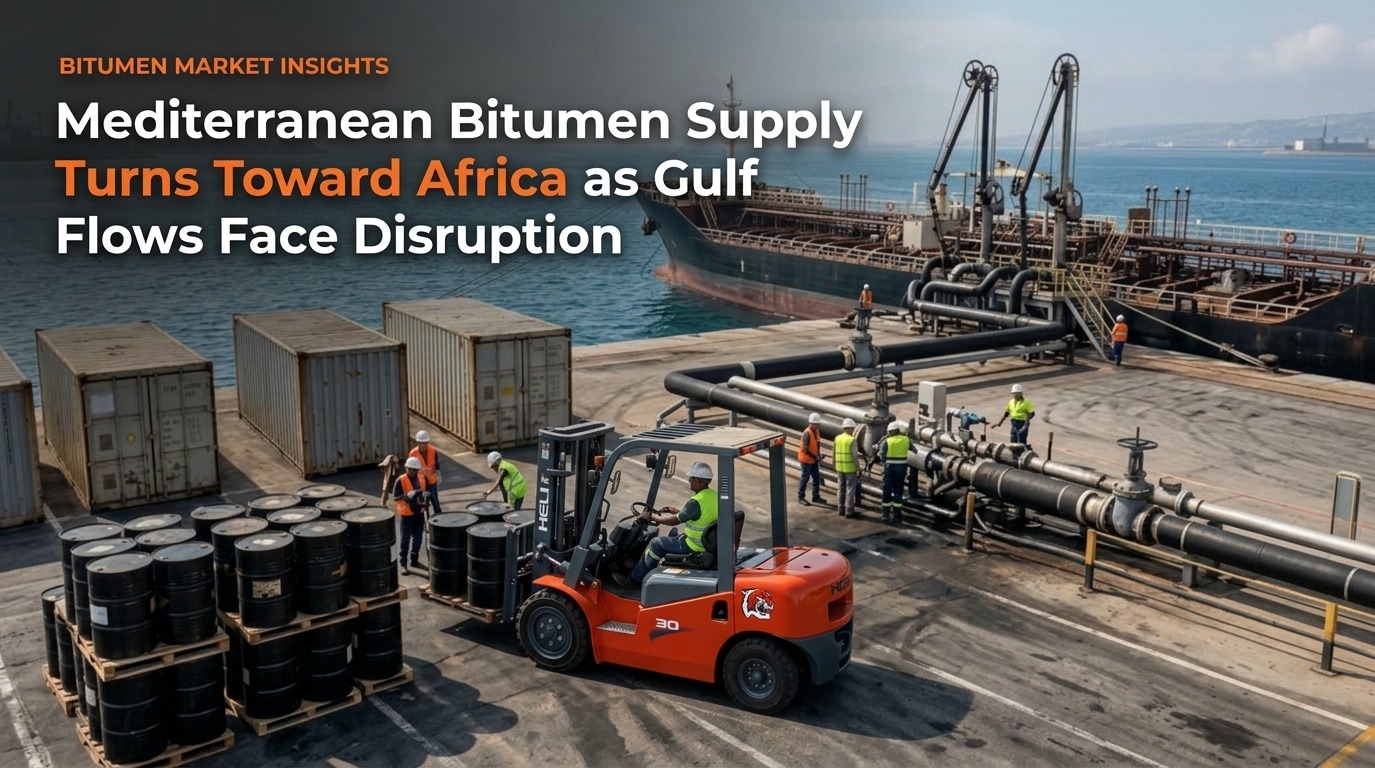
Bitumen supply to Africa is showing a noticeable change in sourcing patterns. According to market reporting for the week ending 2 October 2026, the Mediterranean remains oversupplied as demand in several of its usual outlets stays weak. At the same time, South African importers are drawing more heavily on Mediterranean-origin cargoes as some flows from the Gulf have slowed or face routing concerns, while West African import demand, much of which is regularly met from the Mediterranean, is rising.
Gulf supply to Africa has not stopped. But the reporting points to a clear shift in South Africa toward European-sourced cargoes, rising West African import requirements ahead of the dry season, and early efforts by East African importers to diversify. This article looks at why Mediterranean bitumen is available, how it is reaching African markets, what limits the trade, and what the changing flows mean for African buyers.
For buyers evaluating alternative sources, bulk bitumen supply to Africa can also be assessed alongside Mediterranean and Gulf-origin cargoes.
Why the Mediterranean has surplus bitumen
According to the reporting, Mediterranean bitumen oversupply persisted this week. Cargo prices were broadly steady, and cargo premiums to regional fuel oil values held after recent sharp falls. Delivered price indications into North African destinations remained weak as suppliers sought to encourage buying. Several factors are holding back demand in the region’s traditional outlets.
North African demand held back
North Africa is normally a major outlet for Mediterranean cargoes, but demand there has been restricted, according to the reporting.
- Algeria: imports remain much lower than usual for the time of year. Private importers are still waiting for government approval of their second-half import volumes. Some permits have recently been granted, but only to contractors already working on ongoing road projects.
- Libya: import demand stayed weak, partly because of greater difficulty obtaining letters of credit for shipments at current high prices.
- Morocco: import demand remains buoyant and broadly in line with last year, according to market participants, with favourable weather keeping road paving busy.
The reporting also notes that high outright prices, following the recent escalation in Middle East tensions, have weighed on demand in North African and Black Sea markets alongside political and funding issues.
Weak northern outlets
Demand for Mediterranean cargoes in northwest European markets was described as tepid, which has also restricted those movements. Spanish customers in North Africa and France were reported to have built sufficient inventories during a period of surplus cargo availability through late summer and September.
Uneven availability across origins
The surplus is not evenly spread across the Mediterranean. According to the reporting:
- Spain: spot cargoes continued to be readily available from Spanish export points, even as Spanish exports slipped in September, mainly because of weak regional demand.
- Turkey: strong domestic demand has left little spot export availability from Turkish export terminals.
- Greece: a regional refiner’s October export sell tender offered fewer cargoes than in September, which the reporting linked mainly to reduced uptake in its usual destinations.
For African buyers, this means Mediterranean supply is available, but which origin can supply it, and how quickly, varies.
South Africa: a shift toward Mediterranean origin cargoes
Why buyers are looking beyond the Gulf
According to the reporting, Gulf flows to South Africa and other destinations have slowed because of the US-Iran stand-off. Some market participants also pointed to potential risks for cargoes moving via the Red Sea, given what the reporting describes as a recent escalation in Saudi-Houthi hostilities. South African domestic prices firmed, reflecting rising seasonal demand and worries over reduced cargo supplies from the Gulf.
A clear shift in import sources
The reporting describes a clear shift toward European-sourced flows into South Africa. South African imports in September came mostly from Turkey, followed by Greece, according to ship-tracking data cited in the reporting. Further cargoes loaded in Turkey and Spain were due at Durban during October.
These August and September inflows helped fill inventories at South African terminals and depots. As a result, market participants consider the market reasonably well equipped to meet rising seasonal demand in October and into November, despite concerns over Gulf flows.
Seasonal and election-related demand
Road paving activity in South Africa is gathering pace with the southern hemisphere summer season. Market participants said the upcoming municipal elections on 4 November have also supported paving activity and bitumen requirements. South Africa is leading a seasonal revival in regional demand, although many other southern African countries continue to face limited government funding for infrastructure.
Buyers evaluating bitumen exporter to Africa options can compare European, Mediterranean and Gulf-origin supply based on destination, timing and delivered cost.
West Africa: dry season demand meets Mediterranean supply
West Africa is the other main African market where Mediterranean supply plays a central role. According to the reporting, the bulk of the region’s cargo import needs are regularly met from the Mediterranean.
Rising import requirements
West African import demand rose this week as end-users and importers prepared for the dry season, which is expected to begin during October. Market participants said this typically marks the point when road paving work gathers momentum. Cargo prices into the region changed little during the week, but domestic truck prices in Nigeria firmed on rising truck requirements and cargo imports.
In Nigeria, road construction activity has already begun to recover after the rainy season. Market participants expect a significant rise in paving activity in October and November, and they expect activity to accelerate further ahead of presidential elections scheduled for January 2027.
A regional supply disruption
West African buyers also had to adjust to a disruption in regional supply. According to the reporting, production at a refinery in Ivory Coast was cut during August and much of September because of a crude supply issue. Nigerian end-users had to look more widely for supply during that period, and cargo and truck exports from the refinery to Ghana were halted for several weeks. One buyer in Ghana said stocks at a terminal there had run out in mid-September.
The reporting indicates that the situation was on the way to being resolved after a long-awaited crude cargo arrived at the refinery in late September. For buyers, the episode illustrates how quickly a single regional supply interruption can push importers to look more widely for supply.
How Mediterranean bitumen reaches African markets
The reporting shows Mediterranean-origin bitumen moving to Africa through several distinct logistics routes. Each has different implications for cost, timing and the size of shipments buyers can receive.
Direct bulk cargoes
The most straightforward route is a direct bulk cargo from a Mediterranean or nearby Atlantic export point to an African import terminal. The reporting describes cargoes loaded in Spain heading to Nigeria and Cameroon, and a cargo loaded at Turkish and Spanish ports bound for Durban. Some cargoes discharge at more than one port, for example a part-cargo into Cameroon followed by Nigeria.
Trans-shipment through West African hubs
A trans-shipment hub in Lome, Togo, plays an important role in moving Mediterranean bitumen to Africa. According to the reporting, cargoes received at Lome are regularly loaded at Turkish or Greek export terminals using large vessels. They are then transferred, including through ship-to-ship operations, onto other vessels for delivery to Nigerian terminals and as far as South Africa. One cargo due at Durban in early October, after first calling at Cape Town, appeared to have been loaded this way.
As general context, hubs like this let suppliers move large volumes on bigger, more economical vessels and then distribute smaller parcels regionally.
Via the Suez Canal and the Red Sea
Some Mediterranean cargoes have reached southern and eastern African destinations via the Suez Canal and the Red Sea. According to the reporting, major trading houses have shipped Mediterranean export cargoes through this route, crossing the Bab el-Mandeb strait with no reported difficulties. One such cargo from Turkey discharged at Durban in the first half of September.
For buyers monitoring Middle East shipping disruptions and bitumen sourcing, routing conditions can affect freight, insurance and delivery timing.
Containerized supply to inland markets
Mediterranean bitumen is also reaching landlocked and less accessible markets in container-sized packaging. The reporting describes Spanish bitumen shipped in specialised bitumen boxes by container to Lome, then trucked to Ouagadougou, Burkina Faso. Similar flows in bitumen boxes were reported into the Democratic Republic of Congo via its Atlantic port at Matadi.
As general context, this format avoids the need for heated bulk terminals at the destination. However, sea freight, inland trucking and packaging all add to the delivered cost.
East Africa: diversifying bitumen supply
East Africa traditionally relies heavily on Gulf supply, but the reporting points to early signs of diversification. Regional importers were making renewed efforts to source cargoes from outside the Gulf, mainly from the Mediterranean, to meet buoyant demand in markets such as Kenya. At least one Mediterranean cargo from Turkey reached Kenya via the Red Sea in August.
This remains an emerging trend rather than an established shift, and Gulf supply continues to serve the region. We will look at East African import conditions in more detail in a separate article.
Constraints on the Mediterranean to Africa trade
Mediterranean supply is available, but several factors limit how far and how cheaply it can replace other sources.
Rising freight
Cross Mediterranean bitumen tanker freight rates edged up this week, adding to sizeable increases in recent weeks, according to the reporting. Rates rose on several routes from Italy, Spain and Greece to North African destinations. In sub-Saharan Africa, higher freight rates on some routes contributed to firmer truck and cargo prices. As general context, freight is a significant part of the delivered cost on longer voyages to West and South Africa.
Turkish domestic demand
Turkey is a leading origin for cargoes into South Africa and an important supplier to the trans-shipment trade, but strong domestic demand has limited spot export availability from Turkish terminals. The reporting notes that southern and West African markets are increasing their demand for Turkish flows at the same time. If Turkish domestic demand remains strong, availability from this origin may stay tight.
Red Sea routing conditions
The Suez Canal and Red Sea route offers a shorter path from the Mediterranean to eastern and southern Africa. Some cargoes have used it with no reported difficulties, but some market participants pointed to potential risks given recent regional hostilities. Buyers relying on cargoes routed this way may face additional uncertainty over timing, insurance and freight costs compared with routes around West Africa.
Uneven origin availability
As noted above, spot availability differs by origin: readily available from Spain, limited from Turkey, and reduced through some Greek tenders. Buyers seeking Mediterranean supply may therefore have fewer real options at any given time than the overall regional surplus suggests.
What Bitumen Supply to Africa Means for Buyers
The following points are our interpretation of this week’s reported conditions, not forecasts.
- Compare origins on delivered cost. A Mediterranean cargo may look competitive at origin, but freight, multi-port discharges, trans-shipment and inland trucking all affect what a buyer actually pays. Freight on several Mediterranean routes has been rising, so delivered-cost comparisons should use current freight levels.
- Weigh reliability alongside price. This week’s reporting shows that supply can be interrupted at origin, whether by a regional refinery’s crude problems, strong domestic demand in an exporting country or concerns over shipping routes. Buyers with more than one qualified origin may be better placed to manage these interruptions.
- Match the route to the destination. Direct bulk cargoes, trans-shipment hubs, the Suez and Red Sea route and containerized bitumen boxes each suit different buyers. Coastal importers with heated storage can take bulk cargoes, while inland projects may find packaged supply more practical despite the higher cost.
- Plan ahead of seasonal peaks. Demand is rising in West Africa with the dry season and in South Africa with the summer paving season and the run-up to municipal elections. Buyers who secure volumes and shipping slots early may face less competition for available cargoes.
- Do not rule out Gulf supply. Gulf flows to Africa have slowed and face routing concerns, but they have not stopped. Diversifying toward the Mediterranean is one option among several, and the right balance will depend on each buyer’s location, storage and project timing.
For buyers comparing supply options, bitumen supply solutions for African markets can be evaluated alongside origin, freight and project requirements.
What market participants are watching
The following combine expectations attributed to market participants with factors highlighted in this week’s reporting. They are not Tiger Bitumen forecasts.
- The start of West Africa’s dry season. It is expected during October, and market participants expect it to bring higher paving activity and import demand. In Nigeria, participants expect activity to rise significantly in October and November.
- South African demand into November. Market participants said the upcoming municipal elections on 4 November have supported paving activity. The market is described as reasonably well supplied for October and into November.
- Turkish export availability. Strong domestic demand has limited spot export volumes from Turkey, even as southern and West African demand for Turkish flows increases.
- North African import permits. Algeria’s government has yet to approve import permits for private firms planning new projects. Any approvals could absorb more Mediterranean supply, although importers say elevated prices would still restrict flows.
- Red Sea and Gulf routing. Market participants are watching potential risks to Red Sea routing and the pace of Gulf flows to African destinations.
- Regional refinery supply in West Africa. Recovery at the Ivory Coast refinery after its crude supply issue may affect how much West African demand needs to be met from further afield.
Conclusion
The Mediterranean has surplus bitumen, held back by weak demand in North Africa, the Black Sea and northwest Europe, and African markets are absorbing more of it. South Africa has shifted noticeably toward European-sourced cargoes as some Gulf flows slowed, while West African import requirements are rising ahead of the dry season. East Africa is showing early signs of diversification, though Gulf supply continues to serve the region.
Mediterranean bitumen is reaching Africa through direct cargoes, trans-shipment hubs, the Suez and Red Sea route and containerized supply to inland markets. Rising freight, tight Turkish export availability and Red Sea routing concerns all limit the trade. For African buyers, bitumen supply to Africa is becoming more diverse, and sourcing decisions depend on delivered cost, supply reliability and timing rather than origin price alone.