
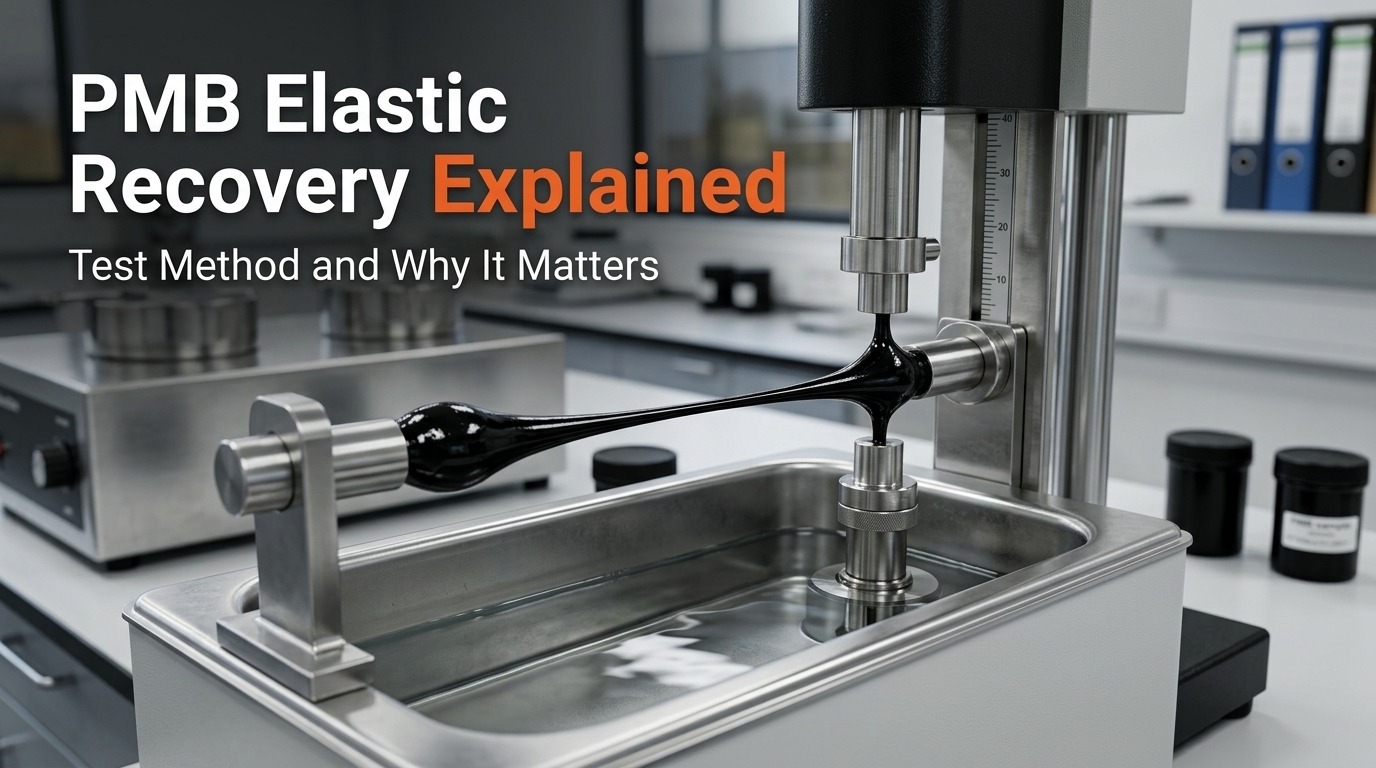
A technical data sheet for polymer modified bitumen (PMB) will often show a single elastic recovery percentage. On its own, that figure says much less than it appears to. The result only has meaning when the reader knows how the laboratory measured it, including the test method and edition, test temperature, other test conditions, binder condition, and specification used for comparison.
This article explains what elastic recovery means, how the test works in principle, how the main standards differ, and how to read the result correctly. For the broader PMB classification framework, see our EN 14023 classification article.
What Is Elastic Recovery in Polymer Modified Bitumen?
Elastic recovery describes how far a binder returns toward its original shape after stretching and release. Unmodified bitumen generally recovers little. An elastomeric polymer such as SBS can form a network within the bitumen that allows part of the deformation to recover. For this reason, engineers commonly associate elastic recovery with elastomer-modified binders. We explain the underlying mechanism in our article on what polymer modified bitumen is.
Not every PMB behaves the same way. The polymer family, polymer content, base bitumen, and formulation all influence the result. Some modifiers, such as plastomers, mainly increase binder stiffness rather than forming the same type of elastic network associated with elastomeric modification.
Why Elastic Recovery Matters for PMB
A Marker of Elastomeric Modification
PMB specifications often use elastic recovery as an indication of an elastic response associated with polymer modification. ASTM D6084 describes the test as useful for confirming that a material has been added to asphalt to provide a significant elastomeric characteristic. However, the test does not necessarily identify the type or amount of material added.
What It Does and Doesn’t Say About Deformation
Research describes elastic recovery as a parameter related to a PMB’s ability to recover part of a load-related deformation. However, engineers must consider other rheological properties when evaluating binder behaviour. Research has also raised questions about how directly binder elastic recovery predicts pavement performance.
Therefore, elastic recovery provides one useful piece of information, but it does not provide a complete performance assessment of a PMB.
How Does the Elastic Recovery Test Work?
The Ductilometer Test, Step by Step
Standards that use a ductilometer follow the same basic principle. The exact laboratory method depends on the governing standard, so the outline below explains the concept rather than providing a laboratory procedure.
- A laboratory technician conditions a moulded binder specimen at the specified test temperature.
- The technician stretches the specimen at a controlled rate to the specified length.
- The technician cuts the stretched thread at its midpoint, leaving two half-threads.
- The two halves recover for the period specified by the test method.
- The technician measures how far the cut ends move back toward each other and compares that movement with the original stretch.
How Results Are Expressed
The result represents the share of the original elongation that the binder recovered, expressed as a percentage. A higher percentage means the binder recovered a larger share of the stretch under those particular test conditions. A result near zero indicates very little recovery.
The percentage is only part of the result. The test method, temperature, binder condition, elongation, recovery period, and other specified conditions provide the context needed to interpret it.
Standards and Methods That Define Elastic Recovery
No single universal elastic recovery test applies to every PMB. The methods below share a recovery-based principle, but their test conditions and applications differ.
| Method | What it measures | Conditions stated in the method | Where it appears |
| EN 13398 | Elastic recovery of binders in a ductilometer; written especially for thermoplastic-elastomer-modified binders | Test temperature typically 25 °C or 10 °C (other temperatures can be used); elongation in general 200 mm; recovery read 30 minutes after cutting | Called up by EN 14023 where elastic recovery is required |
| ASTM D6084 | Elastic recovery of asphalt materials by ductilometer, from the recoverable strain after severing an elongated specimen | Unless otherwise specified: 25 +0.5°C and 5 cm/min +5 % | Specifications that call for ASTM D6084 |
| MSCR percent recovery (AASHTO T 350 / M 332) | Recovery in repeated creep-and-recovery cycles in a dynamic shear rheometer | Stress levels include 0.1 and 3.2kPa: each cycle allows only seconds of recovery; run at an elevated temperature, typically the binder’s high-temperature grade | Performance-graded specifications under AASHTO M332 |
EN 13398 and EN 14023
EN 13398 provides the European ductilometer method for measuring elastic recovery. The method focuses especially on binders modified with thermoplastic elastomers, although laboratories can also apply it to other binders that show small recovery. The 2017 edition replaced the 2010 edition, so always check which edition the project specification cites.
EN 14023 provides the specification framework for polymer modified bitumens and calls for EN 13398 when the specification requires elastic recovery. Within this framework, elastic recovery is a selectable property rather than a mandatory requirement for every PMB.
The framework provides graded classes at 25 °C or 10 °C for binder in its original state and after short-term ageing. The applicable specification determines which requirements apply.
EN 14023 also allows low-temperature elastic recovery at 10 °C where Fraass breaking point does not provide a suitable approach for some highly modified PMBs. We do not reproduce class values here because the applicable specification determines the required class.
ASTM D6084 and AASHTO T 301
ASTM D6084 defines a ductilometer method for measuring elastic recovery, while AASHTO T 301 provides another ductilometer-based elastic recovery method used in North American specifications.
Some US agencies add elastic recovery as an additional “PG Plus” requirement alongside performance grading. Agencies may also specify alternative procedures. For procurement and compliance, check the exact method and conditions named in the project specification.
IS 15462
Indian Standard IS 15462 for PMB also includes elastic recovery among its requirements. Technical data sheets that report an IS 15462 elastic recovery value normally state the test temperature alongside the result.
We have not reproduced the detailed IS 15462 test conditions here because the standard defines those conditions. The 2004 and 2019 editions are different documents with different grade designations. Our PMB vs PG article explains the relationship between PMB classification and Performance Grade systems.
If your project specification references IS 15462, confirm the edition and use the conditions specified for that edition.
MSCR Percent Recovery: A Different Measure
MSCR percent recovery does not provide another way to report ductilometer recovery. The MSCR method uses a dynamic shear rheometer and repeated creep-and-recovery cycles at an elevated temperature. It reports recovery together with non-recoverable creep compliance.
EN 13398 uses a different approach: the laboratory stretches and cuts a binder thread, then measures recovery after the specified recovery period. Because the methods use different test principles and timescales, their recovery percentages should not be treated as interchangeable.
For more on MSCR and its relationship with performance grading, see our PMB vs PG article.
How to Read an Elastic Recovery Result
Before relying on an elastic recovery number, establish the following:
- The method and edition, such as EN 13398, ASTM D6084, AASHTO T 301, or another named method
- The test temperature
- The other conditions specified by the method, such as elongation and recovery period
- The condition of the binder: original or after short-term ageing
- Whether the figure represents a specification requirement, typical value, or particular batch result
- The requirement in the project specification under the same conditions
Compare two figures only when these factors match. A value measured at one temperature does not automatically represent performance at another temperature. Likewise, do not assume a general conversion between different test methods.
The useful comparison is the measured result against the requirement in the applicable specification under the specified test conditions.
What Elastic Recovery Can Tell You, and What It Cannot
Elastic recovery can indicate:
- Whether the binder shows an elastic response consistent with elastomeric modification under the test conditions
- Whether a product or shipment meets a stated requirement for this property
It cannot:
- Identify the polymer type or amount. ASTM D6084 states that the test does not necessarily identify the type or amount of material added. Therefore, an elastic recovery result cannot establish that a binder contains SBS or another specific polymer, or determine its dosage.
- Establish pavement performance by itself. Elastic recovery represents one property among several that engineers use to assess a modified binder.
- Fit every modified binder. Laboratory work has recorded low recovery for some plastomer-modified binders. Some highly rubber-modified materials may also present limitations during ductilometer testing because the specimen can break before reaching the required elongation. In such cases, a low or unobtainable value reflects the limits of the test rather than automatically providing a verdict on the binder.
- Separate the polymer from the bitumen around it. Recovery depends on the interaction between the polymer network and the bitumen phase. Different formulations can therefore produce similar recovery percentages.
- Replace the other required properties.
Why a Higher Result Is Not Automatically Better
A project specification establishes the required level, and compliance with that requirement matters most. A result above the specified minimum does not automatically demonstrate better pavement performance.
Elastic recovery represents only one property, and the result depends on the polymer, bitumen phase, formulation, and test conditions. A higher value is therefore a different test result, not a universal quality ranking.
Elastic Recovery Alongside the Rest of the Specification
Under EN 14023, a PMB uses a complete designation that combines the nominal penetration range with the minimum softening point. The applicable specification also determines which additional characteristics the binder must meet. For more detail, see our article on PMB grades.
Read elastic recovery alongside the other required characteristics rather than treating it as a substitute for them. For guidance on selecting the appropriate grade and standard for a project, see our guide to choosing the right bitumen grade.
Reviewing Elastic Recovery on a PMB Technical Data Sheet
- Find the elastic recovery entry and determine whether it represents a limit, typical value, or batch result.
- Check the method, edition, test temperature, other stated conditions, and whether the result refers to original or aged binder.
- Compare the result with your project specification at the same test conditions, and review it alongside the other required properties.
- If the technical data sheet does not state an important condition, ask the supplier rather than making an assumption.
What to Confirm Before Ordering PMB?
- The governing specification and its edition
- Whether elastic recovery is required, and under which method, temperature, and binder condition
- The complete designation your project requires, not only a penetration range
- Which other properties the specification requires the supplier to declare
- Documentation: Tiger Bitumen provides a PMB-specific technical data sheet and a shipment-specific certificate of analysis matched to the applicable grade and project specification. SGS or Bureau Veritas inspection can also be arranged where required
- Packaging, quantity, and delivery terms
Explore Tiger Bitumen’s Polymer Modified Bitumen Range
To review PMB documentation or request a quotation against your project specification, visit our Polymer Modified Bitumen (PMB) range or request a quotation.
Standards referenced in this article: EN 13398:2017; EN 14023:2010; ASTM D6084/D6084M; AASHTO T 301; AASHTO T 350 and M 332; IS 15462.
Frequently Asked Questions
What is elastic recovery in PMB?
How far a polymer modified binder returns toward its original shape after being stretched and released, expressed as a percentage. It is closely associated with elastomeric modification.
How is PMB elastic recovery tested?
Typically in a ductilometer: a conditioned specimen is stretched, cut at its midpoint and left to recover, and the recovery is measured as a share of the original stretch. The governing method sets the conditions.
What does a high elastic recovery value mean?
A larger share of the stretch was recovered under those test conditions, which can indicate an elastic response consistent with elastomeric modification. It does not by itself mean a better PMB.
Does elastic recovery prove a binder contains polymer?
It can indicate an elastic response of the kind polymer modification provides, but ASTM D6084 notes it does not necessarily identify the type or amount of material added, and some modified binders may record low recovery or cannot be tested. It is not proof on its own.
Is PMB elastic recovery the same as MSCR recovery?
No. Ductilometer elastic recovery stretches and cuts a thread, while MSCR percent recovery is measured in a dynamic shear rheometer using short creep-and-recovery cycles. The two should not be treated as interchangeable.
Why do elastic recovery values use different test temperatures?
Each method and specification defines its own conditions: EN 13398 is typically run at 25 °C or 10 °C, and ASTM D6084 at 25 °C unless otherwise specified. Values at different temperatures are not interchangeable.
Is there a minimum elastic recovery for PMB?
There is no universal minimum. Any requirement is set by the applicable specification and varies with the standard, the grade and the method.