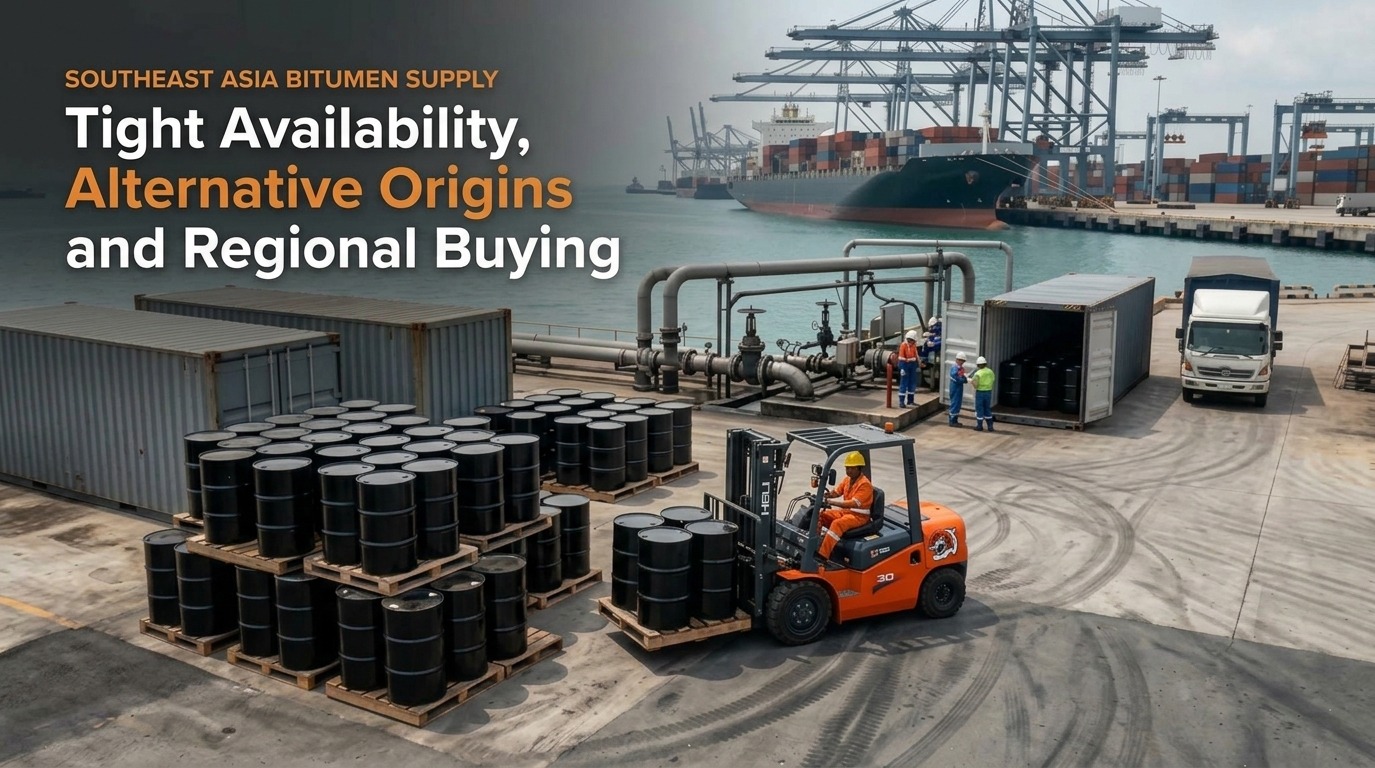
Southeast Asia bitumen supply remained tight in the week ending 2 October 2026. According to market reporting, Singapore, the region’s main export hub, offered few fixed-price cargoes, and market participants said output is unlikely to increase in October. Several other regional producers also reported limited export availability.
Buyers responded in different ways. Importers with urgent, project-specific needs were willing to pay higher prices, while others held back because of budget constraints. Some importers looked beyond Singapore to Malaysia, south China, Taiwan and Thailand. This article examines what is driving tight availability in Southeast Asia, how buyers in Vietnam, Indonesia and Malaysia are sourcing, and what the changing patterns mean for procurement teams.
Southeast Asia bitumen supply at a glance
Conditions this week varied by market, but limited availability was the common theme across the region.
| Market | Supply conditions | Buying conditions |
| Singapore | Few fixed-price offers; output unlikely to rise in October, according to participants | Export and domestic prices rose |
| Malaysia | Domestic production stable; Singapore tank-truck supply more expensive | Moderate demand; lessurgent projects postponed |
| Indonesia | Seaborne cargoes unavailable, according to the reporting | Firm demand from importers with urgent needs; others budget-constrained |
| Vietnam | No fixed-price offers for Singapore-origin cargoes | Firm demand; importers seeking alternative origins |
| Thailand | Export supply limited by crude feedstock shortages | Domestic demand slowed by flooding and heavy rain |
Summary of reported conditions for the week ending 2 October 2026.
Singapore: limited offers and constrained output
Singapore is the main reference point for Southeast Asian bitumen pricing and supply, so conditions there shape sourcing across the region.
Why output is limited
Singapore bitumen prices rose this week, supported by tight supply. Market participants said output is unlikely to increase in October for two reasons. First, logistical disruption in the Middle East has limited the availability of suitable crude feedstock. Second, a turnaround at a key Singapore refinery is expected to reduce supply further during the month.
The reporting also notes that Singapore refiners have been limiting purchase quotas because of restricted output. According to market participants, one major refinery stopped bitumen production for two weeks. Domestic selling prices in Singapore were raised for October, in line with higher seaborne values.
Few fixed-price offers
The practical effect for buyers was a lack of fixed-price export offers from Singapore. Some importers responded by looking to south China and Malaysia instead.
Where supply is offered, some of it is priced differently. According to the reporting, another major Singapore refinery, which participants expect to have more supply available in November, was offering cargoes on a floating price basis linked to the Singapore benchmark rather than at a fixed price.
As general context, floating-price offers shift price risk to the buyer: the final cargo price depends on where the benchmark settles during the pricing period. In a rising market, this can make budgeting harder for buyers working to fixed project costs.
Regional buying: urgency vs. budgets
Across Southeast Asia, buying behavior this week split between importers with urgent project requirements, who were willing to pay higher prices, and those facing budget limits, who held back.
Vietnam
Demand for Singapore-origin cargoes loading in October was firm, but no fixed-price offers emerged. Vietnamese buyers’ price ideas for Singapore cargoes were capped, according to the reporting, and some importers sought cargoes from south China and Malaysia instead. Demand for Taiwan-origin cargoes was also firm.
Consumption in southern Vietnam was limited by poor weather, while the north showed signs of improvement. Market participants expect domestic demand to pick up in the coming weeks as some projects are due for completion by year-end. However, they said higher import prices may push some contractors to the sidelines.
Indonesia
Bitumen supply in Indonesia remained limited because seaborne cargoes were unavailable, according to the reporting. This kept buying firm among importers with urgent requirements. Consumption in eastern Indonesia was slower than in western regions such as Java.
Most Indonesian buyers sought October-loading cargoes below current Singapore levels, though some were willing to pay closer to prevailing levels for November-loading cargoes. Buyers whose customers faced budget constraints could only accept lower delivered prices.
Malaysia
Demand in Malaysia was described as moderate. Some construction projects are underway to meet year-end deadlines, while less urgent projects have been postponed because high bitumen prices have made work less viable. Most Malaysian buyers opted for cargoes from domestic refineries, which were more competitively priced than tank-truck supply from Singapore.
Importers said tank-truck cargoes from Singapore are becoming increasingly expensive, and that if prices continue to rise, construction activity could be temporarily halted. Malaysian importers also warned of a possible supply shortage if construction activity increases and Singapore-origin tank-truck cargoes do not arrive.
Thailand
Thai domestic demand slowed as severe flooding and heavy rainfall disrupted road paving. The effect was limited, however, because most projects had been completed before the new fiscal year began on 1 October.
Alternative origins buyers are turning to
With Singapore supply limited, Southeast Asian importers continued to seek alternative sources, according to the reporting. Each alternative origin carries its own supply constraints.
Malaysia
Malaysian supply played a dual role this week, serving domestic buyers and export markets. According to the reporting, a Malaysian refiner sold two October-loading cargoes into Southeast Asia at a small premium to the Singapore benchmark. Malaysian cargoes were also offered on a delivered basis into southern Vietnam.
There are limits, however. Importers said one domestic refinery may not produce in November. In our view, that could reduce Malaysian availability later in the quarter.
South China
South China was an important alternative for Vietnamese buyers, with offers made on a delivered basis into northern Vietnam. However, October-loading cargoes from south China were reported to be almost sold out, and at least one seller was under no pressure to sell because of limited supply. Import demand for November-loading south China cargoes had already emerged, according to the reporting.
Taiwan
Demand from Vietnam for Taiwan-origin cargoes was firm, driven by specific projects, and at least one cargo was negotiated on a delivered basis into northern Vietnam. Taiwanese export supply is constrained, though. The reporting says production was limited by restricted availability of bituminous crude feedstock, and strong domestic demand ahead of local elections further limited export volumes.
Thailand and South Korea
Thai producers were offering October-loading cargoes, with some sellers seeking higher levels because of tight supply. At least one Thai cargo was offered on a delivered basis into southern Vietnam. However, the reporting notes that Thai producers faced crude feedstock shortages, which limited export supply.
South Korean supply is also part of the picture. At least one cargo was discussed for delivery to Southeast Asia for October loading, although Korean export prices rose this week following export tenders.
Competition for the same origins
Southeast Asian buyers are not the only ones seeking these alternatives. Importers in Australia and New Zealand were reported to be sourcing mainly from China, Thailand and Taiwan, in addition to term commitments for Singapore cargoes, because of the ongoing shortage of Singapore supply. As general context, this means several import markets are competing for the same limited pool of non-Singapore cargoes.
Freight, logistics and changing trade flows
Unlike some other regions, Southeast Asia did not face a freight shock this week. The challenge was finding available product rather than shipping it.
Freight held steady
Bitumen freight rates on the main intra-Asian routes were unchanged during the week, according to the reporting. These include routes from Singapore to Vietnam and Indonesia, from south China and Taiwan to Vietnam, and from Thailand to south China. Demurrage rates for small bitumen vessels in Singapore were also steady.
As general context, stable freight means differences in delivered cost between origins this week were driven mainly by product prices and availability rather than by shipping costs. Because intra-Asian voyages are relatively short, switching between nearby origins such as Malaysia, south China and Taiwan need not add much freight cost.
Tank-truck supply into Malaysia
Some Singapore supply moves to Malaysia by tank truck rather than by sea. According to the reporting, tank-truck cargoes to Malaysia moved at higher prices than the previous week, and importers said they are becoming increasingly expensive. Most Malaysian buyers preferred domestic refinery supply because it was more competitively priced.
Trade flows on the water
Southeast Asia bitumen supply remained tight in the week ending 2 October 2026. According to market reporting, Singapore, the region’s main export hub, offered few fixed-price cargoes, and market participants said output is unlikely to increase in October. Several other regional producers also reported limited export availability.
Buyers responded in different ways. Importers with urgent, project-specific needs were willing to pay higher prices, while others held back because of budget constraints. Some importers looked beyond Singapore to Malaysia, south China, Taiwan and Thailand. This article examines what is driving tight availability in Southeast Asia, how buyers in Vietnam, Indonesia and Malaysia are sourcing, and what the changing patterns mean for procurement teams. Buyers are also reassessing established sourcing strategies as regional availability changes.
For broader context on how Southeast Asian buyers are changing their sourcing strategies, see Southeast Asian bitumen buyers and sourcing diversification.
Southeast Asia bitumen supply at a glance
Conditions this week varied by market, but limited availability was the common theme across the region.
| Market | Supply conditions | Buying conditions |
| Singapore | Few fixed-price offers; output unlikely to rise in October, according to participants | Export and domestic prices rose |
| Malaysia | Domestic production stable; Singapore tank-truck supply more expensive | Moderate demand; lessurgent projects postponed |
| Indonesia | Seaborne cargoes unavailable, according to the reporting | Firm demand from importers with urgent needs; others budget-constrained |
| Vietnam | No fixed-price offers for Singapore-origin cargoes | Firm demand; importers seeking alternative origins |
| Thailand | Export supply limited by crude feedstock shortages | Domestic demand slowed by flooding and heavy rain |
Summary of reported conditions for the week ending 2 October 2026.
Singapore: limited offers and constrained output
Singapore is the main reference point for Southeast Asian bitumen pricing and supply, so conditions there shape sourcing across the region.
Why output is limited
Singapore bitumen prices rose this week, supported by tight supply. Market participants said output is unlikely to increase in October for two reasons. First, logistical disruption in the Middle East has limited the availability of suitable crude feedstock. Second, a turnaround at a key Singapore refinery is expected to reduce supply further during the month.
The reporting also notes that Singapore refiners have been limiting purchase quotas because of restricted output. According to market participants, one major refinery stopped bitumen production for two weeks. Domestic selling prices in Singapore were raised for October, in line with higher seaborne values.
Few fixed-price offers
The practical effect for buyers was a lack of fixed-price export offers from Singapore. Some importers responded by looking to south China and Malaysia instead.
Where supply is offered, some of it is priced differently. According to the reporting, another major Singapore refinery, which participants expect to have more supply available in November, was offering cargoes on a floating price basis linked to the Singapore benchmark rather than at a fixed price.
As general context, floating-price offers shift price risk to the buyer: the final cargo price depends on where the benchmark settles during the pricing period. In a rising market, this can make budgeting harder for buyers working to fixed project costs.
Regional buying: urgency vs. budgets
Across Southeast Asia, buying behavior this week split between importers with urgent project requirements, who were willing to pay higher prices, and those facing budget limits, who held back. These conditions are part of wider regional Southeast Asia bitumen supply constraints affecting origin selection and buying timing.
Vietnam
Demand for Singapore-origin cargoes loading in October was firm, but no fixed-price offers emerged. Vietnamese buyers’ price ideas for Singapore cargoes were capped, according to the reporting, and some importers sought cargoes from south China and Malaysia instead. Demand for Taiwan-origin cargoes was also firm.
Consumption in southern Vietnam was limited by poor weather, while the north showed signs of improvement. Market participants expect domestic demand to pick up in the coming weeks as some projects are due for completion by year-end. However, they said higher import prices may push some contractors to the sidelines.
Indonesia
Bitumen supply in Indonesia remained limited because seaborne cargoes were unavailable, according to the reporting. This kept buying firm among importers with urgent requirements. Consumption in eastern Indonesia was slower than in western regions such as Java.
Most Indonesian buyers sought October-loading cargoes below current Singapore levels, though some were willing to pay closer to prevailing levels for November-loading cargoes. Buyers whose customers faced budget constraints could only accept lower delivered prices.
Malaysia
Demand in Malaysia was described as moderate. Some construction projects are underway to meet year-end deadlines, while less urgent projects have been postponed because high bitumen prices have made work less viable. Most Malaysian buyers opted for cargoes from domestic refineries, which were more competitively priced than tank-truck supply from Singapore.
Importers said tank-truck cargoes from Singapore are becoming increasingly expensive, and that if prices continue to rise, construction activity could be temporarily halted. Malaysian importers also warned of a possible supply shortage if construction activity increases and Singapore-origin tank-truck cargoes do not arrive.
Thailand
Thai domestic demand slowed as severe flooding and heavy rainfall disrupted road paving. The effect was limited, however, because most projects had been completed before the new fiscal year began on 1 October.
Alternative origins buyers are turning to
With Singapore supply limited, Southeast Asian importers continued to seek alternative sources, according to the reporting. Each alternative origin carries its own supply constraints. This diversification is an important part of how Southeast Asia bitumen supply is being managed by regional buyers.
Malaysia
Malaysian supply played a dual role this week, serving domestic buyers and export markets. According to the reporting, a Malaysian refiner sold two October-loading cargoes into Southeast Asia at a small premium to the Singapore benchmark. Malaysian cargoes were also offered on a delivered basis into southern Vietnam.
There are limits, however. Importers said one domestic refinery may not produce in November. In our view, that could reduce Malaysian availability later in the quarter.
South China
South China was an important alternative for Vietnamese buyers, with offers made on a delivered basis into northern Vietnam. However, October-loading cargoes from south China were reported to be almost sold out, and at least one seller was under no pressure to sell because of limited supply. Import demand for November-loading south China cargoes had already emerged, according to the reporting.
Taiwan
Demand from Vietnam for Taiwan-origin cargoes was firm, driven by specific projects, and at least one cargo was negotiated on a delivered basis into northern Vietnam. Taiwanese export supply is constrained, though. The reporting says production was limited by restricted availability of bituminous crude feedstock, and strong domestic demand ahead of local elections further limited export volumes.
Thailand and South Korea
Thai producers were offering October-loading cargoes, with some sellers seeking higher levels because of tight supply. At least one Thai cargo was offered on a delivered basis into southern Vietnam. However, the reporting notes that Thai producers faced crude feedstock shortages, which limited export supply.
South Korean supply is also part of the picture. At least one cargo was discussed for delivery to Southeast Asia for October loading, although Korean export prices rose this week following export tenders.
Competition for the same origins
Southeast Asian buyers are not the only ones seeking these alternatives. Importers in Australia and New Zealand were reported to be sourcing mainly from China, Thailand and Taiwan, in addition to term commitments for Singapore cargoes, because of the ongoing shortage of Singapore supply. As general context, this means several import markets are competing for the same limited pool of non-Singapore cargoes.
Freight, logistics and changing trade flows
Unlike some other regions, Southeast Asia did not face a freight shock this week. The challenge was finding available product rather than shipping it.
Freight held steady
Bitumen freight rates on the main intra-Asian routes were unchanged during the week, according to the reporting. These include routes from Singapore to Vietnam and Indonesia, from south China and Taiwan to Vietnam, and from Thailand to south China. Demurrage rates for small bitumen vessels in Singapore were also steady.
As general context, stable freight means differences in delivered cost between origins this week were driven mainly by product prices and availability rather than by shipping costs. Because intra-Asian voyages are relatively short, switching between nearby origins such as Malaysia, south China and Taiwan need not add much freight cost.
Tank-truck supply into Malaysia
Some Singapore supply moves to Malaysia by tank truck rather than by sea. According to the reporting, tank-truck cargoes to Malaysia moved at higher prices than the previous week, and importers said they are becoming increasingly expensive. Most Malaysian buyers preferred domestic refinery supply because it was more competitively priced.
Trade flows on the water
Vessel tracking reported during the week shows cargoes moving along several intra-regional routes that do not involve Singapore. These include south China ports to Indonesia, Malaysia and northern Vietnam, Malaysian ports to Vietnam and Indonesia, and Taiwan to Malaysia. While a single week’s tracking is only a snapshot, it is consistent with the reported shift by buyers toward non-Singapore origins.
What this means for Southeast Asian buyers
The following points are our interpretation of this week’s reported conditions, not forecasts.
Availability
The main constraint this week was access to product, not shipping. With few fixed-price offers from Singapore and limited export supply from Thailand and Taiwan, buyers with firm project schedules may need to secure volumes earlier than usual. This remains a key consideration for Southeast Asia bitumen supply planning.
Supply origin
Malaysia, south China, Taiwan, Thailand and South Korea all offered some supply this week, but each has its own limits. October south China cargoes were reported almost sold out, Taiwanese exports are constrained by domestic demand, and Thai exports by feedstock shortages. Keeping several origins qualified, including product specifications and supplier relationships, may help buyers respond when one source tightens.
Import timing
Timing appears to matter more than usual. Some Indonesian buyers were willing to pay more for November-loading cargoes than for October, and import demand for November-loading south China cargoes had already emerged. Participants also expect one major Singapore refinery to have more supply available in November. Buyers who can be flexible on loading month may have more options.
Freight and landed cost
Intra-Asian freight was steady this week, so delivered-cost comparisons between nearby origins depend mainly on product price and pricing basis. Buyers comparing a fixed-price offer with a floating-price offer linked to the Singapore benchmark should consider how much price risk they are willing to carry until the cargo prices out.
Reliability of alternative sources
Several alternative origins face their own feedstock or domestic-demand constraints, and buyers in Australia and New Zealand are also sourcing from some of the same origins. A source that is available this month may be less available next month, so contingency planning remains important.
For broader regional availability considerations, buyers can also review bitumen availability by region.
Regional supply conditions
Demand across the region is uneven. Some projects are being postponed because of high prices, while others with year-end deadlines are pressing ahead. Buyers may benefit from aligning purchases with project priorities rather than buying uniformly across the portfolio.
What market participants are watching
The following combine expectations attributed to market participants with factors highlighted in this week’s reporting. They are not Tiger Bitumen forecasts.
- Singapore output in October and November. Participants said output is unlikely to rise in October because of limited suitable crude and a refinery turnaround. One major Singapore refinery is expected to have more supply in November.
- Malaysian refinery supply. Importers said one Malaysian refinery may not produce in November.
- Vietnamese demand into year-end. Participants expect demand to pick up as projects near completion, though higher import prices may keep some contractors on the sidelines.
- Malaysian construction activity. Importers warned that further price increases could temporarily halt some construction, and that a supply shortage is possible if activity rises and Singapore tank-truck cargoes do not arrive.
- South China availability. With October cargoes almost sold out and November demand already emerging, south China’s capacity to keep supplying Southeast Asia will be closely watched.
- Taiwan’s domestic demand. Strong demand ahead of local elections is limiting export volumes for now.
Conclusion
Southeast Asia bitumen supply was tight this week. Singapore offered few fixed-price cargoes, and market participants said output is unlikely to rise in October because of limited suitable crude and a refinery turnaround. In Indonesia, supply was limited because seaborne cargoes were unavailable, according to the report, and Thai and Taiwanese export supply was constrained.
Buyers responded by turning to Malaysia, south China, Taiwan, Thailand and South Korea, but each of these origins has its own limits. Freight held steady, so the challenge was finding product rather than shipping it. For procurement teams, availability, origin flexibility, loading-month timing and the choice between fixed and floating pricing are likely to matter as much as the headline price in the weeks ahead.
For buyers evaluating suppliers and alternative sourcing options, Tiger Bitumen’s bitumen suppliers and export supply information provides additional sourcing context.