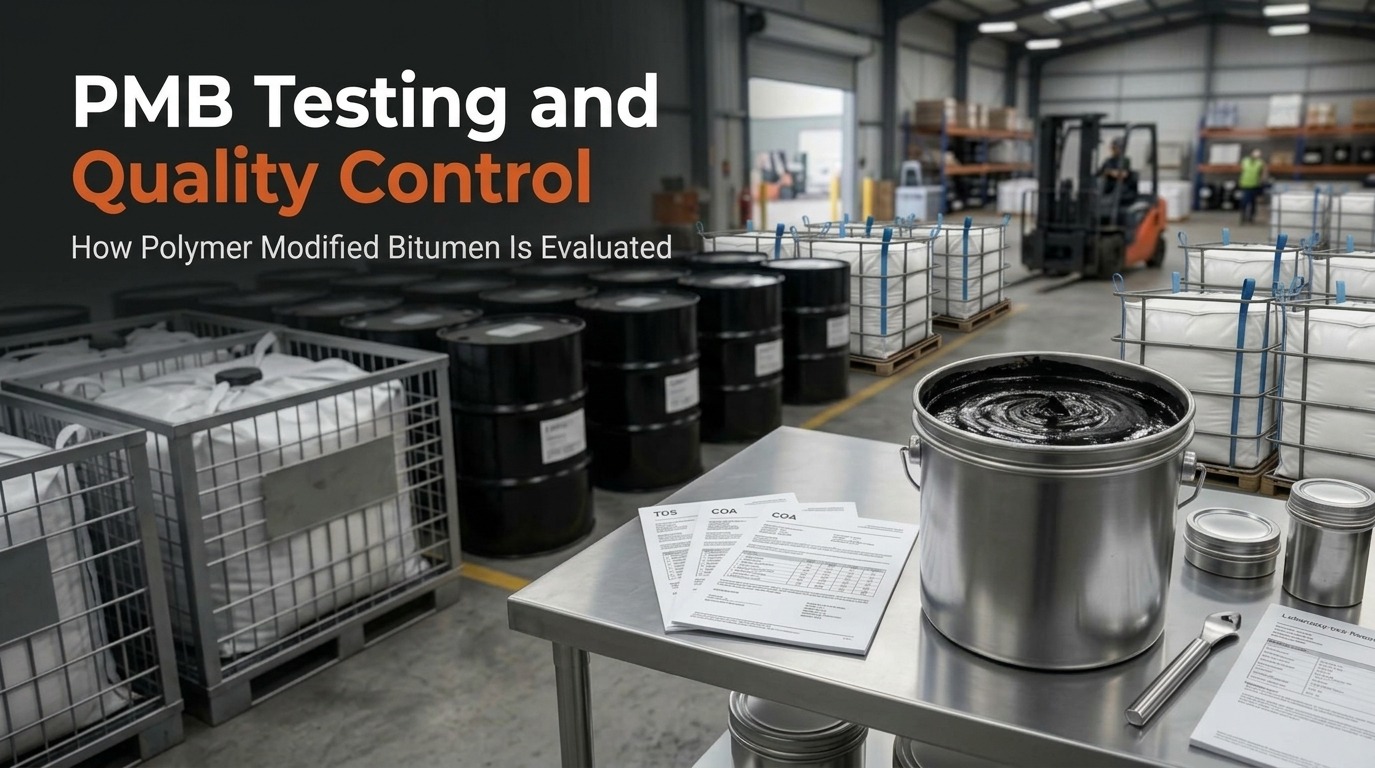
PMB testing and quality control involve more than checking a few laboratory numbers. Each PMB test answers a specific question using a defined method, sample, temperature, and specification.
Moreover, the document that reports a result also has a defined purpose. A technical data sheet, certificate of analysis, laboratory report, and inspection report each provide different types of quality evidence.
This article explains the main tests used to evaluate polymer modified bitumen, what each test measures, which frameworks require or allow it, and how different layers of quality evidence relate to one another.
What PMB Testing and Quality Control Mean
PMB testing and quality control cover several activities. Each activity serves a different purpose, so buyers should assess them according to the applicable specification.
- Classification: placing a binder in a defined class.
- Specification compliance: checking a binder against the requirements agreed for a project.
- Routine quality control: performing ongoing checks to confirm production remains consistent.
- Type/formulation testing: demonstrating initially that a product conforms.
- Ageing assessment: evaluating how the binder responds to controlled ageing procedures.
- Supplementary performance evaluation: using additional tests when the governing specification or project requires them.
For background information, see our guide to what is polymer modified bitumen.
Why PMB Needs More Than One Test
PMB behaviour includes several properties. These include consistency at different temperatures, cohesion, durability during heating and ageing, handling characteristics, and rheological performance.
Therefore, one test cannot describe the complete behaviour of a modified binder. In addition, conventional test results may not fully distinguish some highly modified binders or predict rutting performance on their own.
For this reason, specifications may combine conventional tests with additional performance-based methods such as MSCR. However, the governing specification always determines which tests and limits apply.
How PMB Tests Support Quality Control
Different tests provide different pieces of information. Consequently, buyers should read the results together instead of judging PMB quality from one number.
| Property | What it tells you | Typical test method / framework | Role | Important caveat |
| Sampling and preparation | Whether a result represents the material | EN 58, EN 12594 | Precondition | A result is only as representative as its sample |
| Penetration | Consistency at intermediate temperature | EN 1426; ASTM D5 | Classification (EN 14023 Table 1) | One point on the consistency curve |
| Softening point | Consistency at elevated temperature | EN 1427; ASTM D36 | Classification (EN 14023 Table 1) | Research reports limited ability to discriminate highly modified binders or reflect rutting on its own |
| Cohesion | Internal strength; discriminates PMB from other binders | EN 13589 with En 13703, En 13587 or EN 13588 | Classification (EN 14023 Table 1) | One method is chosen and stated; the methods are not interchangeable |
| Resistance to hardening | Durability under short-term ageing | EN 12607-1 (RTFOT); ASTM D2872 / AASHTO T 240 | Classification; PG ageing step | Ageing procedures differ between systems |
| Flash point | Handling safety | EN ISO 2592; ASTM D92 / AASHTO T 48 | Classification; safety | A safety property, not a performance one |
| Fraass | Low-temperature brittleness | EN 12593 | EN 14023 Table 2, where required | The standard notes it is unsuitable for some highly modified PMBs |
| Elastic recovery | Elastic response consistent with elastomer modification | EN 13398; ASTM D6084; AASHTO T 301 | Where required; supplementary | Conditions differ by method |
| Storage stability | Separation tendency in hot storage | En 13399; ASTM D7173 | EN 14023 Table 2, where required | The two methods are not equivalent |
| Viscosity | Handling, mixing and compaction temperatures | EN 12595 / 12596 / 13302; ASTM D4402; AASHTO T 316 | Specification-dependent | Applies only where a specification calls for it |
| DSR | Viscoelastic behaviour at high temperature | EN 14770; AASHTO T 315 / ASTM D7175 | PG grading; supplementary | Results are not EN 14023 classes |
| BBR | Low-temperature stiffness and creep | EN 14771; AASHTO T 313 / ASTM D6648 | PG grading | Same |
| MSCR | Rutting resistance and recovery under repeated loading | AASHTO T 350 / A 332; ASTM D7405; EN 16659 | M 332; supplementary | Not the same as ductilometer elastic recovery |
| Solubility | Purity of plain bitumen | EN 12592; ASTM D2042 | Optional | Not a universal EN 14023 PMB requirement; polymers can interfere with filtration-based methods |
For more detail, see our articles on PMB elastic recovery and PMB storage stability.
EN 14023 PMB Testing and Classification
What EN 14023 Covers
EN 14023 provides a classification framework for polymer modified bitumen. However, it should not be treated as a universal performance specification for every project.
The applicable grade and requirements depend on the specification in use. Therefore, buyers should identify the required class before comparing PMB test results.
See our guide to EN 14023 PMB classification for a detailed explanation.
EN 14023 Table 1 and Table 2
EN 14023 uses different property groups for classification and additional requirements. Table 1 includes properties used for classification, while Table 2 covers additional characteristics where required.
For cohesion, the available methods include force ductility using EN 13589 with EN 13703, tensile testing using EN 13587, and the Vialit method using EN 13588. These methods are not interchangeable, so the specified method matters when buyers compare results.
Similarly, DSR testing can provide useful supplementary rheological information. However, its results should not be presented as EN 14023 classes.
ASTM and AASHTO PMB Testing
Performance Grading
ASTM D6373 and AASHTO M 320 provide frameworks for performance grading. These systems use rheological measurements to evaluate binder behaviour at relevant temperatures.
For example, DSR evaluates high-temperature rheological behaviour, while BBR evaluates low-temperature stiffness and creep. In addition, ageing procedures form part of the performance-grading process.
MSCR and AASHTO M 332
AASHTO M 332 uses MSCR to evaluate rutting-related behaviour and recovery under repeated loading. As a result, MSCR provides information that differs from conventional ductilometer elastic recovery.
Some agencies also use additional requirements or “PG Plus” provisions. Therefore, the project or agency specification should always be checked before deciding which tests apply.
For the relationship between these systems, see PMB vs PG bitumen.
IS 15462 PMB Testing Requirements
IS 15462 includes requirements for polymer modified bitumen, including properties such as elastic recovery and separation-related characteristics. However, the 2004 and 2019 editions differ in their requirements.
Consequently, buyers should confirm the applicable edition before assessing a test result. Results should also not be assumed to be automatically equivalent to EN or AASHTO requirements.
PMB Quality Control and Quality Evidence
Why Quality Control Uses Multiple Evidence Layers
Testing forms only one part of PMB testing and quality control. Quality evidence can come from several layers, and each layer answers a different question.
For example, type testing demonstrates initial conformity, while batch testing provides results for a defined quantity. Likewise, third-party inspection covers the scope agreed with the buyer or project.
| Layer | What it is | What it does not show |
| Type (initial) testing | Initial demonstration that a product conforms to the specification | Results for any particular batch |
| Factory production control | A documented system of controls over production; En 14023 requires product testing at minimum frequencies set in the standard | That every characteristic is tested on every batch |
| Routine production QC | Ongoing checks that properties stay consistent with the type-tested product; scope and frequency vary | Full re-testing against the whole specification |
| Batch or shipment testing | Measured results for a defined batch or shipment | Anything about material outside that batch |
| Third-party inspection or testing | Independent sampling, witnessing or testing within a scope the buyer or project defines | Results beyond that scope |
| Pre-shipment testing | Checks before dispatch; the scope depends on the contract | Conditions of the material after dispatch |
In the EU/EEA, conformity under EN 14023 can involve a declaration of performance and CE marking supported by factory production control, depending on the destination market and applicable regulatory framework.
How to Read PMB Test Results
Check the Governing Specification
First, identify the governing specification and its edition. Next, confirm the exact test method and edition used.
Check the Sample and Test Conditions
Then, check the sample or batch represented by the result. Test conditions also matter because temperature, ageing state, preparation, and other conditions can affect the reported value.
Compare the Result with the Requirement
Finally, compare the result with the required class or limit. At the same time, determine whether the test is mandatory, optional, or supplementary under the applicable specification.
For PMB grade comparisons, see our guide to polymer modified bitumen PMB grades.
Do Not Judge PMB by One Number
A single test result rarely describes the complete quality or performance of a PMB. Instead, assess the result alongside the specification, test method, sample identity, test conditions, and other relevant properties.
PMB Testing Documents: TDS, COA, and Laboratory Reports
Technical Data Sheet (TDS)
A TDS provides product-level technical information and declared characteristics. It helps buyers understand the typical or specified properties of a product.
However, a TDS should not automatically serve as proof of the properties of a particular shipment.
Certificate of Analysis (COA)
A COA normally provides measured results for a defined batch or shipment. Therefore, it can provide more direct evidence about the material supplied under a specific order.
Laboratory Report
A laboratory report should identify the sample, test method, conditions, results, and relevant deviations. These details allow buyers to assess the result properly rather than view it as an isolated number.
Inspection Report
An inspection report provides evidence within the agreed inspection scope. For example, it may cover sampling, witnessing, quantity, packaging, or testing requested by the buyer.
Importantly, each document has a defined scope. Therefore, buyers should not use a document as evidence for matters it does not actually cover.
Common PMB Testing and Quality Control Mistakes
- Comparing results produced by different test methods.
- Treating every available test as mandatory.
- Assuming that a higher numerical result is always better.
- Reading a result without checking the method, temperature, sample, or test conditions.
- Confusing ductilometer elastic recovery with MSCR recovery.
- Confusing storage stability with ageing performance.
- Treating a TDS as shipment-specific proof.
- Assuming one test result represents an entire shipment.
What Buyers Should Check Before Ordering PMB
Before placing an order, confirm the governing specification and edition. Then identify the required PMB grade and the test methods that apply.
Buyers should also request the relevant TDS and a shipment-specific COA where required. In addition, confirm the sampling and testing basis agreed for the order.
Finally, arrange third-party inspection or testing when the contract, project, or buyer’s quality procedure requires independent verification.
PMB Testing and Quality Control with Tiger Bitumen
Tiger Bitumen can provide PMB-specific technical data and shipment-specific COA documentation matched to the applicable grade and specification. In addition, third-party inspection can be arranged when required by the buyer or project.
Explore the polymer modified bitumen product range or request a bitumen quote.
Frequently Asked Questions
What tests are performed on polymer modified bitumen?
It depends on the specification. EN 14023 specifies penetration, softening point, cohesion, resistance to hardening and flash point for all PMBs it lists, with further tests such as Fraass breaking point, elastic recovery and storage stability where required. US performance grading uses DSR, BBR and, under M 332, MSCR.
How is PMB quality checked?
Through several evidence layers: specification testing, factory production control, routine QC, batch or shipment testing and, where required, independent inspection. Their scope varies by supplier, specification and contract.
Is elastic recovery required for every PMB?
No. Under EN 14023 it applies where required, and other specifications differ. See our article on elastic recovery.
What is the difference between PMB testing and PG testing?
EN 14023 classifies PMB by consistency, cohesion and durability properties, while PG grades binders by rheological performance at pavement design temperatures. They are not equivalent.
What is the difference between a PMB TDS and a COA?
A TDS gives product-level declared information. A COA reports measured results for a defined batch or shipment.
Does one PMB test prove overall quality?
No. Each test answers one question, and results should be read together with the specification.
Why do PMB test results need a test method and specification?
Methods differ in conditions and meaning, so a result can only be compared with a requirement that uses the same method.