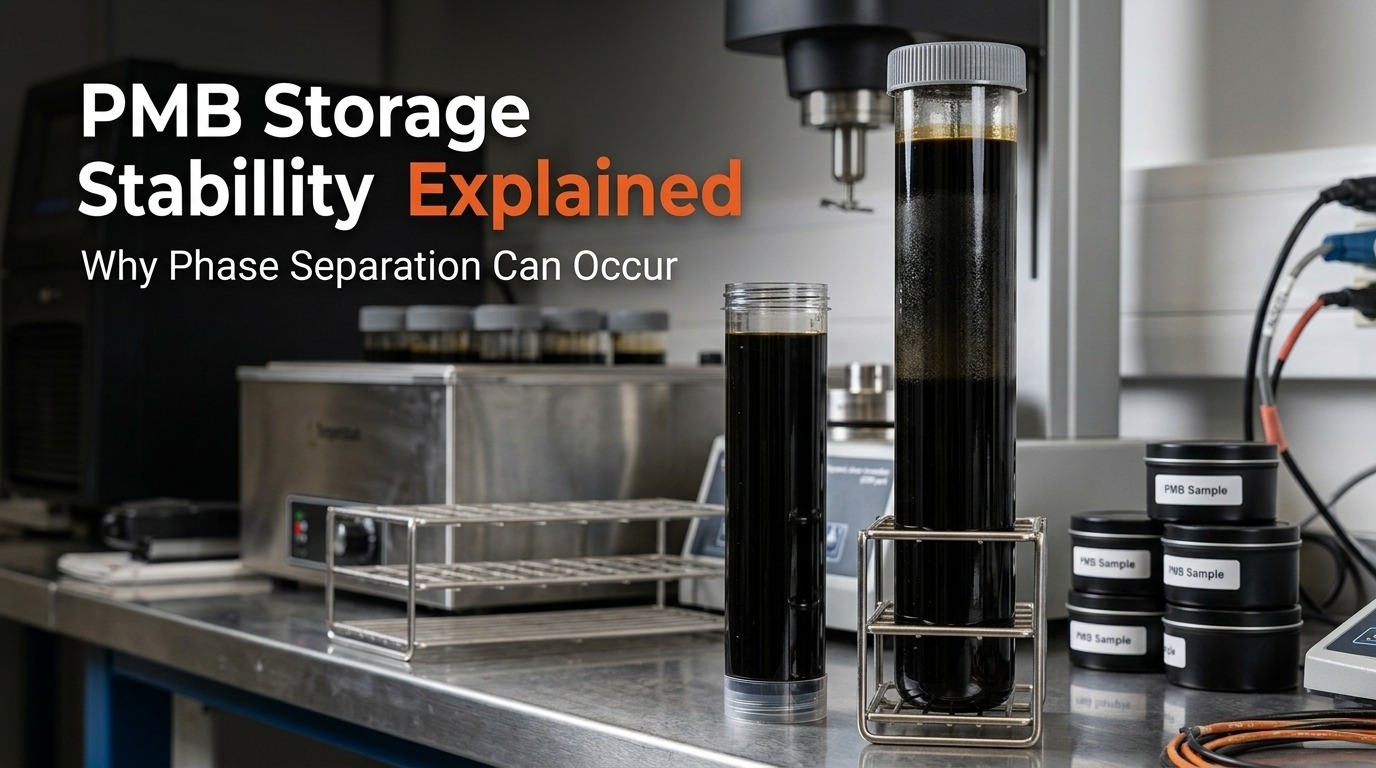
Polymer modified bitumen (PMB) is not a single uniform material. It contains bitumen with a polymer dispersed through it, and that dispersion may change when the binder remains hot and undisturbed. The polymer-rich and bitumen-rich phases can move apart, which is why PMB storage stability appears in specifications, test standards, and supplier documentation.
This article explains what PMB storage stability means, why phase separation can occur, how EN 13399 and ASTM D7173 evaluate it, what EN 14023 says, and what buyers should ask a supplier. It focuses on polymer separation during hot storage. For general bitumen storage practice, see our bitumen storage and handling best practices.
What Is PMB Storage Stability?
PMB storage stability is the ability of a modified binder to remain sufficiently homogeneous during hot storage, with the polymer remaining dispersed instead of forming separate polymer-rich and bitumen-rich regions. This matters wherever PMB remains hot before use, including storage tanks at terminals and asphalt plants.
EN 14023 provides the specification framework for polymer modified bitumens. It recognizes the importance of homogeneity, requires the supplier to provide storage conditions, and allows the tendency to separate to be assessed using the EN 13399 storage stability test. It does not guarantee identical stability for every PMB formulation because the applicable specification determines the selected requirements. For the wider classification framework, see our EN 14023 PMB classification article.
Why Can PMB Separate During Storage?
Phase separation is a tendency, not a certainty. The likelihood and rate of separation depend on the formulation, base bitumen, polymer or modifier, and storage conditions.
A Two-Phase System
When a polymer such as SBS is blended into bitumen, it can swell by absorbing lighter fractions of the bitumen. This creates a swollen polymer-rich phase dispersed through a bitumen-rich phase. Some PMB systems are thermodynamically unstable, so the phases can separate under gravity during static hot storage.
The underlying modification mechanism depends on the polymer and formulation. For a broader explanation, see our article on what polymer modified bitumen is.
Density and Viscosity Differences
The swollen polymer phase can have a different density from the surrounding bitumen phase. In a tank that remains undisturbed, gravity can encourage the phases to move relative to each other. Viscosity also affects the rate of movement: a more viscous binder generally slows phase movement.
Polymer-Bitumen Compatibility and Base Bitumen
Compatibility describes how well the polymer and bitumen form a stable system. Research has found differences in storage stability depending on factors such as aromatic content, asphaltene content, polymer concentration, and polymer structure.
For example, some studies have reported better compatibility with bitumens containing higher aromatic fractions, while higher asphaltene content or increasing SBS concentration affected separation in the systems studied. These findings do not establish a universal rule for every PMB. They show why two products with similar descriptions can behave differently during storage.
Temperature, Time, and Storage Conditions
Storage temperature and duration can affect separation, but temperature does not act as a simple universal control. Polymer content, viscosity, tank geometry, tank size, and agitation can also influence the result.
Laboratory research on SBS-modified bitumen has shown that top-to-bottom differences can change with storage temperature and that prolonged exposure to very high temperatures can also change binder properties. Those effects are formulation-specific, so the supplier’s product-specific storage instructions should govern handling.
What Happens When PMB Becomes Unstable?
When phase separation occurs, the polymer-rich material can concentrate toward one part of the storage vessel while the bitumen-rich material concentrates toward another. The binder may then show different properties at different levels of the tank.
Properties such as softening point and penetration can differ between the top and bottom portions. As a result, a sample taken from only one level may not represent the entire stored material.
Whether a separated PMB can return to a sufficiently uniform condition through mixing or circulation depends on the formulation and the extent of separation. No general restoration rule applies to every PMB, so the supplier’s instructions should determine the appropriate handling procedure.
How Is PMB Storage Stability Tested?
The main laboratory methods use a similar concept: keep a PMB sample hot and relatively undisturbed, then compare the properties of material taken from the top and bottom.
EN 13399
EN 13399 specifies a method for measuring the storage stability of modified bitumen at high temperature. The standard recognizes that modified bitumen, including polymer modified bitumen, can display phase separation under certain conditions. EN 13399:2017 is the current European edition.
In the standard method, a homogeneous sample is held in a vertical vessel at 180 °C, or at a temperature specified by the producer and reported with the result, for 72 hours. After cooling, the sample is divided into three sections and the top and bottom portions are analysed for differences. The standard defines the vessel, preparation, cutting, and testing requirements.
The important point for buyers is that the reported result must be read together with the test method and conditions. A storage stability value without its test context is not enough for a meaningful comparison.
ASTM D7173
ASTM D7173 is a practice for determining the tendency of polymer to separate from polymer-modified asphalt during static heated storage. The current active designation is ASTM D7173-20(2024). ASTM states that the practice can help compare materials and establish formulation or field-handling procedures. Large top-to-bottom differences indicate a degree of incompatibility between the polymer and base asphalt.
The procedure uses a sealed aluminium tube containing the modified asphalt. The sample is conditioned vertically under heated static conditions, after which the top and bottom portions are separated and tested. The selected tests depend on the polymer system and the information required.
Earlier versions of the method used 48 hours at 163 °C ± 5 °C. Because standards can be revised or reaffirmed, buyers should confirm the exact edition and conditions stated in the project specification rather than assuming that an older test description applies.
EN 13399 and ASTM D7173 address the same general problem but are not interchangeable. Their procedures, temperatures, durations, and evaluation approaches differ. A result from one method should therefore not be treated as a direct equivalent of a result from the other.
How Are PMB Storage Stability Results Interpreted?
The basic comparison looks at the difference between the top and bottom portions of the stored sample. A smaller difference generally indicates a more uniform binder under the specified test conditions.
The acceptable difference depends on the applicable specification. Under the EN 14023 framework, storage stability can be addressed through classes based on differences in softening point and penetration, alongside options such as no requirement or to be reported.
One available softening-point class uses a maximum difference of 5 °C. This is a selectable specification class, not a universal pass-or-fail rule for every PMB. The applicable project specification determines which requirement applies.
Some research also uses rheological measurements to investigate separation because softening point alone may not capture every aspect of phase behaviour in every modified binder.
Other national specifications also address separation. For example, IS 15462 includes a separation requirement based on the difference between top and bottom softening-point results. If a project uses IS 15462, confirm the edition and the exact requirement before evaluating a supplier’s result.
Is Phase Separation Always a Sign of Poor PMB Quality?
Not necessarily. PMB is a multi-phase material, and storage stability tests measure its tendency to remain sufficiently uniform under defined conditions. ASTM describes its separation test as a tool for comparing materials, formulating products, and establishing field handling procedures rather than as a complete quality verdict.
A PMB that meets the storage stability requirement in the applicable specification is one situation. A PMB stored outside the supplier’s specified conditions is another. Storage conditions therefore matter alongside the laboratory result.
The reverse also applies. A good storage stability result does not prove overall PMB quality. It is one property among several. Buyers should read it alongside other specified characteristics, including PMB elastic recovery and softening point.
Storage Stability vs Compatibility vs Ageing
These three terms describe different aspects of PMB behaviour and should not be treated as interchangeable.
| Concept | What it is | How it is assessed |
| Compatibility | How well the polymer and bitumen mix, an underlying property influenced by composition | Indirectly, for example through a storage test; large top-to-bottom differences indicate a degree of incompatibility (ASTM D7173) |
| Storage stability | The tendency of the binder to remain homogeneous in static hot storage | EN 13399 or ASTM D7173: top compared with bottom |
| Ageing | Changes in the binder itself over time at temperature, such as hardening | In EN 14023, resistance to hardening, including changes in softening point and elastic recovery after short-term ageing (EN 12607-1) |
Separation and ageing can occur as different effects. A top-to-bottom difference can indicate phase separation, while a change in average binder properties over time can indicate ageing. A PMB can therefore show one effect without showing the other to the same extent.
How Manufacturers Improve PMB Storage Stability
Research and technical literature describe several approaches that manufacturers may use to improve PMB storage stability. These include selecting a compatible base bitumen, controlling polymer type and concentration, using high-shear mixing, applying chemical coupling such as sulfur cross-linking, and using compatibilising additives.
Research has also examined additives such as nanoclays and other modification systems. The appropriate approach depends on the formulation and the performance requirements of the final binder.
No single method is universally superior, and formulation choices do not replace testing against the applicable specification. The final product should demonstrate the required properties under the specified test conditions.
What Buyers Should Check Before Ordering PMB
- The governing specification and its edition. Confirm the applicable standard, grade designation, and any national or project-specific requirements.
- Whether the specification includes a storage stability requirement. Under EN 14023, the applicable requirement can be a defined class, no requirement, or to be reported.
- The test method and conditions behind any reported result. Confirm the method, edition, temperature, storage period, and property used for the top-to-bottom comparison. EN 13399 and ASTM D7173 results are not interchangeable.
- The technical data sheet and certificate of analysis. Check whether storage stability is reported and whether the reported result relates to the required grade and specification. Tiger Bitumen provides a PMB-specific technical data sheet and a shipment-specific certificate of analysis matched to the confirmed grade and project requirements.
- The supplier’s storage conditions. EN 14023 requires the supplier to provide storage conditions. Ask for the product-specific conditions in writing rather than relying on a generic temperature or storage period.
- The planned storage period and arrangement. Tell the supplier how long the binder will remain in storage, the expected temperature range, and the storage arrangement so the conditions can be reviewed against the product requirements.
- The complete PMB designation. Do not rely only on a penetration range. See our guide to PMB grades and classification for more detail.
Explore Tiger Bitumen’s Polymer Modified Bitumen Range
Tiger Bitumen supplies Polymer Modified Bitumen according to the applicable grade, EN 14023 framework, project specification, and confirmed technical requirements. The current PMB range includes multiple penetration ranges, with storage stability and other performance properties confirmed against the complete designation and project requirements. See the Polymer Modified Bitumen (PMB) range or request a PMB quotation.
Frequently Asked Questions
What is PMB storage stability?
The ability of a polymer modified binder to remain homogeneous during hot storage, without the polymer separating from the bitumen.
Why does polymer modified bitumen separate during storage?
The swollen polymer-rich phase and the bitumen-rich phase differ in density and viscosity, and the two are not fully compatible, so gravity can move them apart in static hot storage. The extent depends on the formulation, base bitumen and conditions.
How is PMB storage stability tested?
By holding a sample hot in a vertical tube, cooling it, and comparing top and bottom portions. EN 13399 and ASTM D7173 do this under different conditions.
Does PMB always need agitation?
There is no general answer. Separation depends on factors including time, temperature, polymer content, viscosity, and tank geometry and agitation, and EN 14023 puts the storage conditions with the supplier. Ask for them for your specific product.
How long can PMB be stored?
No universal period applies. As our guide to bitumen shelf life and storage conditions notes for bitumen generally, the supplier’s documentation governs, and for PMB that includes the supplier’s storage conditions.
Are EN 13399 and ASTM D7173 the same test?
No. They share a principle, but their conditions differ and EN 14023 calls on EN 13399.
Does EN 14023 guarantee storage stability?
No. It makes homogeneity necessary and provides selectable classes, but the requirement that applies, and the stability of a given formulation, are matters for the specification and the supplier.