
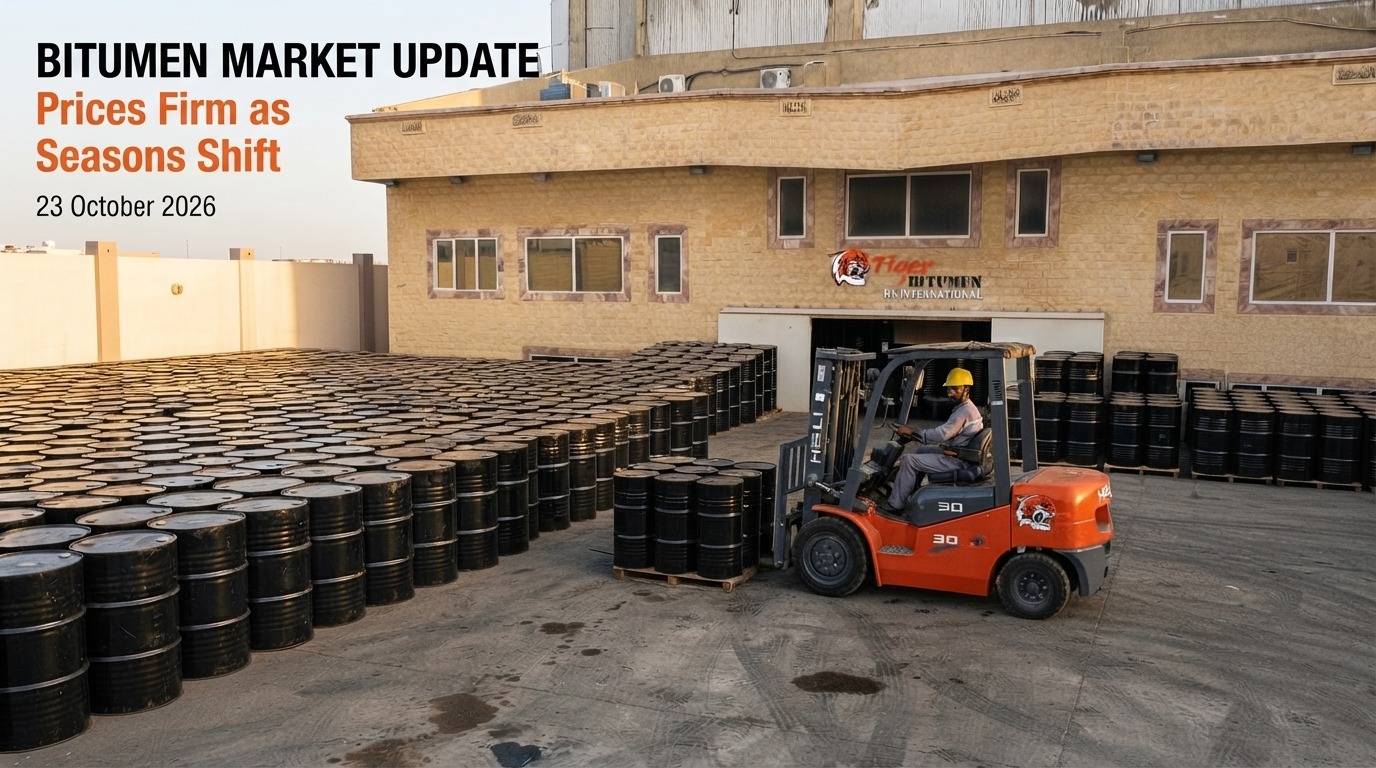
23 October 2026 | Tiger Bitumen, a brand of HY International Group
This bitumen market update for the week ending 23 October 2026 highlights rising prices across most major markets. Firmer crude oil and high-sulphur fuel oil values lifted outright prices in Europe, Africa and Asia-Pacific, while seasonal demand shifts created diverging regional trends.
In Europe and northern China, the paving season is drawing to a close. In West and southern Africa, Southeast Asia and Australasia, construction activity is picking up. This week’s bitumen market update examines how seasonal shifts, combined with constrained refinery output in several regions, are shaping prices, trade flows and buyer behaviour.
Key Takeaways This Week
- Prices firmer overall: Outright bitumen values rose in most regions, following gains in crude and fuel oil.
- Central Europe tightened sharply: Late-season demand met reduced refinery output, lifting domestic prices in Germany, Poland and the Czech Republic.
- Mediterranean premiums softened: High outright prices and freight costs kept cargo buyers cautious.
- Sub-Saharan Africa strengthened: Seasonal demand rose in West and southern Africa, with South Africa’s supply tightening.
- Asia-Pacific stayed tight: Limited Singapore supply pushed buyers to look for other origins, while China’s domestic market eased with the onset of winter.
What Is Driving Bitumen Prices This Week?
Two forces are working together. The first is feedstock cost. Bitumen values generally follow crude oil and high-sulphur fuel oil, and both moved higher this week.
The second is refinery output. In several regions, refiners are producing less bitumen. Some cannot secure enough of the heavier, sour crude grades that yield bitumen. Others are directing more of each barrel towards higher-value products such as diesel. Where reduced output meets strong seasonal demand, prices have risen fastest.
These factors can affect both product availability and delivered costs. For additional context, read our analysis of shipping disruptions and global bitumen sourcing, which discusses how logistics can influence procurement decisions.
Northwest Europe: Activity Fades as Winter Approaches
Cargo buying in Northwest Europe was limited as the regional season winds down, particularly in the Nordic markets. Outright cargo prices edged higher with crude and fuel oil. However, cargo premiums over fuel oil eased, reflecting weaker seasonal appetite.
Domestic truck prices in the Benelux and the UK held steady. Recent cargo arrivals have kept Benelux supply sufficient to meet a strong October, although stormy weather disrupted project work late in the week. Regional suppliers are expected to raise prices for November, which is likely to be the last active month before the winter slowdown.
In France, cargo imports have picked up as maintenance work at a domestic refinery has reduced local bitumen output and truck availability. Market participants also noted that North American bitumen supply could find its way into Northwest Europe, which may encourage some winter stock-building.
For a broader view of seasonal changes across international markets, see our seasonal bitumen demand guide for Q4 2026.
Central Europe: Late-Season Demand Meets Reduced Output
Central Europe saw the sharpest price movements of the week. Domestic truck prices rose strongly in Germany, Poland and the Czech Republic. Contractors are rushing to finish projects before winter, at a time when several regional refineries are producing less bitumen. Read our detailed analysis of Central Europe bitumen prices for more information about these regional supply constraints.
In Poland and the Czech Republic, output has been constrained by limited availability of bitumen-yielding sour crude. A major Polish refiner has told customers it will prioritise fixed-price contracts and review additional orders case by case. That has pushed buyers towards neighbouring supply, spreading the tightness into Germany and beyond. In southern Germany, a large refinery has increased middle-distillate production, further reducing local bitumen supply.
The effect has reached adjacent markets. Buying interest increased into northern Italy, Slovenia and Croatia, while Hungarian and Romanian prices also moved higher. In the Nordic and Baltic markets, by contrast, demand is falling with colder weather, and spot availability from the Baltic is expected to increase in the coming weeks.
Mediterranean: Buyers Step Back from Higher Prices
Mediterranean cargo premiums over regional fuel oil softened during the week. Rising outright prices and high freight rates continued to deter buyers. Spot supply was also limited, partly because of production problems at Italian refineries, which made it harder for buyers and sellers to agree deals.
North African demand remained uneven. Algerian importers are widening their sourcing to other Mediterranean origins as supply from their usual sources has tightened. Moroccan imports continued at a regular pace, and local contractors are reported to hold enough stock to cover near-term needs. In Libya, buyers remained largely absent, as higher prices have strained project budgets and made it harder to arrange letters of credit for cargo purchases.
On the supply side, Spanish domestic demand has started to ease after most planned autumn paving was completed. Export availability from Spain is expected to rise from early November, which could weigh further on Mediterranean premiums. Sub-Saharan Africa is offering a healthier outlet for Mediterranean surplus as its own season gathers pace. The wide price gap between Asian and Mediterranean cargoes also continued to attract interest in eastbound shipments.
These developments highlight the importance of comparing regional availability, freight costs and cargo premiums rather than relying on outright prices alone. Our published bitumen market analysis provides additional context on regional price movements and sourcing conditions.
Sub-Saharan Africa: Seasonal Demand Lifts Prices
Prices rose across Sub-Saharan Africa, supported by higher crude and fuel oil values and stronger seasonal activity.
West Africa: Dry-season conditions are boosting construction work and import enquiries across Nigeria, Ghana and neighbouring markets. Supply has improved. A regional producer has been returning towards normal output since early October, and steady European cargo arrivals are adding to availability. Ghana’s product availability has improved after an extended period of very limited supply. So far, higher prices have not significantly deterred buying in Nigeria, although some participants warned the impact could be felt more strongly if international prices keep rising.
East Africa: Incoming bulk cargoes are expected to improve supply in Kenya, Uganda and Tanzania, where road project activity remains busy. Regional buyers are increasingly receiving bulk bitumen rather than drummed product, and import facilities are expanding their capacity to discharge bulk cargoes into heated truck containers. Some Tanzanian buyers are sourcing bulk truck volumes from Kenya.
Southern Africa: South Africa’s supply position has tightened. Import cargo arrivals have slowed considerably since early September, just as the peak paving season gets under way. Domestic truck prices rose again, driven by higher import costs and higher tanker freight linked to rising marine fuel costs. Some market participants expect further price increases over the coming weeks, which could slow the pace of project activity. Read our detailed update on South Africa’s bitumen supply for a closer look at these conditions.
Seasonal demand and supply availability can vary considerably across African markets. For a wider perspective on these changes, see our Q4 2026 seasonal bitumen demand guide.
Asia-Pacific: Tight Supply in Southeast Asia, Softer Demand in China
Singapore bitumen prices rose on tight supply, although trading was limited. Refiners have struggled to secure suitable crude feedstock to increase bitumen output, and spot availability of Singapore-origin cargoes is expected to remain limited. Some participants expect output to improve for December-loading cargoes, though perhaps not to earlier levels. Truck supply in the region has also tightened, with purchase quotas reduced and at least one refiner suspending trucked sales. For further details, read our report on Asia bitumen supply conditions.
For a more detailed regional assessment, read our Southeast Asia bitumen market outlook for Q4 2026, which examines supply constraints, buyer behaviour and sourcing considerations.
Demand across Southeast Asia is mixed:
- Vietnam: Demand increased during the peak construction period, supported by road repairs following recent typhoons. Budget constraints remain a concern if prices rise sharply.
- Indonesia: Many buyers stayed on the sidelines because of high prices. Some projects, particularly in eastern regions, may be delayed. Buyers with urgent needs sought non-Singapore origins.
- Thailand: Domestic demand rose as drier weather supported paving and repairs in flood-affected areas, while export supply stayed limited.
- Malaysia: Demand was steady, supported by highway expansion and new projects.
In Australia and New Zealand, demand increased as dry weather supported road construction. With Singapore supply short, some buyers have turned to other regional origins.
North Asia moved the other way. China’s domestic bitumen prices fell as demand slowed after the late-September paving and restocking rush, particularly in the north, where winter is setting in. Southern China remains more stable thanks to mild weather. Weaker Chinese demand reduced import appetite, and South Korean export cargoes are increasingly being offered to destinations outside China. Taiwan’s export supply remained limited by curtailed output and firm domestic consumption.
Central Asia: Possible Change in Kazakhstan’s Export Rules
Kazakhstan has published a draft order that would allow road bitumen exports to destinations outside the Eurasian Economic Union during its winter off-season. The proposal is open for public discussion until 4 November 2026. If approved, it could add winter supply to neighbouring Central Asian markets at a time when Kazakh domestic demand is seasonally low. Read our update on the Kazakhstan bitumen export proposal for further details.
The proposal remains subject to approval. Buyers should check the official status of the draft before making procurement decisions based on a possible change in export rules.
Bitumen Market Outlook: What to Watch
- Seasonal demand shift: Activity in Europe and northern China is set to slow further, while West and southern Africa, Southeast Asia and Australasia move deeper into their active seasons.
- Crude and fuel oil direction: Feedstock costs remain a key driver of outright bitumen prices across all regions.
- Mediterranean export availability: Rising Spanish supply from November could put further pressure on Mediterranean cargo premiums.
- Singapore output: Any recovery in refinery production for December loading would be closely watched by Southeast Asian and Australasian buyers.
- South Africa supply: Import arrivals during the peak season will be important for domestic price direction.
- European refinery maintenance: Major refinery turnarounds planned in Germany for early 2027 may affect regional supply ahead of the next season.
Buyers assessing product requirements can also explore Tiger Bitumen’s range of bitumen products and confirm the appropriate grade against their project specifications.
Conclusion
This week’s bitumen market update shows a market that is firm overall but increasingly shaped by the seasons. As the northern paving season closes, attention is shifting to markets where demand is rising and supply is tight, most clearly in Southeast Asia, Australasia and southern Africa. For buyers in these regions, securing dependable supply and planning purchases ahead of peak project periods is becoming more important.
At Tiger Bitumen, a brand of HY International Group, we review global bitumen market developments every week to help our customers plan with confidence. Buyers reviewing their supply plans for the months ahead are welcome to contact our team to discuss their requirements.
Explore our Bitumen Market Updates for further regional market analysis and weekly price developments.