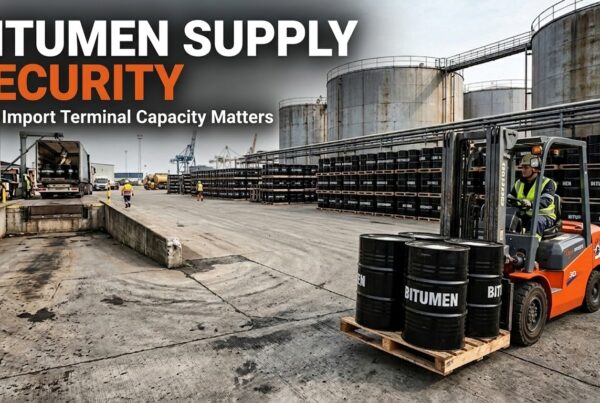
The bitumen price vs fuel oil relationship is important in many export markets, where bitumen cargoes are priced at a premium, or differential, to High-Sulphur Fuel Oil (HSFO). A buyer’s final bitumen price therefore depends on two key factors: the underlying HSFO price and the premium that bitumen commands above it.
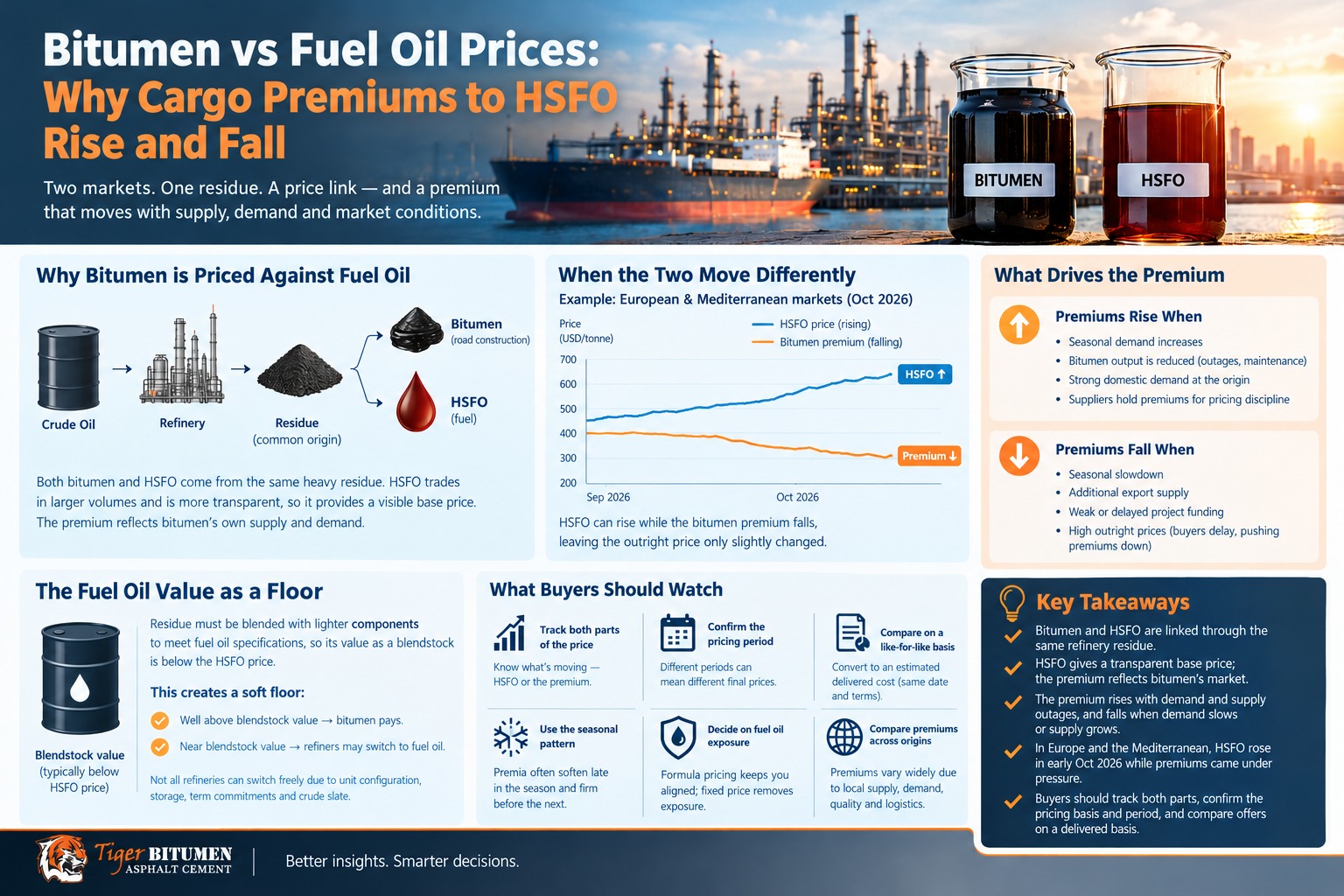
These two parts often move independently. HSFO can rise while the bitumen premium falls, leaving the outright price only slightly changed. That pattern appeared in European and Mediterranean markets in early October 2026.
This article explains why bitumen is linked to fuel oil and what drives the premium up or down. It also covers what buyers should watch when an offer is quoted against HSFO.
Why bitumen is priced against fuel oil
Both come from the same residue
Bitumen and HSFO both come from the heavy residue left after crude oil is distilled. A refinery with suitable residue can often send it to either product. In refineries where that choice exists, fuel oil is the main alternative outlet for material that could otherwise become bitumen.
That shared origin makes HSFO a natural reference point. If bitumen is worth too little relative to fuel oil, a refiner has a reason to send residue to fuel oil instead. If bitumen is worth more, the refiner has a reason to make more bitumen.
HSFO is the more transparent market
HSFO trades in larger volumes, in more locations and more frequently than bitumen. Its price is easier to observe day to day. Linking bitumen to HSFO gives buyers and sellers a visible base price, so negotiation can focus on the premium. The premium reflects bitumen’s own supply and demand.
Pricing conventions differ by region. In European and Mediterranean export markets, cargo values are commonly expressed as a differential to HSFO. Some delivered markets in Africa also quote import values against HSFO. In parts of Asia, cargoes are more often discussed as outright prices or against regional bitumen benchmarks.
Fuel oil value as a floor for bitumen
When refiners compare the two outlets, the relevant figure is not simply the HSFO price. It is what the residue would be worth as a fuel oil blendstock.
Residue usually has to be blended with lighter, more valuable components to meet fuel oil viscosity specifications. As a result, its value as a blendstock is typically below the HSFO price itself. Market reporting tracks this blendstock value as a reference for bitumen’s alternative worth.
In practical terms, this creates a soft floor:
- When bitumen prices are well above blendstock value, producing bitumen pays.
- When bitumen prices approach blendstock value, refiners that can switch have less reason to make bitumen. Some may prefer to send residue to fuel oil, particularly in the off-season.
The floor is soft because not every refinery can switch freely. Unit configuration, storage, term commitments and the refinery’s crude slate all limit how quickly output can move between products.
What makes the premium rise?
Bitumen premiums to HSFO tend to firm when bitumen’s own market tightens. The most common causes are:
- Seasonal demand. Premiums usually strengthen when paving activity peaks and buyers compete for prompt cargoes.
- Reduced bitumen output. Refinery outages, maintenance or lower bitumen yields reduce export availability without necessarily affecting HSFO.
- Strong domestic demand at the origin. When local road-building absorbs more output, export cargoes become scarcer and sellers can ask more.
- Refinery pricing discipline. Suppliers sometimes hold premiums firm even when HSFO moves, protecting bitumen margins where they have the market position to do so.
What makes the premium fall?
Premiums tend to soften when bitumen supply outruns demand, or when outright prices become hard for buyers to absorb:
- Seasonal slowdown. As paving winds down, refiners with bitumen in tank may cut premiums to clear storage.
- Additional export supply. When more cargoes become available from several export points at once, competition between seller’s narrows premiums.
- Weak or delayed project funding. Budget constraints reduce buying regardless of the HSFO price.
- High outright prices. When HSFO rises sharply, the total price of bitumen rises with it even if the premium is unchanged. Buyers may then delay purchases, which can push premiums down.
The 2026 example: HSFO up, premiums under pressure
Early October 2026 showed how the two components can diverge. The examples below summaries market reporting and are not Tiger Bitumen forecasts.
- Northwest Europe and the Baltic. Cargo premiums to HSFO fell on weak demand, partly because seasonal activity in the Nordic region was fading. Outright cargo prices still edged up, because HSFO itself rose.
- Mediterranean. Cargo prices edged up on modest gains in regional HSFO values. At the same time, most refinery suppliers sought to keep premiums to fuel oil firm. Earlier, Mediterranean premiums had fallen through September as more supply became available from several export points while demand weakened.
- Spain. Export premiums softened on weak northwest European demand. Elevated crude and HSFO prices, linked to the escalation of the US-Iran conflict, also deterred some North African buying.
- Italy. Domestic suppliers were reported to be bringing bitumen prices more into line with crude and HSFO after sharp rises in those values.
- Benelux. Elevated bitumen prices during the summer were reported to have led some end users and contractors to scale back or delay planned projects.
Asia showed a different pattern. Bitumen prices there rose mainly because of tight bitumen supply, while Asian fuel oil prices also rose. Where bitumen supply is the binding constraint, its price can move largely on its own fundamentals rather than tracking fuel oil.
Our interpretation: In Europe and the Mediterranean, rising HSFO lifted outright prices. Weak seasonal demand and the cost burden on buyers pushed premiums the other way. For buyers, a falling premium did not necessarily mean cheaper bitumen.
What this means for buyers
Know which part of the price is moving
When an offer is quoted as HSFO plus a premium, the buyer carries exposure to both. A stable premium offers no protection if fuel oil rises. Separating the two helps buyers judge whether a price change reflects the bitumen market or the wider oil market.
Check the pricing period
HSFO-linked cargoes are usually priced against an average of fuel oil quotations over a defined period. That period might fall around loading, around delivery or over a calendar month. Two offers with the same premium can produce different final prices if their pricing periods differ. Buyers should confirm the reference, the period and the quotation source before comparing.
Compare offers on the same basis
An HSFO-linked offer, a fixed-price offer and an offer against a regional bitumen benchmark are not directly comparable. Convert them to an estimated delivered cost on the same date and the same delivery terms before ranking them. Our guide to bitumen landed cost explains what to include.
Use the seasonal pattern
Premiums often soften late in a region’s paving season and firm as the next season approaches. Buyers with storage capacity may be able to time purchases around this pattern. Our seasonal bitumen demand guide outlines how timing differs by region. Even so, premium movements also depend on supply events, so this pattern is not a guarantee.
Decide how much fuel oil exposure to accept
Formula pricing keeps contracts aligned with the market, but it passes fuel oil volatility to the buyer. Fixed-price purchases remove that exposure for a single cargo, but the seller may price in a margin for the risk. Many buyers combine approaches, as discussed in our guide to term vs spot bitumen procurement.
Look at premiums across origins
Premiums reflect local supply and demand, so they can differ widely between export regions at the same time. A narrow premium in one origin and a wide one in another may point to an opportunity. It may also simply reflect differences in quality, logistics or availability. Our article on regional bitumen price differences explains why origins diverge.
Conclusion
Bitumen and HSFO are linked because they compete for the same refinery residue, and HSFO provides a transparent base price. The premium above HSFO reflects bitumen’s own market. It rises with seasonal demand, supply outages and strong local consumption. It falls when demand slows, export supply grows or high outright prices deter buyers.
The 2026 experience in Europe and the Mediterranean shows that the two components can move in opposite directions. For buyers, the practical lesson is to track both parts of the price. Confirm the pricing basis and period, and compare offers on a like-for-like delivered basis.
Buyers comparing penetration grade bitumen or other grades can request a bitumen quote with their required grade, quantity, packaging, destination and preferred pricing basis. This article is general commentary and does not constitute a price or availability offer.