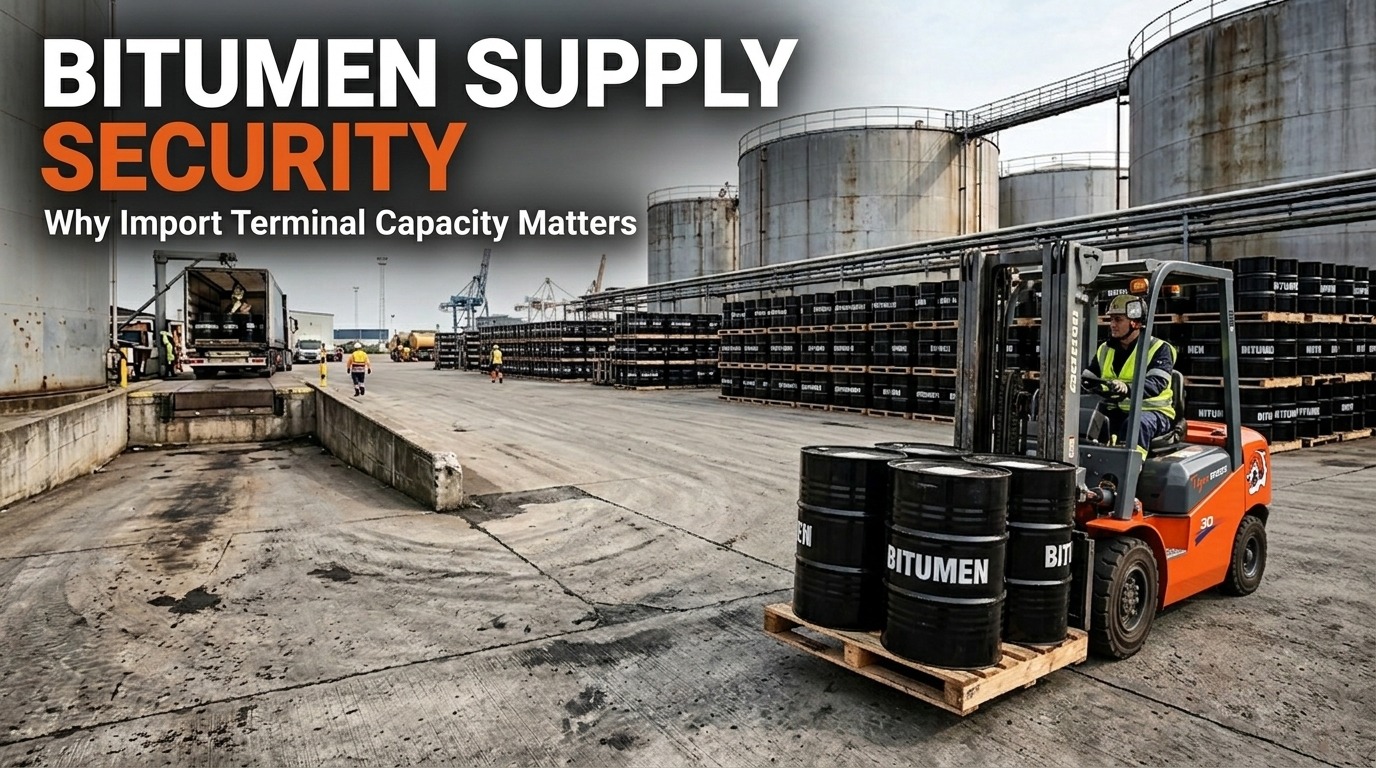
For a bitumen importer, supply security is not only about finding a cargo. It also depends on whether there is heated tank space to receive the cargo, enough stock to bridge gaps between deliveries, and more than one source to call on when a usual supplier falls short.
Import terminals are where these factors meet. A terminal with adequate capacity, healthy stock and diversified supply can absorb a refinery outage or a delayed vessel without disrupting customers. A terminal running on empty, or tied to a single source, can run out of product quickly.
This article explains how terminal capacity, stock levels, source diversification and terminal operations shape bitumen supply security. It also outlines what importers can do to strengthen each.
What supply security means for a bitumen importer
For most importers, supply security means delivering the right grade to customers when they need it, without interruption. Three conditions have to hold at once:
- Product is available from at least one supplier at a workable price.
- The product can be received and held, with heated tank space and the right handling equipment.
- Stock lasts long enough to cover the gap until the next delivery.
Weakness in any one of these can leave customers short, even if the others are strong. A plentiful global market does not help an importer whose tanks are full of the wrong grade. Equally, ample tank space does not help if the only supplier has stopped loading.
Heated storage capacity: the buffer between ships and trucks
Bulk bitumen arrives by sea in parcels and leaves by road in many small truckloads. The import terminal is the buffer between these two flows. Its heated tank capacity sets how much product can be held in reserve.
More capacity allows an importer to:
- Receive larger parcels, which can reduce the number of voyages needed.
- Hold stock ahead of peak demand, rather than buying in the same rush as other importers.
- Keep grades separate. Each grade generally needs its own tank to avoid mixing, so the number of tanks matters as well as their total volume.
- Ride out delays if a vessel or a supplier’s loading schedule slips.
Capacity also has costs. Heated storage must be maintained at suitable temperatures, product in tank ties up working capital, and bitumen should not be held hot for longer than necessary. Our guide to bitumen storage and handling best practices covers the technical side. The commercial decision is how much buffer the business needs, given its customers and supply risks.
Stock cover: how long the tanks can last
A useful way to think about stock is in days of cover: how long current stock would meet normal demand if no new cargo arrived. The right level depends on:
- Supply reliability. Less reliable sources call for more cover.
- Voyage distance. Longer lead times from origin mean more stock is needed between deliveries.
- The season. Cover needs to rise ahead of busy paving periods, as our seasonal bitumen demand and supply planning guide explains.
- Customer commitments. Firm supply obligations to contractors justify holding more stock than spot-driven sales.
When stock falls to zero, the effects reach customers quickly. Contractors without bitumen cannot pave, and projects may be delayed.
Single-source risk at the terminal level
Many terminals are supplied mainly by one refinery or one supply route. That arrangement can work well for years, until the source is disrupted. When it is, a terminal without qualified alternatives may have no immediate way to refill its tanks.
Diversification at terminal level means having credible alternative supply that has already been assessed for:
- grade and specification compatibility;
- vessel and berth compatibility with the terminal;
- commercial terms and documentation;
- realistic lead times from each alternative origin.
The broader case for qualifying more than one origin is explained in our article on regional bitumen price differences and sourcing flexibility. At terminal level, the key question is practical: if the usual source stops tomorrow, which cargo could the terminal receive next, and when?
Terminal operations that affect supply
Physical capacity is only part of the picture. Day-to-day operations also determine how securely a terminal can supply customers:
- Receiving capacity. Berth access, discharge rates and heated pipelines determine how quickly a cargo can be landed. A slow discharge can delay restocking and add cost.
- Truck loading capacity. Loading gantries and scheduling determine how much product can leave each day. This becomes the bottleneck during peak demand.
- Product testing on receipt. Sampling and testing incoming cargoes against specification protects customers but takes time. That time needs to be planned for. Our guide to bitumen quality testing explains the key tests.
- Maintenance and availability. Tanks, heating systems and pumps need servicing. Planned downtime should avoid peak seasons where possible.
- Delivery scheduling. Coordinating vessel arrivals with tank space avoids both stock-outs and vessels waiting to discharge.
What 2026 market reporting showed
Market reporting in early October 2026 illustrated how terminal stock and supply diversification affect outcomes. The examples below are reported developments, summarized without naming operators. They are not Tiger Bitumen forecasts.
When a single source falls short
- Ghana. An import terminal supplied mainly by a neighbouring regional refinery was reported to have been out of stock since late September. Output and supply from that refinery had been curtailed for several months.
- Nigeria. With the same regional refinery’s export availability limited, a Nigerian importer sourced its latest cargo from Spain instead.
- Algeria. Importers reported reduced supply from their usual Italian refinery source and switched to alternative Mediterranean suppliers.
When stock provided a buffer
- France. A partial outage at a major refinery curtailed bitumen output and truck supply. French buyers with adequate stocks said they expected no problems with overall supply, helped by truck availability from other domestic refineries. Lackluster demand earlier had given end users time to build inventories.
- South Africa. Recent cargo arrivals were reported to have filled tanks sufficiently to meet early-summer paving requirements.
- Benelux. Buyers concerned about tightness were expecting a large cargo into a major Antwerp storage terminal, which was due to improve local availability.
When stock ran low
- Indonesia. Importers reported low or empty tank inventories. Some contractors unable to secure enough supply delayed roadworks.
Terminals and new supply routes
- Kenya. An import terminal began receiving bulk cargoes from Europe after suppliers moved away from Middle Eastern loading points, and was seeking further European cargoes. Having bulk receiving capacity allowed the importer to switch origin rather than wait for its usual route to reopen.
- Nigeria. A bitumen storage terminal resumed operations after several years out of use, ahead of the dry season, adding receiving capacity to the market.
Our interpretation: Across these markets, the importers that coped best had stock in tank, alternative sources ready, or both. Those relying on a single source with low inventory were the most exposed.
Practical steps for importers
Importers can strengthen supply security in several ways:
- Set a stock-cover target for each grade, based on supply reliability, voyage distance and season, and review it before each peak period.
- Qualify at least one alternative source for every key grade, including checks on specification, vessel compatibility and documentation.
- Match tank allocation to demand. Make sure the highest-volume grades have enough dedicated capacity.
- Plan discharge and testing time into the replenishment schedule, not just the voyage time.
- Combine supply arrangements. Term supply can provide a predictable base volume, while spot purchases fill gaps. Our guide to term vs spot bitumen procurement explains the trade-offs.
- Consider packaged supply as a complement. Where bulk terminal access is limited, or for inland and smaller customers, bitumen in steel drums can supplement bulk supply without heated tank capacity at the destination.
Conclusion
Bitumen supply security is decided as much at the import terminal as at the refinery. Heated tank capacity sets how much buffer an importer can hold. Stock cover determines how long that buffer lasts. Diversified, pre-qualified sources determine whether the tanks can be refilled when a usual supplier falls short.
The examples reported in 2026 show the difference these factors make. Importers with stock and alternatives absorbed disruptions. Those dependent on one source with little inventory ran short. For importers, investing attention in capacity, stock planning and source diversification is one of the most practical ways to protect customers and projects from supply shocks.
Importers reviewing their supply options can request a bitumen quote with their required grade, quantity, packaging and destination. This article is general commentary and does not constitute a price or availability offer.