Bitumen jumbo bags give international buyers another way to receive and handle bitumen. Buyers may also encounter terms such as “jumbo bag,” “bulk bag,” “FIBC,” and “bitumen bag” when researching this packaging format.
These terms can create confusion because suppliers sometimes use them loosely. The differences matter when you specify packaging for a real shipment. They affect how the cargo is handled, stored, and unloaded at your site.
This article explains what bitumen jumbo bags are, how they are constructed, and what buyers should confirm before placing an order. It focuses specifically on Tiger Bitumen’s confirmed format: the 1 Metric Ton (1,000 kg) PP woven bag in steel cage supplied through the Bitumen Bags division of Tiger Bitumen’s export operation.
For a broader comparison across packaging formats, including drums, bitutainers, and bulk vessel supply, see the Bitumen Packaging Guide for International Buyers.
What Are Bitumen Jumbo Bags?
A bitumen jumbo bag is a packaging format for bitumen. It provides an alternative to steel drums or bulk tanker and vessel supply. It does not represent a different bitumen product.
The packaging does not change the bitumen grade or its penetration and viscosity characteristics. Instead, it changes how buyers contain, handle, transport, and unload the material.
Tiger Bitumen packs bulk bitumen sourced in tankers and vessels into this bagged format at its packaging facility in the Karachi Export Processing Zone. The team prepares the product for export according to the buyer’s specification.
The confirmed format is a single one: a 1 Metric Ton PP woven bag housed in a steel cage.
Tiger Bitumen does not publish a smaller or larger confirmed bagged unit. If your project needs a different quantity arrangement, discuss the requirement with Tiger Bitumen’s export team.
For the full commercial specification and ordering details, see Bitumen Bags.
Jumbo Bag, Bulk Bag, or FIBC? Clearing Up the Terminology
In the packaging industry, FIBC stands for Flexible Intermediate Bulk Container. The term describes large woven polypropylene bags used to move bulk solids and semi-solids.
“Jumbo bag” and “bulk bag” are common trade terms for the same general category. Buyers can also encounter these terms when researching bitumen packaging.
However, it is important to check the actual construction.
A standard FIBC usually consists of a self-supporting flexible bag. It normally has lifting loops and does not need an outer rigid structure. This design works for many free-flowing granular products.
Bitumen has different handling characteristics. It is a dense, semi-solid material. A full 1,000 kg load needs structural support during lifting, stacking, and transport.
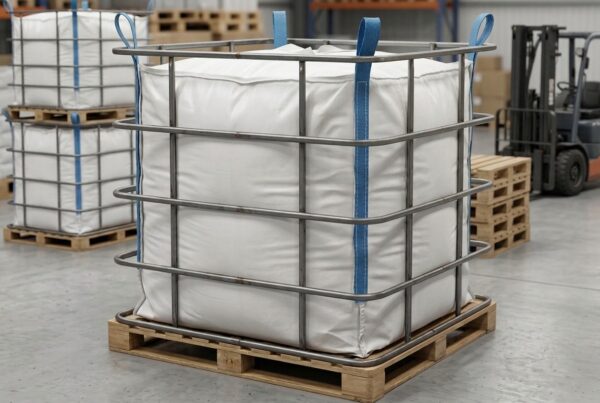
For this reason, Tiger Bitumen does not supply its bitumen bag as a standalone flexible FIBC. The woven PP bag sits inside a steel cage. Together, the bag and cage form one supported handling unit.
If another supplier describes a product as a “bitumen FIBC,” check whether the bag includes a cage or another rigid support structure. The construction may differ from the Tiger Bitumen format described here.
How a Bitumen Jumbo Bag Is Constructed
The confirmed construction has two main components.
PP woven outer bag. The bag uses woven polypropylene (PP) fabric. This material commonly appears in bulk bag applications. The PP bag contains the bitumen and forms the inner part of the packaging system.
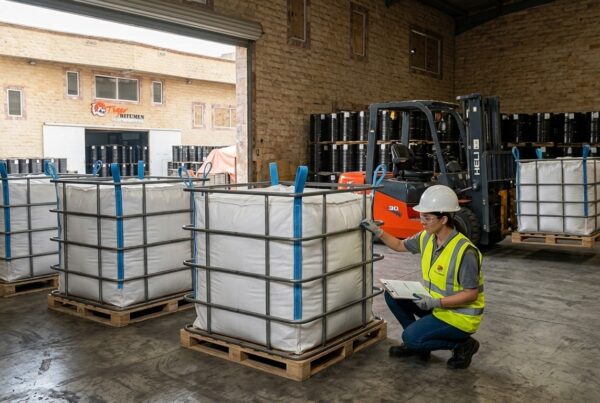
Steel cage function. The steel cage houses the PP bag and supports the full 1,000 kg load during handling and transport.
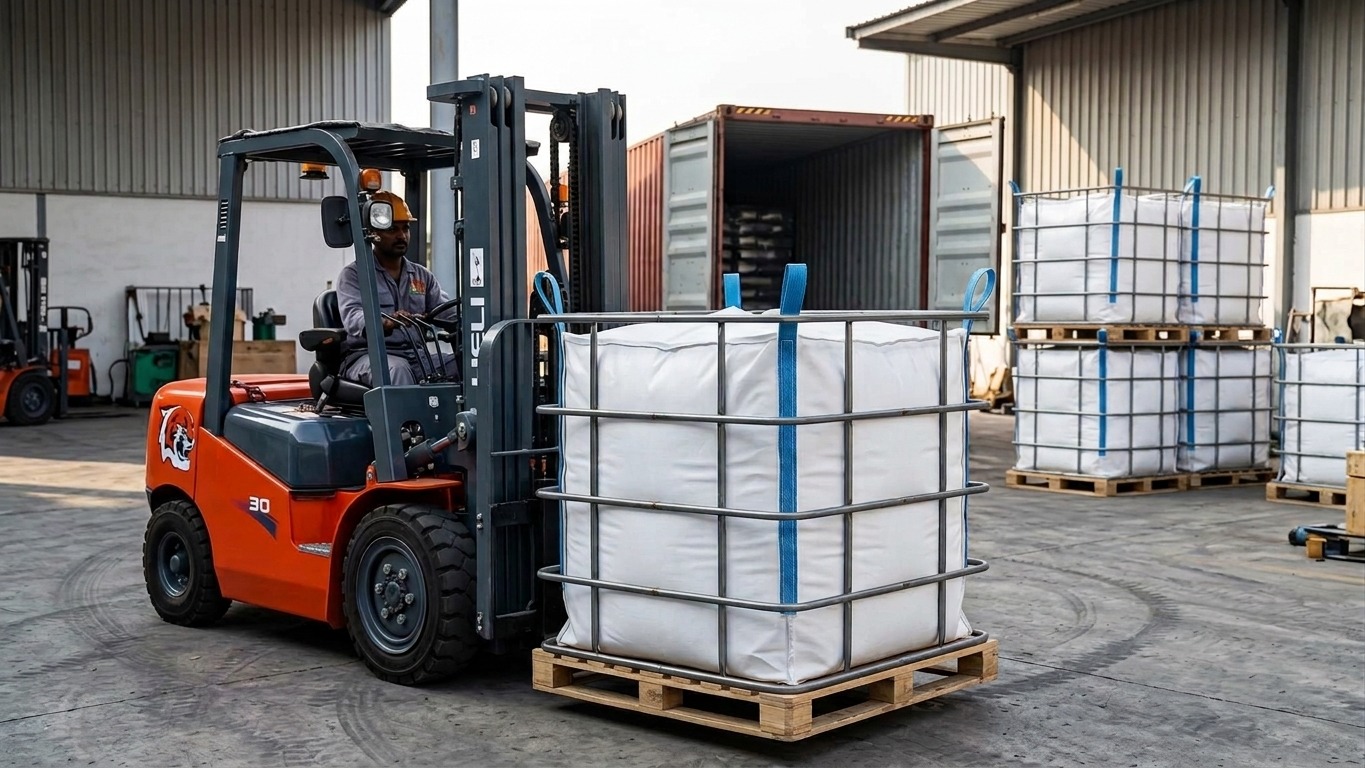
The cage allows operators to handle the unit as a rigid, supported load. They can use standard forklift or crane equipment instead of handling the soft-sided bag alone.
Tiger Bitumen has not published further construction details. These details include cage dimensions, cage material grade, and bag liner specification.
If your project requires this information for engineering, customs, or handling-equipment sign-off, confirm it directly with the export team through the Technical page or your RFQ.
Jumbo Bags vs Drums vs Bulk Supply: A Quick Comparison
Packaging format does not change what the bitumen can be used for. It changes how the cargo arrives and how your site handles it.
A quick orientation:
| Format | Confirmed unit | Typically handled with | Tends to suit |
| Bulk tanker / vessel | Large volumes, molten | Tank receiving and reheating infrastructure | Buyers with tank side receiving capability and continuous high volume demand |
| Steel drums | 150kg or 180kg per drum | Forklifts, individual handling | Buyers without palletised bag handling equipment, or smaller/specified shipments |
| Bitumen jumbo bag | 1,000kg (1 MT)per bag, PP woven bag in steel cage | Forklifts or cranes, palletised | Buyers with pallet/forlift capability, project based or phased volumes |
Containerised bulk systems such as bitutainers sit outside this comparison. The Bitumen Packaging Guide covers those systems and the broader trade-offs between packaging formats.
No format here is universally “better.” Bitumen jumbo bags suit buyers whose receiving infrastructure can handle palletised material.
They do not replace bulk or drum supply in every situation. Project volume, site infrastructure, and handling capability should guide the packaging decision.
Handling and Palletising
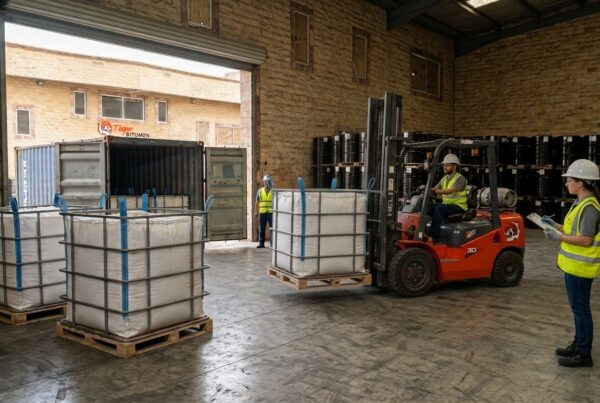
The steel-caged 1 MT bag is typically handled using forklifts or cranes. The equipment should have the capacity to move a one-tonne load safely.
The steel cage provides the main structural support. It allows the operator to move the unit in a way similar to other rigid palletised cargo.
For detailed guidance on receiving, moving, and storing bagged bitumen, see How to Handle and Store Bagged Bitumen.
Bags are placed on pallets during container loading for every Bitumen Bags shipment. The logistics team confirms the exact pallet arrangement for each order.
The arrangement can include the number of bags per pallet and the way pallets fit inside the container. Destination, order quantity, and loading requirements can affect the final configuration.
There is no published fixed figure for bags per pallet or pallets per container. Confirm the arrangement with the logistics team before shipment.
Handling should follow your site’s safety procedures. Buyers should also follow any order-specific guidance from Tiger Bitumen’s export team.
Warehouse Storage Considerations
Store the 1 MT bag under cover. Protect it from direct weather exposure, excessive heat, and contamination.
Good storage practices help protect packaged industrial materials. However, storage requirements can vary by bitumen grade and local climate.
Tiger Bitumen has not published detailed storage limits for every bagged product. These limits may include maximum stacking height and specific ambient temperature ranges.
For that reason, confirm the appropriate storage guidance for your grade and destination before arrival.
For broader bitumen storage principles, including temperature control, contamination prevention, and handling discipline, see Bitumen Storage and Handling Best Practices and Bitumen Shelf Life and Storage Conditions.
Use these articles as general references. For bag-specific storage limits, confirm the requirements with the export team.
Export & Shipping Logistics for Bagged Bitumen
Bitumen jumbo bags ship internationally by sea freight in containers. Tiger Bitumen offers FOB, CFR, or CIF terms depending on the agreed logistics arrangement.
Export documentation typically includes:
- Commercial Invoice
- Packing List
- Bill of Lading
- Certificate of Origin
- Certificate of Analysis (COA), which confirms tested technical properties of the specific batch
- SGS inspection report, where required
Many buyers request an independent SGS inspection before shipment. This can provide additional confidence in quantity and condition.
See How SGS Inspection Ensures Bitumen Quality for an overview of the SGS inspection process.
Transit time is not fixed. The shipping route, destination country, vessel schedule, weather, and port conditions can affect the final transit period.
One practical point deserves attention before ordering. The confirmed bagged unit contains 1 Metric Ton of bitumen.
Make sure your receiving facility can handle at least one complete unit. Check your unloading equipment and site access before shipment.
For the full loading, palletising, and export process, see Packaging & Logistics.
Where Bagged Bitumen Is Typically Used
Bagged bitumen can support several project and industrial applications:
- Road construction uses bitumen as a binder in surface and binder courses. Bagged supply can suit sites with compatible palletised-material handling facilities.
- Asphalt production uses bitumen as the binder in asphalt mixtures. The plant must have a receiving and pre-processing setup that works with bagged material.
- Waterproofing can use selected grades and formulations. Product suitability depends on the grade and the waterproofing system, not simply on the packaging format.
Bitumen jumbo bags can also support general infrastructure projects. They may suit remote or phased project sites where practical handling matters more than bulk volume.
Distributors can also use bagged supply when they manage smaller or phased volumes.
For waterproofing-related projects, see Bitumen Bags for Waterproofing Applications for more detail on product suitability, receiving, handling, storage, and site logistics.
Application suitability is fundamentally a grade question. The packaging format does not make an unsuitable grade appropriate for a particular application.
First, confirm the grade your project specification requires. Then confirm whether Tiger Bitumen can supply that grade in the bagged format.
Full application information is available on the Applications page.
For a specific road and asphalt use case, see Bitumen Bags for Road Construction & Asphalt Projects.
What to Confirm Before Ordering Bitumen Jumbo Bags
Before finalising an order for bitumen jumbo bags, buyers should confirm:
- The required bitumen grade and its availability in bagged format
- The total quantity required in 1 MT bag units
- Any construction detail needed beyond the standard PP bag and steel cage
- Any engineering or customs sign-off requirements
- Bags per pallet and bags per container for the destination
- Loading configuration and palletising requirements
- Shipping method and Incoterm (FOB / CFR / CIF)
- Destination port and local unloading or storage constraints
- Required documentation, including COA, SGS inspection, Bill of Lading, and Certificate of Origin
- Target shipment date
Tiger Bitumen’s most prominent bagged product lines include Penetration Grade bitumen, such as 35/50, 50/70, 60/70, and 80/100.
They also include Oxidized Bitumen, such as 85/25, 95/25, and 115/15.
If your project requires a grade outside these core lines, check its bagged-format availability before ordering.
For example, you can review Performance Grade and Viscosity Grade bitumen.
Published materials do not confirm bagged-format availability for every grade. Ask the export team to confirm the fit for your specific requirement.
Conclusion
Tiger Bitumen supplies bitumen jumbo bags as a specific packaging system. The system combines a woven PP bag with a steel cage.
The confirmed unit holds 1,000 kg of bitumen. The steel cage provides structural support for forklift or crane handling.
Bitumen jumbo bags do not suit every project. They also do not replace drums or bulk supply in every situation.
However, the format can work well for buyers whose sites can receive and handle palletised bagged material.
If your project’s grade, volume, and receiving setup fit this format, confirm the details against your specific requirement.
Visit Bitumen Bags for the full commercial specification.
You can also go directly to Request a Quote with your grade, quantity, and destination. The Tiger Bitumen export team can then confirm the remaining shipment details.
FAQs
What is a bitumen jumbo bag?
A packaging format for bitumen an alternative to steel drums or bulk tanker/vessel supply. Tiger Bitumen’s confirmed version is a 1 Metric Ton PP woven bag housed in a steel cage.
Is a bitumen jumbo bag the same as an FIBC?
The terms are used interchangeably in the trade, but a standard FIBC is typically a self-supporting flexible bag used on its own. Tiger Bitumen’s bitumen bag is specifically a woven PP bag housed inside a steel cage the two are supplied and handled together as one unit, not a standalone flexible bag.
What is the bag made of?
Woven polypropylene (PP), the standard outer material used across the bulk bag industry, housed within a steel cage. Further construction detail liner type, cage material grade, cage dimensions should be confirmed with the export team.
What does the steel cage do?
It houses the PP bag and provides structural support for handling and transport of the full 1,000 kg load, so the unit can be handled with standard forklift or crane equipment rather than as a soft-sided bag alone.
How much bitumen does one bag hold?
1 Metric Ton (1,000 kg) per bag Tiger Bitumen’s standard bagged export weight.
What is the minimum order quantity?
Bags are supplied as complete 1 Metric Ton units. There’s no smaller confirmed bagged quantity.
How is bagged bitumen shipped internationally?
By sea freight in containers (20ft containers), under FOB, CFR, or CIF terms, with documentation typically including a Commercial Invoice, Packing List, Bill of Lading, Certificate of Origin, and Certificate of Analysis, plus an SGS inspection report where required.
Which bitumen grades are available in bagged format?
Penetration Grade and Oxidized Bitumen are the confirmed core bagged product lines. Availability for other grades in Tiger Bitumen’s wider range isn’t confirmed grade by grade check with the export team for your specific requirement.