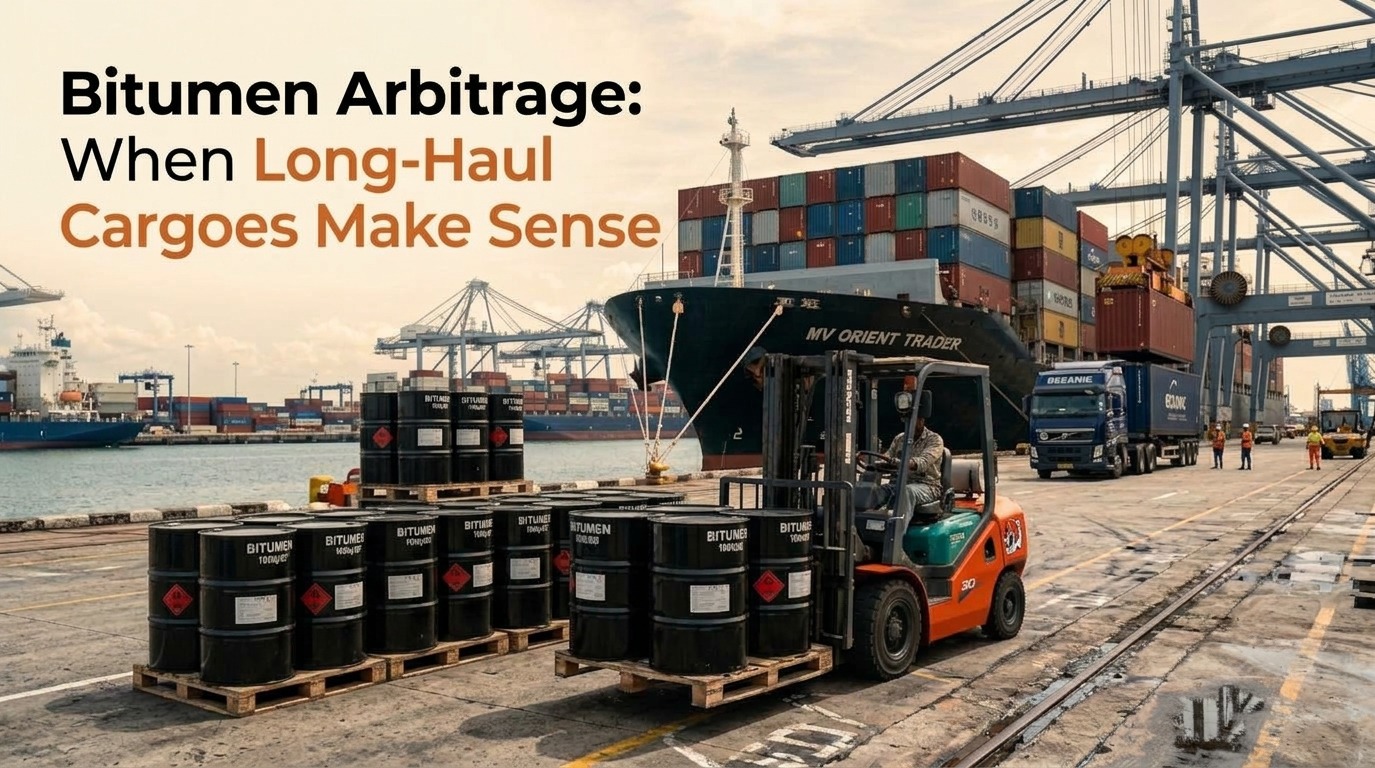
Bitumen arbitrage is the trade of moving a cargo from a lower-priced origin to a higher-priced destination. It works only when the price gap is larger than the full cost and risk of getting the cargo there.
That sounds simple, but bitumen is harder to move than most oil products. It travels hot, on specialized tankers, into terminals with heated storage. It must also meet the destination’s specification on arrival.
Market conditions in 2026 show why the question matters. Several Asian refiners have struggled to secure the heavy crude grades that yield bitumen, tightening regional export supply, while demand in import-dependent markets such as Australia has remained firm heading into the peak paving season. Imbalances like this are when cargoes from distant origins start to look competitive. This article explains what makes such cargoes viable and what can turn a profitable spread into a loss.
Five factors decide the outcome:
- The price differential between origin and destination, measured at arrival rather than at loading.
- Freight, including the cost of keeping the cargo hot.
- Voyage time, which exposes the cargo to price moves and seasonal change.
- Demurrage risk at discharge.
- Specification fit with the destination market’s standard.
Destination demand sits across all five: a cargo is only worth what local buyers will pay when it arrives.
The price differential: the starting point, not the answer
A wide gap between two regional prices is what draws attention to an arbitrage. But the headline spread between two FOB prices says little on its own.
What matters is the margin left once every cost of delivery is deducted. In simple terms:
Arbitrage margin ≈ destination price at arrival − (origin price + freight + insurance and finance + port and terminal costs + demurrage allowance + quality adjustments)
This is the same logic behind comparing offers on a full bitumen landed cost basis, and the reason FOB prices can mislead buyers comparing offers. Arbitrage simply applies that logic across oceans.
Why regional spreads open
Bitumen is a residue of crude refining, so regional bitumen price differences open when local refining conditions change. Three causes are common:
- Feedstock shocks. When refiners lose access to the heavy crudes that yield bitumen, output in that region can fall regardless of demand elsewhere.
- Seasonal mismatch. Paving in much of the Northern Hemisphere slows in autumn and winter, while Australia and New Zealand move into their spring and summer construction season. Surplus in one region can meet demand in another.
- Refinery economics. Refiners can sell heavy residue as bitumen or as fuel oil. Because the same feedstock can yield more fuel oil than bitumen, refiners may favor fuel oil even when bitumen prices are attractive, which limits bitumen supply.
All three have been visible in 2026. Feedstock disruption has reduced bitumen output at several Asian export refineries, and fuel oil has competed for the same heavy residue. The seasonal factor typically adds to these pressures in the final quarter, as our seasonal bitumen demand guide explains.
Price at arrival, not at loading
The destination price that matters is the one prevailing when the cargo discharges. A long-haul voyage takes weeks. A spread that looks wide on the loading date can narrow before arrival.
This matters most when the cargo is priced on a floating basis linked to a benchmark. In that case, the final price depends on where the benchmark settles during the pricing period. Fixed-price deals transfer that risk to whichever party agreed the fixed price.
Freight and voyage time: why distance costs more for bitumen
Freight is one of the largest cost components in international bitumen trade. For bulk bitumen, the cost of distance is higher than for most oil products because the cargo must stay hot all the way.
Heated cargo and a specialized fleet
Bulk bitumen moves on dedicated tankers. Many have insulated, independent cargo tanks heated by thermal-oil systems. Depending on grade, the cargo is carried at temperatures of around 110°C or higher, and heating has to be maintained through the voyage and during cargo operations. The same temperature discipline continues ashore, as covered in our guide to bitumen storage and handling.
That has three cost consequences for long-haul trades:
- Fuel for heating. Boilers burn fuel to keep the cargo pump able, so a longer voyage adds heating cost on top of propulsion fuel.
- A limited fleet. Most bitumen tankers are relatively small, typically around 5,000 to 12,000 tones deadweight, with fewer larger vessels. Larger ships suited to long voyages are less common, so suitable tonnage can be harder to find.
- The return leg. A tanker sent on a long voyage may have to reposition afterwards without cargo, and owners will usually seek to recover that cost in the freight rate.
Bigger ships, lower cost per tonne, harder logistics
Large bitumen tankers spread voyage costs over more tonnes. But a large cargo needs berths that can take the vessel and enough heated tankage at the destination. When one terminal cannot take it all, the cargo may be split across several ports. Each extra discharge adds port costs, time and demurrage exposure.
Voyage time is market risk
A longer voyage is not only a freight cost. It is also time during which prices, demand and competing supply can change. Three questions help frame the risk:
- Will the destination still be short of supply when the cargo arrives?
- Are other long-haul cargoes heading to the same market, adding supply at the same time?
- Will the destination’s paving season still be running on arrival, or ending?
When many traders see the same spread, several cargoes can arrive within a short period. That extra supply tends to narrow the spread that attracted them. This is how arbitrage corrects itself.
Demurrage: the cost that appears at the end of the voyage
Demurrage can erase an arbitrage margin after the cargo has already crossed the ocean. It is the amount agreed in the charter party that is payable to the ship-owner for delay beyond the time allowed for cargo operations, where the owner is not responsible for the delay.
How lay time and demurrage work
Under a voyage charter, the charterer has an agreed period, called lay time, for cargo operations and related waiting. Tanker charters commonly allow 72, 84 or 96 hours, Sundays and holidays included, although the charter party sets the actual terms. Once lay time is used up, demurrage generally becomes payable for the extra time. Unlike dry-cargo trades, tanker owners generally do not pay dispatch when operations finish early.
Why bitumen discharges overrun
Several risks are specific to hot bitumen cargoes:
- Shore tank space. The receiving terminal needs empty, heated tankage. If earlier cargoes have not been drawn down by road tankers, the vessel waits.
- Cargo temperature. Bitumen thickens quickly as it cools, which slows pumping and can leave material in the tanks.
- Multi-port discharge. Splitting a large cargo across ports multiplies berthing, testing and waiting time.
- Quality checks. Waiting for test results before discharge adds time. Whether that time counts against lay time depends on the charter party.
Who carries the risk depends on the contract?
The party exposed to demurrage depends on the sale terms. A charterer can sit between several sets of lay time terms: with the ship-owner, the supplier and the receiver. Buyers should check who carries freight and insurance risk under the Incoterm used, and how demurrage passes down the chain.
For the buyer, the key point is that a CFR price may not be the final cost. Depending on the sale contract, delays at the receiving terminal can be passed on to the buyer.
Specification fit: a cheap cargo is worthless if it fails the standard
A long-haul cargo must meet the destination’s grading system, not the origin’s. This is often the deciding factor for Australia and New Zealand, which use different standards from many exporting regions.
Australia: viscosity classes under AS 2008
Australian paving bitumen is specified under AS 2008, Bitumen for pavements. The current edition, AS 2008:2026, was published in May 2026 and supersedes the 2013 edition. Australian paving bitumen is graded into classes by viscosity at 60°C, with higher class numbers indicating stiffer binders. The classes in common use are:
| Class | Tyical use |
| C170 | The most commonly used class for sprayed sealing; also used in lower-volume asphalt |
| C240 | Sprayed sealing where a road agency prefers a slightly more viscous binder than C170, for example in some warm climates |
| C320 | Mainly asphalt mixes; for sprayed sealing it has largely been superseded by polymer modified and multigrid binders |
| C450 | Asphalt mixes where a road agency prefers a slightly more viscous binder than C320 |
| C600 | Heavy-duty asphalt base layers designed for substantial traffic loads |
Class limits and test requirements should always be checked against the current edition of the standard and the road agency’s specification for the project.
The class system has changed as Australia’s supply base shifted. A 2015 paper presented at the AAPA International Flexible Pavements Conference notes that the old C50 class was dropped and C240 and C450 were added. It also notes that some supply points began in-line blending to offer the full range of classes.
What this means for an imported cargo
Many exporting regions produce to penetration grades (such as 60/70 or 80/100) or performance grades. A penetration-grade cargo is not automatically compliant with an AS 2008 class. Viscosity at 60°C must be tested against the class limits, along with the standard’s other properties.
In practice, an importer will want:
- confirmation that the origin refinery can produce to the required class, or a base grade suited to blending at the terminal;
- test certificates from loading, ideally with independent inspection (see bitumen quality testing explained);
- a plan for sampling and testing on discharge before the product is released.
For reference, our Australian Standard bitumen pages list typical properties for Class 170, Class 320 and Class 600.
New Zealand: penetration grades and its own specification
New Zealand differs again. Austria’s guidance describes its sealing grades by penetration, such as 180/200, 130/150 and 80/100. When the country’s only refinery announced in late 2020 that it would stop making bitumen, the national transport agency said it was updating its specification to allow more flexibility for imported product.
The lesson for any arbitrage cargo is the same. Specification is checked before the voyage begins, not after the cargo arrives.
Destination demand: why Oceania is a natural arbitrage outlet
An arbitrage needs a destination that cannot easily cover its own needs. Australia and New Zealand fit that description, which is why they recur in long-haul bitumen trade.
A structural reliance on imports
Australia was largely self-sufficient in bitumen in the early 2000s. The closure of four refineries that had been key bitumen supply points has since left the market reliant on imports. New Zealand followed when its only refinery announced in late 2020 that it would stop producing bitumen.
Import-dependent markets usually draw first on the nearest export hubs. When those hubs are short, as Asian export supply has been in 2026, buyers either pay more for nearby regional origins or look at cargoes from much further away.
Seasonality works in the arbitrage’s favor, until it doesn’t
Spring and summer in the Southern Hemisphere bring peak road construction in Australia and New Zealand. That coincides with the autumn slowdown in Europe and North America. This seasonal mismatch can make long-haul cargoes more attractive late in the year.
The same calendar sets a deadline. A cargo that arrives late in the paving season, or after regional supply recovers, may face weaker demand than the one that justified the voyage.
Terminal capacity sets the ceiling
Demand is only usable if there is heated storage to receive it. The number and size of import terminals limit how much long-haul supply a market can absorb at once. When tanks are full, more cargoes add demurrage risk rather than sales.
What buyers should ask about a long-haul offer
Importers who receive an offer from a distant origin can test it with a few questions before comparing it with nearby supply:
- What is the delivered cost? Compare offers on a landed basis, including freight, insurance, finance, port costs and a realistic demurrage allowance.
- How is the price set? Check whether it is fixed or floating against a benchmark, and over which pricing period.
- When will it arrive? Set the arrival date against your project calendar and the local paving season.
- Does it meet our specification? Ask for the grade, recent test certificates and whether blending will be needed at the terminal.
- Can our terminal take it? Confirm heated tank space and discharge rates for the vessel size proposed.
- Who carries demurrage? Read the lay time and demurrage terms, and how they pass between seller, ship-owner and receiver.
- Does it fit our buying strategy? A one-off arbitrage cargo works differently from contracted supply. See our guide to term and spot buying.
Conclusion
Bitumen arbitrage is a calculation that keeps changing, not a fixed opportunity. A wide gap between regional prices starts the conversation. Freight, heating, voyage time, demurrage and specification fit decide whether any margin is left on arrival.
Conditions in 2026 illustrate these forces. Feedstock shortages have tightened supply at Asian export hubs while demand in import-dependent markets has remained firm, the kind of regional imbalance that can make distant origins competitive. The same forces can also close the window: as Asian supply recovers, more cargoes arrive or the paving season ends, the spread narrows.
For buyers, understanding the mechanics helps in two ways. It shows when a distant offer is worth considering, and it explains why prices and availability can shift quickly when long-haul supply enters or leaves a market.
Buyers comparing supply options can request a bitumen quote with their required grade, quantity, packaging and destination. This article is general commentary and does not constitute a price or availability offer.